Rinky Hijikata Shines at US Open as Wawrinka Bids Farewell
Rinky Hijikata walked onto the grandstand court as the undercard to a farewell and a heavyweight. Within minutes, he had Felix Auger-Aliassime’s full attention.
The world No.4 exploded out of the blocks, ripping through the opening exchanges to grab a 2-0 lead before some fans had even found their seats. It looked like the script was writing itself: top seed in cruise control, local hope hanging on.
Hijikata tore that up.
The Australian steadied on serve, looked unflustered between points, and began to sprint into the corners with purpose. His movement sharpened, his timing followed, and the Canadian’s early stranglehold loosened. Game by game, Hijikata reeled him in. From 0-2 down, he surged to a 5-3 lead in the first set, turning what threatened to be a procession into a proper contest.
Every service game, he looked composed. No fuss. No panic. Just a young player who believed he belonged on one of the US Open’s big stages.
Joint’s breakthrough
On the outside courts, another Australian was doing more than just belonging.
Maya Joint is into the second round, and she earned it the hard way. After dropping the first set 3-6 to Liudmila Samsonova, Joint dug in, lengthened the rallies and refused to be bullied off the baseline. The second set flipped. She stormed through it 6-2, feeding off a crowd that roared for both players but seemed to give her just that little extra surge.
By the third, it was one-way traffic.
Joint dominated the decider 6-2, dictating with confidence and closing out the match with the kind of authority that belongs to a far more seasoned campaigner. When match point landed, she couldn’t hide it – the grin, the release, the sheer delight of a player who knows this is a moment that can change a career.
Her final line: 3-6, 6-2, 6-2. A comeback, and a statement.
Wawrinka’s last stand
Inside the main arena, the mood was different. Heavy, appreciative, emotional.
Stan Wawrinka, the three-time major champion who once tore through this tournament to beat Novak Djokovic in a four-set classic in 2016, played his final grand slam match. The 41-year-old had already announced that this season would be his last on the ATP Tour. The US Open handed him a wildcard, and on Tuesday night it handed him a farewell.
The match itself went the way of Matteo Berrettini: 7-6, 7-6, 6-0. The Italian was too strong, too clean in the big moments. But the tennis quickly became a backdrop to the occasion.
Tournament organisers rolled a career highlights video on the big screens at Flushing Meadows. The crowd rose and stayed there. Berrettini, still courtside, applauded as Wawrinka watched two decades of his life flash by.
“It’s been more than 20 years since I first came here,” Wawrinka told the crowd, voice cracking. He spoke of his first qualifying run, how “impressive” it felt just to be part of it. He admitted one of the reasons he kept going until 41 was for nights like this.
“It was really special to me to finish my grand slam career here, 10 years after winning it,” he said, fighting back tears. “I am going to miss it. I love the game so much ... I really want to thank you all for all those years of support. It was amazing.”
That was it. A champion’s last word on the major stage.
Berrettini, who grew up watching Wawrinka on television, understood the weight of it. “I’m delighted to have shared the court with this legend once again,” he said. He called it a dream come true to face a player he’d watched winning slams as a kid. Twice in a row now, in two grand slams, they’ve met. Twice, Berrettini has been the one to walk off the winner. This time, the result felt almost secondary.
Controversy and a wry smile
Even in a farewell, Wawrinka still found a way to stir debate.
Early in the third set, with Berrettini already leading 7-6, 7-6, 2-0, the Swiss veteran flicked a ball over the net in a way that left his opponent furious. To Berrettini’s eye, Wawrinka had hit the ball twice. Under the rules, the shot must be one continuous motion; a pause and second flick would make it illegal.
“You could see his two motions,” Berrettini argued with the chair umpire, insisting the point should be his.
Wawrinka, now more amused than agitated, met him at the net while the video review team went to work. “I’m 41, that’s why I am slower than you,” he joked, drawing a reluctant laugh from the Italian and easing the tension.
The replay, shown at full speed, cleared him. Legal shot. Point Wawrinka. Berrettini shook his head, unconvinced.
Off court, Australian great Jelena Dokic added another layer. Watching Nine’s slow-motion footage, she said it was clear Berrettini had a case. “The video review is not in slow motion at the US Open, which is a little bit weird,” she said. “It does show that he did hit it twice, so Berrettini is actually right. But when you look at it in normal speed, it doesn’t look like that.”
Wawrinka took the advantage from the ruling, but Berrettini kept his grip on the match, extending his lead to 3-0 in the third and never looking back.
Khachanov’s blunt verdict on Kyrgios
Away from the courts, another Australian name dominated conversation for very different reasons.
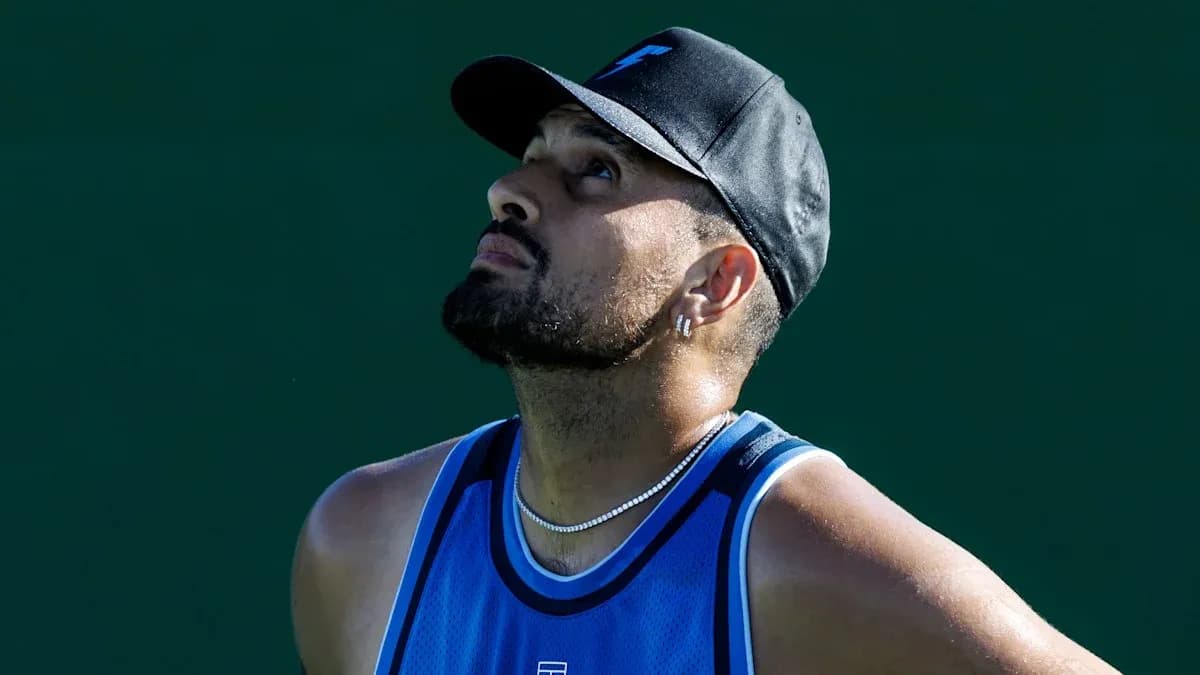
Nick Kyrgios, currently serving a ban after testing positive for cocaine in June, has already admitted on social media that he “made a huge mistake” and would step away from the spotlight to deal with his issues. The 31-year-old has long been one of the most outspoken voices in tennis on doping and drug bans.
Karen Khachanov didn’t let that pass.
Speaking at the US Open, the Russian was asked about Kyrgios and did not soften his words. “Even when he wasn’t playing, he always liked to pick on someone, writing things on Twitter and so on,” Khachanov said. “And now, when all that has turned against him… what do you want me to say? In the end, you reap what you sow.
“Honestly, it’s not just that I’m not surprised, but to some extent, I can’t feel too much pity either. What he got caught for was ultimately his choice. And in the end, look what happened. It backfired on him.”
For a player who has traded barbs with Kyrgios before, it was a pointed reminder that locker-room memories run long.
Aussies in the thick of it
Back on court 9, before her surge to victory, Joint had already shown she was ready for the fight. She lost the first set 6-3 to Samsonova, but the quality of the rallies and her movement hinted at something more. Both players were striking cleanly, both were prepared to work for every point.
Then came the shift. Joint found a new gear, raced to a 3-1 lead in the second, and rode the crowd’s energy better than her opponent. From there, she never really looked back.
On another outside court, Alexei Popyrin ran into a red-hot Grigor Dimitrov, who stamped his authority early and moved ahead 4-2 in the opening set. Dimitrov’s form to start the match matched the ambition he has brought to this season: sharp, aggressive, and unforgiving.
As day turned to night in New York, the themes were clear. One legend said goodbye. A new wave of Australians, led by a fearless Hijikata and a resurgent Joint, pushed into the spotlight. And somewhere in the background, the sport wrestled with its own conscience, as voices like Khachanov’s refused to let off-court controversy slide.
The US Open rarely does quiet opening days. This one, with a grand slam farewell, a breakthrough win and a rising underdog taking aim at a top-four seed, felt like the start of a fortnight that could reshape more than just the draw.