Roger Federer Reflects on His Career with Unique Numbers
Roger Federer has spent a lifetime turning numbers into art. On this night, he chose the strangest numbers of all.
Not the 20 majors. Not the 310 weeks at No 1. Those have been recited to the point of cliché. Federer, standing at the International Tennis Hall of Fame and looking back over nearly three decades, reached instead for the small, almost absurd details that stitched his career together.
“Not the obvious stats like the number of majors or number of weeks at number one,” he said. “I’m talking about the numbers that really paint a picture.”
So he started counting.
From 1998, when he first stepped into the professional world, to his retirement in 2022, Federer estimates he wore more than 5,000 headbands. More than Bjorn Borg and John McEnroe combined, he joked, turning a simple accessory into a running gag about longevity and style.
Then came the socks. Of course there were socks.
“If you think that’s impressive, I wore probably over 7000 pairs of socks,” he continued. “That’s probably twice as many as most of my opponents, because I doubled them up.”
The room laughed. The numbers were ridiculous, but that was the point. You don’t reach eight Wimbledon titles and a global following without an almost comical amount of repetition. Match after match. Practice after practice. Sock after sock. Headband after headband.
Yet even as he played with the stats, Federer made it clear that the real weight of the moment could not be captured on any spreadsheet.
“But really, there’s no way to measure what it means to be here. It’s hard to put it into words,” he said, the levity giving way to something heavier.
This was a man who once chased balls as a 13-year-old ballboy at an ATP event in Basel, now standing as one of the sport’s defining figures. The arc from anonymous kid to global icon hung over every sentence.
He turned directly to the people who now stand where he once did.
“I really want to thank every ball kid who ever stood through my matches or all our matches, for that matter, for hours on end,” Federer said. “I see you. I thank you. I was you.”
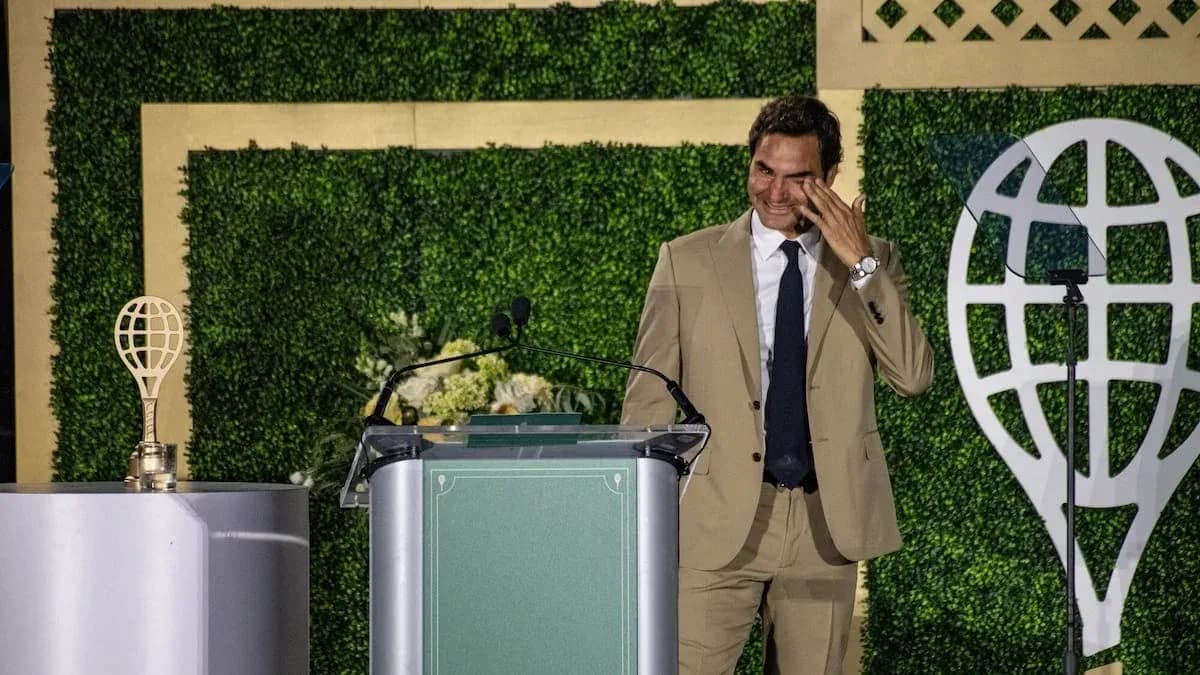
The line hit hard. So did the next few minutes. Federer’s voice wavered as he moved through the roll call of his life in tennis: his idol Stefan Edberg, the champions who pushed him, the family and support staff who carried him through the grind and the glory.
Tears followed. He tried to laugh them off.
“I need tissues and sunglasses and everything to protect me right now,” he joked. “This is such a mess.”
It was, in truth, the kind of mess sport rarely allows its greatest figures to show while they are still competing. Vulnerability usually waits until the last match is long gone. Here, it arrived in full view, with Federer trying to hold himself together and failing in the most human way.
“It’s been an incredible journey,” he said, steadying himself. “For me, the International Tennis Hall of Fame provides a great opportunity to look back, but also to look ahead.”
That line mattered. Federer was not treating this as a museum piece. He spoke instead like someone stepping into a new role in the same old world.
“As you can tell, I’m still writing my love letter to tennis,” he said. “My time as a player is done, but tennis will always stand at the intersection of everything I care most about: my family, our friendships, the past 40 years, the future we’re building. Tennis for me is responsible for it all.”
No trophy count can touch that. No ranking can frame it.
Federer’s career has already been carved into history through titles, rivalries and iconic shots. On this night, he chose to be remembered another way: as the ballboy who never really left, the champion who can still laugh about socks and headbands, and the man who insists his relationship with the sport is not over.
The numbers have stopped. The love letter hasn’t.