Roger Federer: The Emotional Journey of a Tennis Legend
Roger Federer has cried on some of the biggest stages sport can offer. The first time, he didn’t even understand why.
It was Wimbledon, 2001. Centre Court. His debut on the sport’s most sacred lawn and across the net stood Pete Sampras, the man who owned that patch of grass. Federer beat him. The king was out, the pretender through.
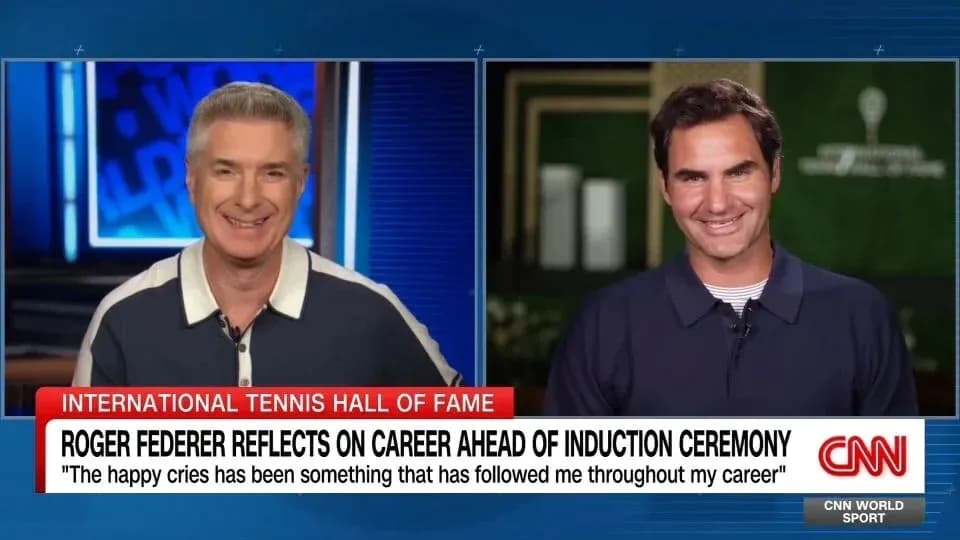
“I go to my knees, (then) I shake hands with Pete and he's my hero … and these emotions came all over me,” he told CNN Sports. “And I was like, 'What is going on?' This is not who I am normally."
From that afternoon until his tear-streaked farewell in 2022, Federer built one of the defining careers in tennis and, almost accidentally, became its most famous crier. The tears never felt like theatre. They were the release valve of a life spent balancing genius with expectation.
This weekend, in Newport, Rhode Island, the emotions are likely to return. The Swiss is being inducted into the International Tennis Hall of Fame, and he knows what that stage can do to him.
"If I'm speaking about the game and all the gratitude that I have, and having my entire family there – from my parents to my wife to my four children and my whole team from coaching staff and physios, etc. I think it could hit home very hard," he said in the hours before his big moment.
"If it happens, it will be more memorable for me personally, but I hope I get through the speech without too many hiccups. We'll see."
A career that always felt inevitable – until it wasn’t
For many, this induction has been a formality in waiting. The destination was obvious as far back as 2004, when Federer seized three of the four grand slam singles titles and climbed to world No. 1, then refused to budge.
He stayed at the top for 237 consecutive weeks – still the benchmark. For more than four and a half years, men’s tennis had a fixed point: Federer, at the summit.
In 2005, he won over 95% of his matches. Then came 2006, the season many still hold up as his masterpiece. Three more majors. Twelve titles in total. A 92-5 record and a scarcely believable 94.8% win rate.
The numbers read like a misprint.
Sampras’ 14 grand slam titles once felt like a mountain nobody would climb. Federer not only scaled it, he moved beyond it, passing the American at Wimbledon in 2009 and continuing on his way. For a long time, he redefined what dominance looked like in the men’s game.
He did it with a style that made opponents suffer and spectators relax. Graceful footwork, liquid timing, an elegance that made the brutal look balletic. Off the court, he carried himself with the same ease – smiling, relaxed, apparently untouched by the grind that devours so many champions.
The myth of effortlessness
Federer insists that image was misleading. If he has any regret, it’s that people thought it all came too easily.
"It looked like I wasn't actually hitting the ball so hard," he recalled of his junior days. "But it was kind of flying off of my racket with a lot of power. People always thought, like, 'It's so simple for you,' because it looked like elastic. But it wasn't the case. There was a lot of work and effort put into it.
"When I would lose, they say, 'Why don't you try harder?' And when you win, they would say, 'Oh my God, it's so easy for you!'"
Inside that contradiction sits the truth behind the tears.
"The sacrifice was massive and I was holding a lot of pressure in."
The public saw the artistry. They rarely saw the strain. The travel, the training, the expectation that every time he walked on court, he would glide to victory. The crying, in victory or defeat, became the one moment when the mask slipped and the weight of it all poured out.
Peace after the storm
Now, that pressure is gone. And he doesn’t want it back.
"It doesn't sound like he misses it all that much" is how the piece around him reads, but Federer himself is more direct in his contentment. He is at peace with his career. No void, no itch to chase the adrenaline of centre court or the burden of being the standard by which everyone else is judged.
"I'm actually really happy going through everyday life at a lower pace," he said.
Life has hardly become quiet. Father of four. Philanthropist. Investor. Businessman. His schedule still hums, just in a different register. The suit has replaced the sweatband, but the travel remains.
"I've always been a guy who loves being on the road."
Newport gives him a rare chance to pause and look back. The Hall of Fame is a museum of the sport’s soul, and Federer now joins the pantheon he once studied as a boy.
He’s even allowed himself to imagine stepping onto the court with the legends whose portraits now hang alongside his.
"I would have a little list," he said, before reeling off the names: Rod Laver, Bjorn Borg, John McEnroe, Stefan Edberg, Boris Becker, and Sampras again. "I think these would be my favorite players to play against. I've always admired their personalities, what they have achieved, and what they represent in the game."
Legacy beyond the numbers
His once-record tally of 20 grand slam titles has been passed by both Rafael Nadal and Novak Djokovic. The numbers, once his fortress, now belong to an era of three giants, not one.
But Federer’s supporters will never surrender the argument. To them, he is the greatest of all time, not because of the final count but because of how he made the sport look and feel. The way he drew gasps with a single backhand. The way he carried the role of champion.
Asked what else he considers himself good at, now that tennis no longer defines his days, Federer’s answer drifts away from trophies and rankings.
"I'm trying to get better at golf," he said. "I would love to start with an instrument again. I used to play the piano, so when I have more time, I'd like to dive into that because my four children and my wife play the piano.
"I hope I'm a good listener and a good decision-maker. Hopefully I'm a guy who people enjoy being around. I'm a big family guy. I love being surrounded by my friends – that's really the priority in my life."
On the grass of Wimbledon, he once cried because he didn’t understand what was happening to him. In Newport, if the tears come again, they will belong to a man who knows exactly why.