Roger Federer Inducted into the International Tennis Hall of Fame
NEWPORT, R.I. — Roger Federer has made a career out of keeping his composure in the tightest of moments. On Saturday evening in Newport, it deserted him again and again.
Under a softening Rhode Island sky, on the grass horseshoe court at the entrance to the International Tennis Hall of Fame, the 45-year-old walked to the stage in a tan suit, kissed and hugged his wife Mirka, and almost immediately felt the weight of the moment.
“Oh man,” he began, the first man to win 20 Grand Slam singles titles suddenly sounding very human. “This is very high level and a tough act to follow.”
Mirka had just introduced him with a poised, heartfelt tribute, and Federer did what he has always done best: he mixed grace with a light touch.
“I don’t know if you have been practicing secretly,” he joked, drawing a warm laugh before turning back to the business of being the 272nd person inducted into the Hall.
A Maestro Overwhelmed
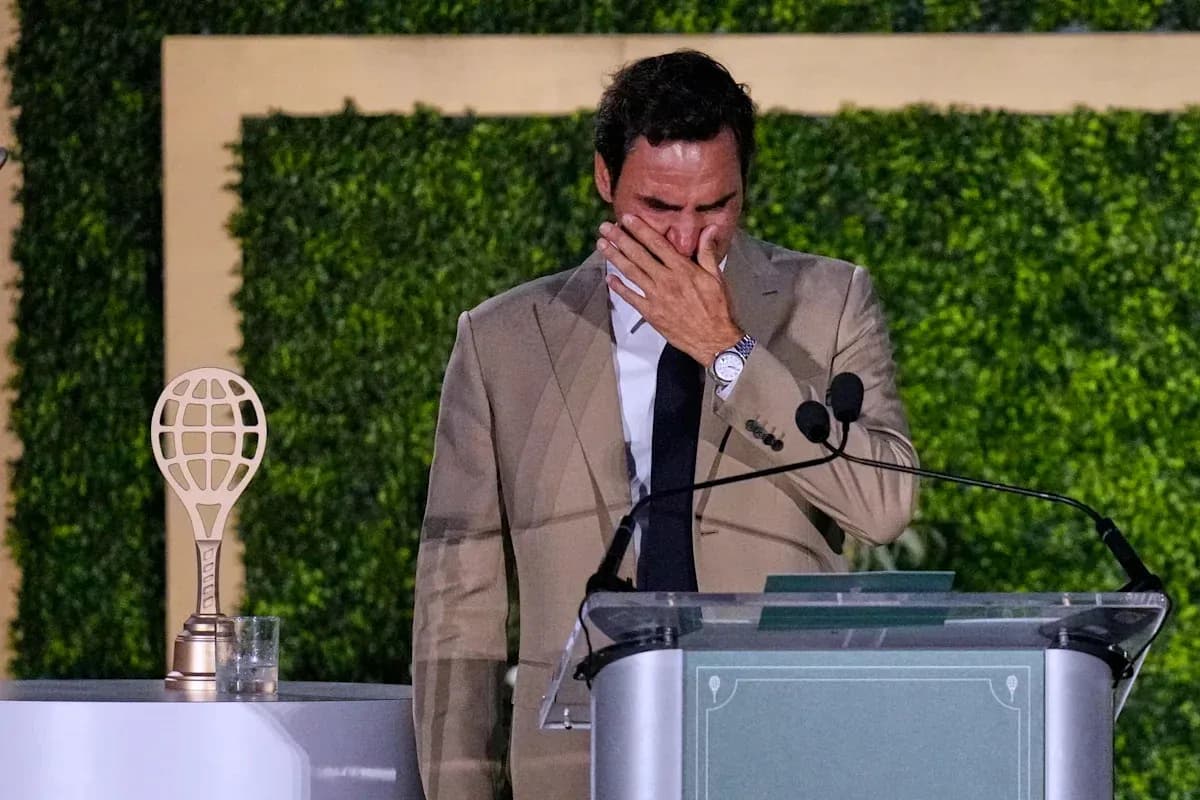
Earlier, during the Hall’s first red-carpet show on center court, the “Swiss Maestro” had admitted he “was a little stressed to be honest.” The ceremony confirmed it. Across nearly 30 minutes, the man whose movement once seemed effortless and whose one-handed backhand carried him to a record 237 consecutive weeks as world No. 1 found himself repeatedly fighting tears.
The first cracks appeared midway through the speech when he mentioned his childhood idol, Stefan Edberg. Federer stopped, emotions surging, and reassured the crowd these were “happy tears.”
They kept coming.
He choked up again while speaking about longtime coach Severin Luthi, a central figure through the peaks and reinventions of his career. Then came the part he had clearly been dreading.
“Now the Mirka part,” he said, stopping as his voice broke. “Oh gosh, this is such a mess.”
He tried to laugh it off, tried to reset, as he had done so many times from break point down. This time, the tears rushed in faster than any opponent’s return.
“I need tissues and sunglasses, everything to protect me right now,” he told the crowd, half-laughing, half-sobbing, as he tried to steady himself again.
Closing Like a Champion
Federer eventually did what he has always done on the biggest stages: he found a way to finish. The same player who collected five straight U.S. Open titles from 2004 to 2008, who strung together 10 consecutive Grand Slam finals and won eight of them, pulled himself together for a closing message that reached beyond his own legend.
He thanked the ball kids, the often-unseen engine of the sport, and urged today’s players to keep pushing tennis into new territory, to take the game to “new levels” as previous generations had done for him.
The résumé that brought him here needs no embellishment. Eight Wimbledon titles. Six Australian Opens. One French Open, that elusive Roland Garros crown finally captured in 2009. A career Grand Slam, a club that includes only eight men in the history of the sport. And, just three weeks removed from his 45th birthday, a place among the immortals in Newport.
“I’m thrilled to have made the journey here,” Federer said. “It’s amazing to see yourself in a place like this. To immerse yourself in the history of the sport means a lot to me.”
On this night, the man who once seemed to float above the game stood firmly inside its story, a chapter now etched in bronze and memory.
Carillo Joins Tennis Royalty
Federer did not enter alone. Mary Carillo, the former player turned acclaimed broadcaster, was inducted as a contributor, presented by Hall of Famer Billie Jean King.
King, who has watched Carillo redefine what informed, incisive tennis coverage sounds like, put it plainly: “She has earned her spot in sports journalism and she has earned her spot in Newport.”
Carillo, 69, looked out at a small but glittering group of Hall of Famers and let the significance of the setting sink in.
“To walk through these gates here in the company of you people, that was beyond my dreams,” she said.
On a Newport evening layered with history, it was fitting that one of the sport’s greatest champions and one of its clearest voices stepped through those gates together. The game they helped shape now asks a new question: who will be brave enough, brilliant enough, to follow them?