Roger Federer Reflects on His Legacy in Tennis
Roger Federer has spent most of his life moving forward – towards the net, towards history, towards another Sunday afternoon with a trophy in his hands. In Newport this weekend, as he enters the International Tennis Hall of Fame, he allowed himself something he almost never granted during his career.
He stopped. And looked back.
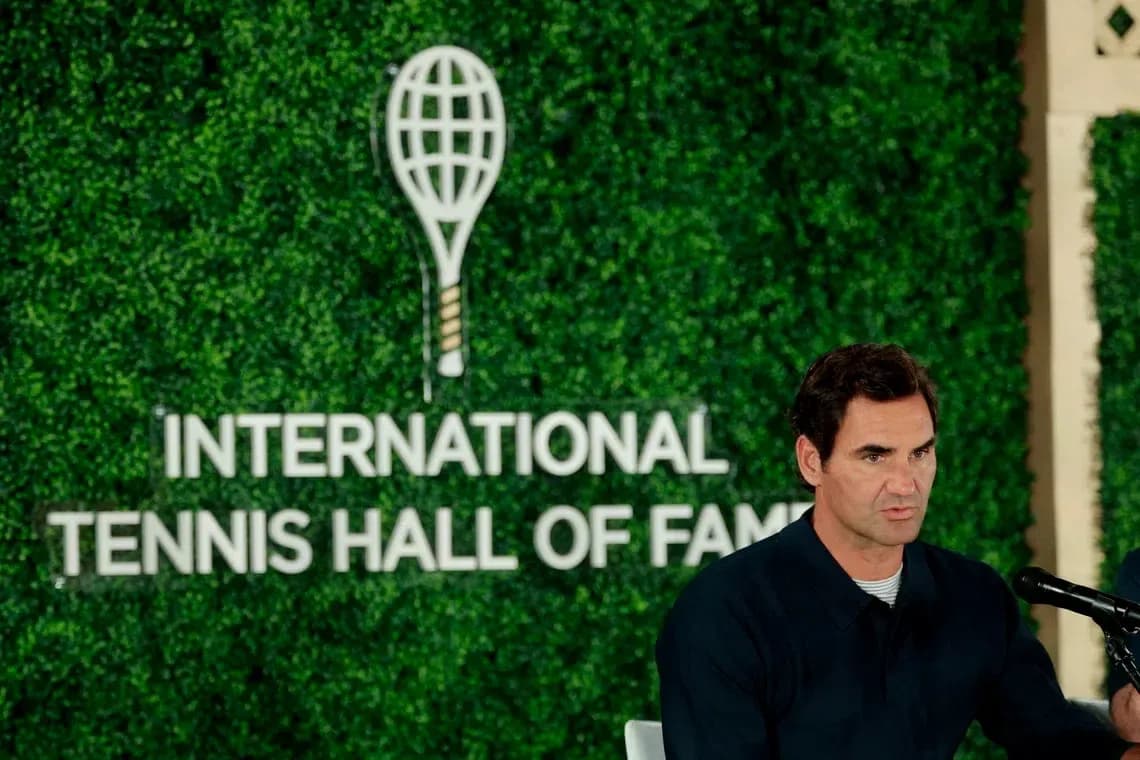
The 20-time Grand Slam champion, to be inducted on Saturday alongside broadcaster and journalist Mary Carillo, spoke on Friday about how this honour feels different from any title, ranking or record that once defined his life.
“It’s a huge, huge honour, one of the greatest we can achieve in this sport,” Federer said at a news conference moderated by Hall of Fame president Patrick McEnroe.
This is not a man short on accolades. Federer, now 45, owns a men’s-record eight Wimbledon crowns. Add six Australian Opens, five U.S. Opens and the 2009 French Open, and you have the complete career Grand Slam that framed his dominance across surfaces and eras. He retired in 2022 with 103 ATP Tour titles and 310 weeks as world number one, numbers that usually close any debate.
But in Newport, the conversation felt different. The Hall of Fame, he suggested, is less about the scoreline and more about the footprint.
Beyond the trophies
Federer made it clear he hopes his legacy stretches beyond the elegance of his one‑handed backhand and the mountain of silverware it produced.
“I hope I represented the sport well,” he said. Then he went further, pointing to the work done away from the cameras and the Centre Courts.
“Maybe I helped drive the sport in the right direction through all the conversations we had together with the leaders of the sport — on the ATP side, with the Slams, the players and councils where I donated my time.”
He spoke with pride about the evolution of tennis economics during his era. Not just the headline prize cheques for champions, but the money that now filters down to those battling in the first and second rounds. For Federer, that shift matters.
He highlighted better conditions for players, for media, for medical staff. Better stadiums. A more professional, more sustainable tour.
“I feel like way more players can make a living. And I hope that I have helped with that as well,” he added.
It was a rare glimpse of Federer the advocate, not just Federer the artist.
Embracing the spotlight
The Swiss star also rewound to the beginning, to the moment a talented teenager from Basel realised he wanted more than just a place on the tour. He wanted the stage.
“I felt like I was a winner early. I liked being on Centre Court. I preferred Centre Court to Court Five or Court 18. I wanted to be that person, so I think I embraced the pressure.”
That pressure, once he arrived at the top, never really left. It grew. With every major, with every rivalry, with every expectation that he would glide through another fortnight as if it were routine.
He acknowledged the toll that comes with that status. The endless judgement. The binary verdicts.
“You get affected by so many outside comments that it’s like one big storm sometimes in your brain,” he said. “Sometimes you lose the fun in it.”
The storm never fully cleared, but Federer insisted he found a way to live inside it.
“For the most part, I’ve really done a good job of staying really happy on the road,” he said, a line that underlined how much of his greatness rested on emotional balance as much as technical brilliance.
Still connected to the game
Retirement has not pulled him far from the sport. On Tuesday, he stepped back into the spotlight at Arthur Ashe Stadium, rolling back the years in an exhibition match ahead of the U.S. Open. The crowd reaction hinted at what tennis still feels for him – and what he still feels for tennis.
He is not yet sure what the next formal chapter will look like, but he left several doors ajar. A future as a Laver Cup captain. A mentoring role for younger players. Perhaps even a stint behind the microphone as a commentator.
“I would like to give back to the sport,” he said. “I try to attend three, four or five events during the year, so I stay connected.
“It rejuvenates me mentally to see what I could be doing in the sport that would be meaningful down the road.”
For a man whose career was defined by forward motion, the Hall of Fame offers a moment of reflection. But even here, as he stands on the game’s highest pedestal, Federer is already scanning the court ahead, searching for the next way to shape the sport he once ruled.