Serena and Venus Williams Shine in Dramatic Doubles Match
Arthur Ashe Stadium has staged countless epics, but a women’s doubles first round rarely owns the night session. The Williams sisters are the rare exception.
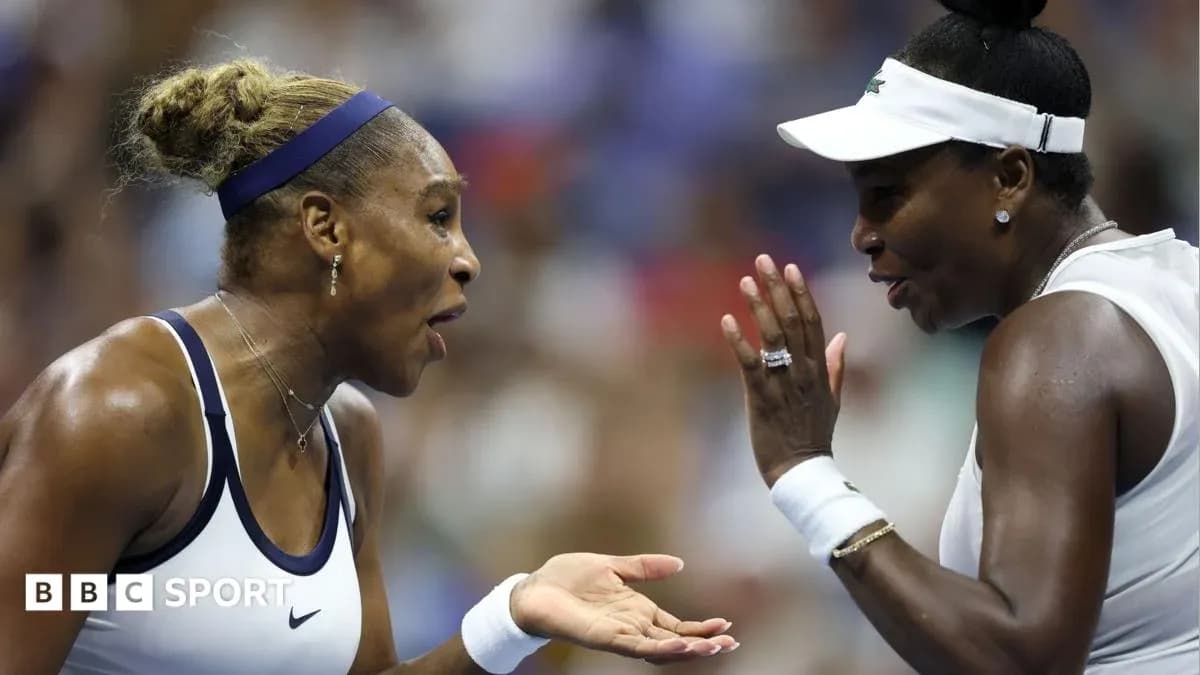
Serena and Venus walked into the New York glare with a combined age of 90 and the aura of champions who have nothing left to prove and yet still insist on competing. The legs are older, the rallies a touch shorter, but the presence? Untouched.
They lost. The scoreline reads 6-3 6-7 (6-8) 7-6 (10-7) to the 14th seeds Hao-Ching Chan and Maya Joint. That’s the record. It says nothing of the noise, the tension, or the feeling that Arthur Ashe was briefly transported back a decade.
A night that refused to fade quietly
Four years had passed since the sisters last shared this court. They stepped out to a reception that belonged to champions, not veterans on a comeback. Between them, eight US Open singles titles on Ashe, two doubles crowns together, and a lifetime of memories. The crowd knew the history and roared accordingly.
The first set did not match the occasion. The stadium, packed and primed, watched an underwhelming start from the home favourites. Chan and Joint settled quickly, pinning the Americans back, taking the opener 6-3 while the decibel level dipped into something close to disbelief.
Chanda Rubin, who once faced the sisters in the 1999 US Open doubles final, watched on from the commentary box and captured the mood: “It was unbelievable how competitive that was. After the first set you wondered if Serena and Venus would be able to find their mojo - but, boy, they did.”
They did, and the night shifted.
The old fire returns
Serena raised her level to meet Venus’s intensity. The groundstrokes grew heavier, the returns more aggressive, the footwork sharper than anyone had a right to expect from two players in their mid-40s. Chan and Joint suddenly found themselves dragged into the kind of exchanges that once broke the wills of the world’s best.
The second set became a battle. The Americans had to fend off four break points in the fifth and seventh games, moments that felt like tipping points for the match and perhaps the comeback itself. Each escape drew the crowd back into full voice.
The tie-break was a throwback. Serena stepping in on second serves. Venus carving angles at the net. The sisters snatched it 8-6, and Arthur Ashe erupted as if another title run had just been announced.
From there, the match turned into something more than a score. It became a test of what remained in the tank.
One last surge, one final twist
The decider seemed to slip away early. Chan and Joint jumped to a 4-1 lead, the stadium’s energy draining with every missed chance from the Americans. For the first time all night, resignation hovered.
The Williams response was pure, distilled career essence.
They clawed back. They chased balls they had no right to reach, held serve under pressure, and dragged the set into a match tie-break. It was the kind of stubborn resistance that has defined three decades of their tennis lives.
Then they surged. A 5-0 lead in the breaker. The crowd on its feet, sensing a storybook finish. Every point felt like it might be the last great roar for this partnership at Flushing Meadows.
But the script broke.
Chan and Joint refused to fold. They chipped away, point by point, helped by a double fault from each sister at brutal moments. The arena that had been ready to explode in celebration instead watched the lead shrink and then vanish.
The 10-7 defeat landed heavily. It was not just the end of a match, but perhaps the end of a chapter.
Legends under the lights
Across nearly three decades, Serena and Venus have changed the sport. Thirty Grand Slam singles titles between them. Fourteen majors as a doubles pair. They arrived as teenagers in the 1990s and reshaped tennis, culturally and competitively, with power, presence, and an unapologetic belief in their own trajectory.
Three decades on, the game still cannot look away.
Serena’s decision to come out of retirement this summer reignited the fascination, especially for those who never saw her in her prime. Venus, a seven-time major champion, never left. She did not “evolve away” from the sport, as Serena once described her own exit. She stayed, accepting wildcards, dividing opinion but never surrendering the right to compete.
There were few complaints about the invitation extended to them at this US Open. Their attempted return at Wimbledon fell apart when Serena injured her knee in a singles loss to Joint, of all people. They finally reunited in Cincinnati, only to fall in a match tie-break to Marta Kostyuk and Peyton Stearns. New York, heartbreakingly, followed the same pattern.
The performance on Ashe, though, was no farewell exhibition. Their groundstrokes were solid, their movement sharper than expected, their competitive instinct undiminished. They rattled Chan and Joint in a partisan, almost suffocating environment. The 14th seeds deserve real credit for surviving it.
“The atmosphere was surreal,” Joint said. “It was something we've never experienced before, and to play against such legends of the game was super special.”
On this night, even the famously restless Ashe crowd sat quietly through points, not out of boredom but reverence. Every changeover, every shared glance between the sisters, felt loaded with meaning. Possibly the final time. Possibly not.
Questions left hanging in the New York air
Serena had hinted earlier in the week, during an appearance on Good Morning America, that she wanted to play singles again. Venus, after her singles exit on Monday, bristled at the idea of being forced into public career planning, saying she should not “have to” think about her future beyond doubles.
After this defeat, they offered no clarity. Tournament organisers said the sisters were “not available” to speak to the media. No farewell speech. No on-court announcement. Just a wave, a long ovation, and 20,000 people standing to say thank you without quite knowing if they were saying goodbye.
The initial disappointment in the stands quickly gave way to something else: appreciation. The volume rose again as the Williams sisters left the court, not as champions this time, but as icons who had once more emptied themselves under the New York lights.
The result will fade. The questions will not. Will Serena truly return to singles? Will Venus choose one more run, or finally step away on her own terms?
For now, the only certainty is this: on a late summer night at Arthur Ashe Stadium, in a first-round doubles match that felt nothing like a footnote, Serena and Venus Williams reminded tennis why their story still commands the stage.