Spain Dominates Czechia in UEFA Nations League Clash
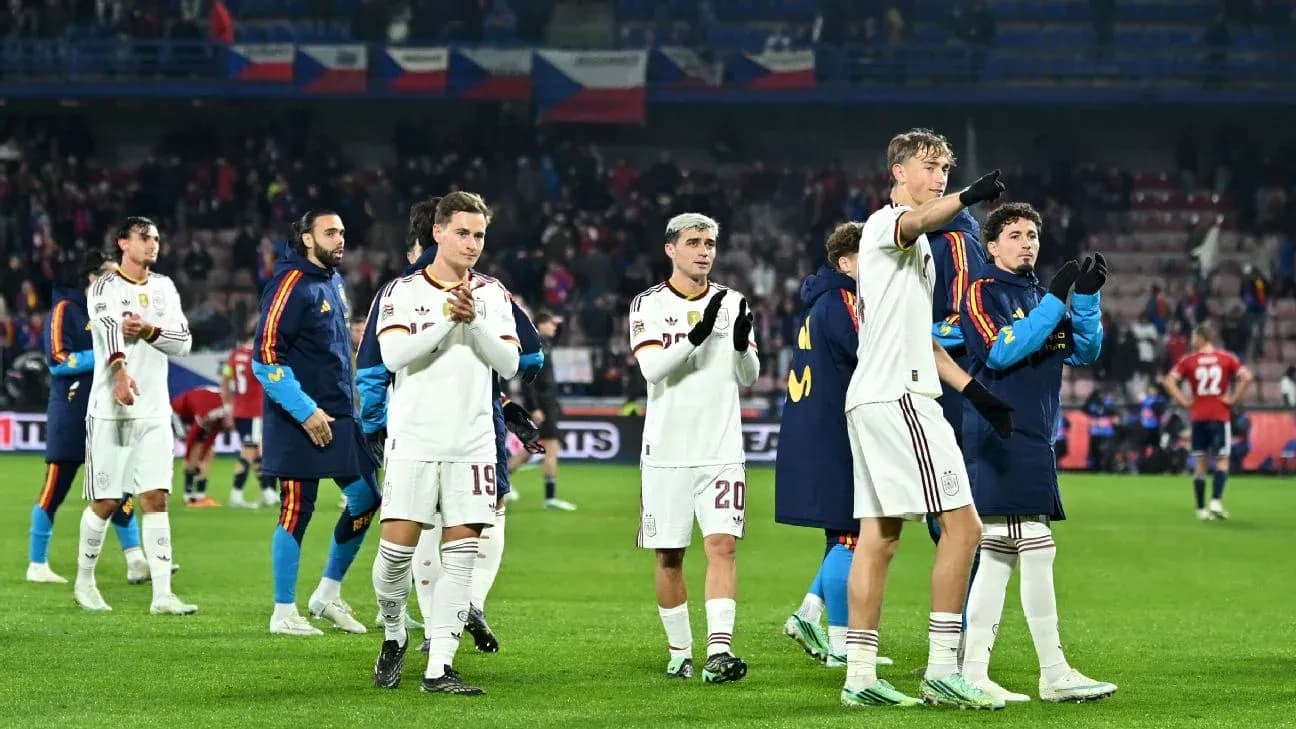
Under the lights of Stadion Letná in Prague, this UEFA Nations League night set two nations on opposite trajectories against each other. Spain arrived as the embodiment of control at the summit of League A – Group C, perfect with 15 points from 5 matches, a total goal difference of +9 (14 scored, 5 conceded). Czechia, rooted to the bottom with 0 points and a total goal difference of -10 (2 scored, 12 conceded), came into this fixture not just chasing a result, but searching for a new identity.
The final 0–2 scoreline felt less like an upset and more like the natural conclusion of two contrasting footballing projects. Spain’s campaign has been defined by fluency and variety in attack, while Czechia’s has been a story of structural strain and late-game unraveling.
I. Shapes, intentions, and seasonal DNA
Both sides lined up in a 4-2-3-1, but the similarity ended on the teamsheet.
Czechia’s structure, with Matěj Kovář in goal and a back four of V. Coufal, D. Zima, L. Krejčí and D. Jurásek, was built to absorb. Ahead of them, A. Král and L. Červ formed a double pivot tasked with screening and connecting, while the band of three – L. Ambros, A. Hložek and L. Provod – tried to support lone forward R. Naderi.
Yet the broader numbers tell the story of a side permanently under siege. Heading into this game, Czechia had played 5 matches, lost all 5, and scored just 2 goals overall. At home they had managed only 1 goal in 3 games, an average of 0.3 per match, while conceding 6 at Letná and beyond, 12 overall at a rate of 2.4 per game. This is a team that spends long stretches without the ball and pays for every structural slip.
Spain’s 4-2-3-1 under Luis de la Fuente, by contrast, is a system of layered control. Unai Simón anchored a back line of Pedro Porro, Pau Cubarsí Paredes, D. Huijsen and Marc Cucurella. In front of them, Martín Zubimendi and Fabián Ruiz formed a double pivot that rarely loses its positional discipline. Ahead, Yeremy Pino and Álex Baena flanked Fermín, with Ferran Torres as the nominal striker.
Spain’s statistical profile is that of a heavyweight: 5 wins from 5, 14 goals scored overall at an average of 2.8 per game, split evenly between home and away (7 on their travels at 2.3 per away match). Defensively, they concede just 1.0 goal per match both home and away. Even more telling, they have failed to score in none of their fixtures and have already converted their only penalty of the campaign, maintaining a perfect record from the spot.
II. Tactical voids and disciplinary shadows
Czechia’s problems are not just about losing; they are about how they lose. The disciplinary data paints a picture of a side that breaks down under pressure late on. Half of their yellow cards this campaign have come between 76–90 minutes (50.00%), with further late trouble stretching into added time. Red cards are spread across 16–30, 61–75 and 76–90, each window accounting for 33.33% of their dismissals.
Ladislav Krejčí, starting again at the heart of defence, epitomises this knife-edge existence. Across the competition he has already been sent off, with a disciplinary line that includes both a straight red and a yellow-red combination. His presence offers aerial dominance and progressive passing – 157 passes at 91% accuracy – but every aggressive duel carries risk for a back line that cannot afford numerical inferiority.
In midfield, the absence of a true destructive specialist is evident. Michal Sadílek, the Czech player with the most yellow cards in the competition, did not feature here, leaving A. Král and L. Červ to manage Spain’s rotations without that natural enforcer edge. The result was a block that often retreated rather than stepped in to break Spain’s rhythm.
Spain, by contrast, have controlled their aggression. Their yellow cards are spread more evenly, with 16.67% arriving in the first 15 minutes, 16.67% between 46–60, and a combined 66.66% coming in the 61–75 and 91–105 windows, but crucially without a single red card all campaign. They can foul to slow transitions without tipping into chaos.
III. Key matchups: Hunter vs Shield, Engine Room vs Engine Room
The most intriguing dynamic was not on the teamsheet but in the wider squad context. Spain’s leading scorer in this Nations League, Lamine Yamal, has 4 goals and 1 assist from midfield, supported by Mikel Merino with 3 goals and 1 assist. Neither started here, yet Spain still carried a constant threat through the line of Ferran Torres, Yeremy Pino, Fermín and Álex Baena.
Baena, especially, is the bridge between Spain’s creative and finishing phases. Across the campaign he has 2 goals and 2 assists, with 11 shots (8 on target) and 8 key passes. His presence in the starting XI in Prague meant Czechia’s left side – Jurásek and Provod – had to live with a constant double threat: Baena drifting inside to combine and Pedro Porro overlapping outside.
On the opposite flank, Yeremy Pino’s direct running targeted the space behind Jurásek and outside Krejčí. Given Czechia’s tendency to concede heavily overall (12 goals in 5 matches) and their lack of clean sheets, Spain’s wide overloads were always likely to stretch the home back four until it cracked.
In the “Engine Room” duel, Zubimendi and Fabián Ruiz faced Král and Červ. Spain’s pair, used to dictating tempo, operated with the comfort of a side that averages 2.8 goals per game overall and has never trailed into panic. Czechia’s double pivot, by contrast, were constantly forced backward, rarely able to connect with Hložek between the lines.
Hložek himself is emblematic of Czechia’s attacking frustration. Across the Nations League he has 2 assists and is their leading creator, with 5 key passes and 6 successful dribbles from 6 attempts. Yet he has no goals, and the team overall averages just 0.4 goals per match. In this match, stationed as the central creator behind Naderi, he was often outnumbered by Spain’s double pivot and dropping centre-backs, starved of the transitions where his power and timing can hurt.
IV. Statistical prognosis and what the 0–2 really says
Following this result, the numbers harden around a simple truth: Spain are built for the sharp end of this competition; Czechia are fighting simply to stay in League A.
Spain’s attack, already fearsome with Lamine Yamal, Merino and Dani Olmo contributing heavily across the campaign, has now shown it can rotate and still control games. Their defensive line, with young centre-backs like Pau Cubarsí Paredes and D. Huijsen, continues to concede at just 1.0 goal per match overall, protected by a midfield that rarely loses its structure.
Czechia, meanwhile, remain winless with 5 defeats from 5, their total goal difference stuck at -10. At home they average 2.0 goals conceded per match and 0.3 scored; on their travels it is 3.0 conceded and 0.5 scored. The late-card surge – 50.00% of yellows arriving between 76–90 minutes – hints at physical and mental fatigue, a side that defends deep for long stretches and then runs out of rope.
In tactical terms, this 0–2 was not a collapse but a confirmation. Spain’s xG profile across the campaign would be expected to sit well above Czechia’s, given their 14 goals and relentless attacking patterns. Even without explicit xG data here, the volume of chances and the structural dominance implied by their averages suggest that this was, more than anything, a match in which probabilities held.
Spain leave Prague with their perfect record intact and their quarter-final pathway already illuminated. Czechia leave with questions that go beyond shape or selection. They must find a way to turn Hložek’s creative flashes into goals, to steady Krejčí’s aggression into leadership, and to stop the late-game disciplinary spiral that keeps turning narrow deficits into structural crises.
For now, the Nations League table is an honest mirror: one side cruising toward the latter stages, the other staring down the barrel of relegation, both revealed under the same floodlights at Stadion Letná.