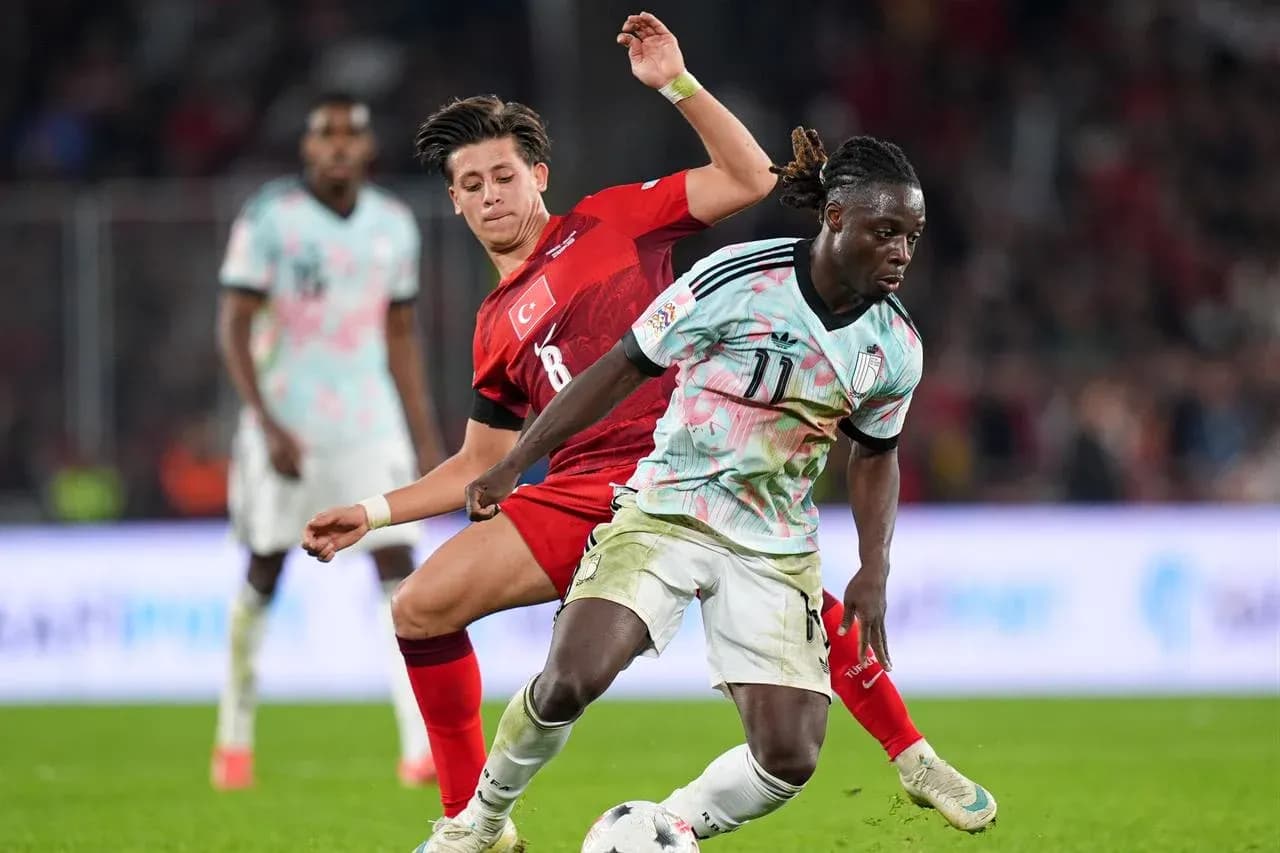
Türkiye vs Belgium: UEFA Nations League Analysis
Under the Izmir floodlights at Gürsel Aksel Stadium, this UEFA Nations League night told a story that had been brewing all campaign. Türkiye, bottom of League A – Group A and already drowning in a five-game losing streak, met a Belgium side whose inconsistencies masked a quietly efficient machine. Over 90 tense minutes, Belgium’s 2–1 away win crystallised the gulf between a side still searching for an identity and another that, for all its flaws, knows exactly where its strengths lie.
I. The Big Picture – contrasting trajectories
Heading into this game, the table was brutally clear. Türkiye were 4th in the group with 0 points, a goal difference of -10 from 3 goals scored and 13 conceded overall. At home, they had played 3, lost 3, scoring just 2 and conceding 7. Belgium arrived in Izmir 3rd in the group with 9 points, their overall goal difference a modest but positive +2, built from 8 goals scored and 6 conceded. On their travels, they had taken 2 wins from 3, scoring 5 and conceding 5 – not watertight, but ruthless enough in key moments.
The formations told you how each coach saw the evening unfolding. Sergen Yalçın set Türkiye up in a 4-2-3-1, a nod to control and compactness after a campaign in which his side had averaged only 0.6 goals for per game overall and conceded 2.6. Mark van Bommel doubled down on Belgium’s strength, rolling again with a 4-3-3 – the shape they had used most this Nations League – trusting the front line to exploit a fragile Turkish back four.
By half-time, Belgium were 2–1 up, and that scoreline felt like a tactical verdict as much as a numerical one. Türkiye’s overall record of 0 wins from 5, with no clean sheets and 2 games failed to score, hung over the stadium like a cloud. Belgium, by contrast, leaned into their profile: 3 wins from 5 overall, averaging 1.6 goals for and just 1.2 against.
II. Tactical voids and discipline – where Türkiye keep hurting themselves
The most striking absence for Türkiye was not a missing name, but a missing anchor. This campaign has lacked a defensive reference point. Their previous heaviest defeats – 1–4 at home and 3–0 away – had already exposed structural issues. Even with Merih Demiral and Ozan Kabak starting together, the numbers told a story of a line that bends and then breaks: at home, Türkiye have conceded an average of 2.3 goals per game.
Uğurcan Çakır’s presence in goal came with its own subtext. He entered the night as one of the league’s top red-carded players, having already been sent off once in this Nations League. That prior dismissal is not just a disciplinary footnote; it shapes how Türkiye defend. A back line already under siege cannot afford its last line to walk a disciplinary tightrope, and it forces the defensive block to sit deeper, wary of exposing their goalkeeper to too many 1v1s.
Card patterns underline Türkiye’s volatility. Overall, 33.33% of their yellow cards have come between 46–60 minutes and 25.00% between 31–45, with another 25.00% in the 61–75 window. This is a side that often loses emotional control around the middle of each half, precisely when games tend to swing. Their single red card this campaign arrived late, between 76–90 minutes – a red-zone moment where fatigue and frustration collide.
Belgium, by contrast, spread their disciplinary risk more evenly. Their yellow cards peak in the 16–30 minute window at 28.57%, but they avoid the catastrophic late-game meltdown that has haunted Türkiye. No red cards this campaign, and a back line that, despite conceding 5 goals away, knows how to survive under pressure.
III. Key matchups – hunters and shields
If there was a central character to this Nations League story, it was Kevin De Bruyne. He arrived in Izmir as one of the competition’s standout performers: 3 goals and 1 assist in 4 appearances, 12 shots with 7 on target, and 11 key passes. Operating as the advanced right-sided midfielder in Belgium’s 4-3-3, De Bruyne was the hunter trained on a defence that had already conceded 13 goals overall.
His direct matchup zones cut across İsmail Yüksek and Orkun Kökçü in Türkiye’s double pivot, and into the channels patrolled by Ozan Kabak and Merih Demiral. That corridor has been Türkiye’s soft underbelly all campaign. Belgium’s away average of 1.7 goals for per game suggested that if De Bruyne found space between the lines, the visitors would almost certainly score.
Further ahead, Charles De Ketelaere added a different threat. With 1 goal and 2 assists in 5 appearances, plus 7 key passes and 49 duels contested, he embodies Belgium’s hybrid forward: part creator, part target. Starting centrally in the front three, his movement dragged centre-backs into uncomfortable areas, freeing Jérémy Doku and Diego Moreira to attack full-backs one-v-one.
On Türkiye’s side, the attacking burden fell heavily on Arda Güler and Enes Ünal. The 4-2-3-1 was built to funnel transitions through Güler in the central pocket, with Yunus Akgün and Barış Yılmaz offering width. But the numbers stacked against them: at home, Türkiye average only 0.7 goals for per game, while Belgium concede just 1.7 away. That meant every Turkish attack had to be near-perfect to break a visiting defence anchored by Brandon Mechele and Nicky Ngoy.
In the engine room, the duel between Kökçü and Youri Tielemans framed the rhythm of the match. Kökçü was tasked with progressing play under pressure; Tielemans, with Nohan Raskin alongside him, with snapping into duels and launching Belgium’s vertical surges. Behind them, Timothy Castagne and Maxim De Cuyper offered the width that allowed De Bruyne to drift into the half-spaces rather than hug the touchline.
IV. Statistical prognosis and what the result confirms
Following this result, the numbers feel less like data and more like confirmation. Türkiye’s overall goal difference of -10 is the arithmetic of a side relegation-bound: 3 scored, 13 conceded, 5 straight defeats. No penalties awarded, none scored, none missed – not even the small lifeline of a spot-kick to tilt a tight game.
Belgium, meanwhile, leave Izmir with 9 points and a +2 goal difference that understates their offensive potential but reflects a side that manages moments well. Two clean sheets overall, one at home and one away, show that when they need to shut games down, they can.
In tactical terms, this 2–1 away win reads like a blueprint. Belgium’s 4-3-3, built around De Bruyne’s creativity and De Ketelaere’s all-round forward play, remains their clearest path to control and incision. Türkiye’s 4-2-3-1, on the other hand, still looks like a sketch rather than a finished plan – flashes of technical quality, but undercut by structural fragility, disciplinary spikes in the middle and late phases of halves, and an attack that simply does not generate enough threat to offset a porous defence.
On a night when the scoreboard matched the story, Belgium looked like a side preparing for bigger tests. Türkiye looked like a team that must first solve itself.