Venus Williams: A Legend's Return to the US Open
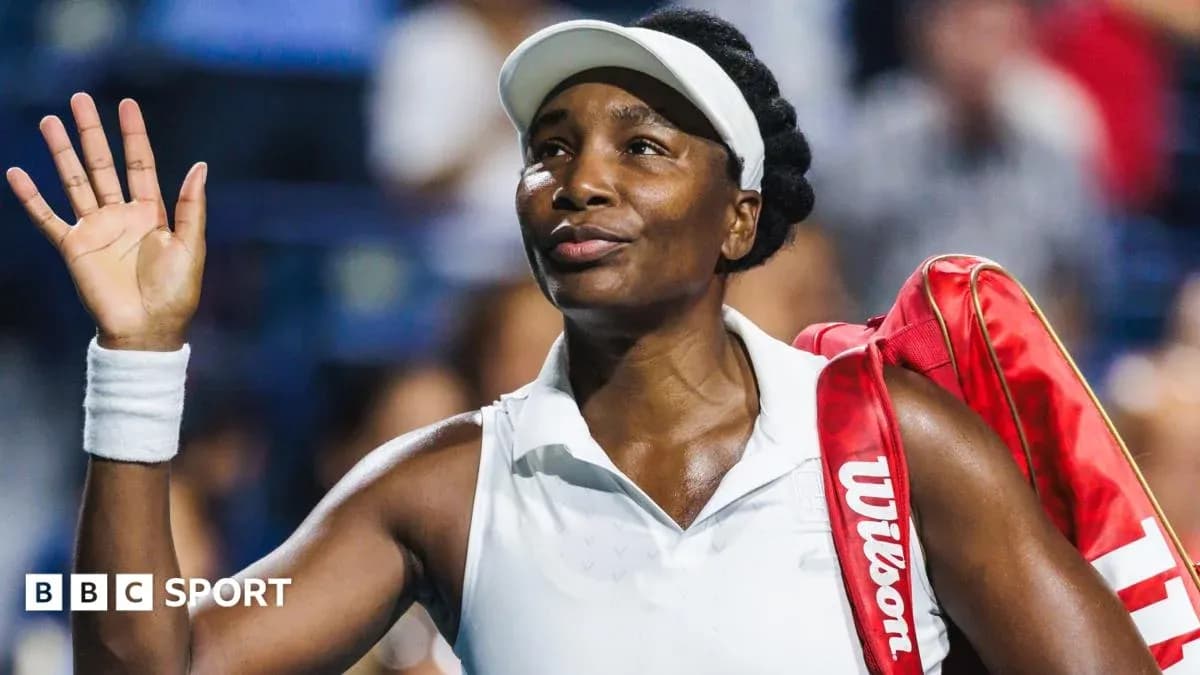
Venus Williams walks back through the gates of Flushing Meadows this year not as a contender, not even as a seeded threat, but as something rarer in sport: a legend still refusing to step away.
At 46, with five Wimbledon singles titles and two US Open crowns already etched into tennis history, she arrives ranked 611 in the world and on a 14-match losing streak in singles. The numbers are brutal. The name is not.
Once again, that name has opened the door.
The United States Tennis Association has handed Williams her 12th wildcard of the season so she can play in the US Open main draw, where she will face fellow Grand Slam champion Sofia Kenin in the first round. Without those invitations, she would not be here. She has not qualified for a major by ranking since Wimbledon 2021 – which is also where she last won a singles match at a Slam.
That is the tension at the heart of this story. How long does a sport keep rolling out the red carpet for its greats when the results no longer match the reputation?
A legend on borrowed time – and borrowed entries
Wildcards are the sport’s most powerful discretionary tool. Eight of the 128 spots in a Grand Slam singles draw are set aside for them. WTA and ATP events typically hold back four to eight places, depending on draw size. Those slots can launch a career, revive one, or – as in Williams’ case – extend it.
This season alone, tournament directors in New Zealand, Australia, Spain, Germany, Canada and the United States have decided that Venus Williams is still worth one of those precious passes. Eleven times already they have done it. The USTA has now made it 12.
There is a clear commercial logic. A Williams sister still moves the needle.
“I think it's good for tennis to have these generational icons,” said Karl Hale, the tournament director in Toronto who gave her a wildcard for this month’s WTA 1000 event. “That they are still allocating wildcards for them says something to their intrinsic value to the tournaments.”
Hale made sure Toronto knew early that Venus was coming. He wanted the buzz.
“The way we looked at Venus is that her legacy is phenomenal,” he told BBC Sport. “She's done so much for the sport and is really popular here in Toronto and our markets specifically – so we thought it was really good to announce it early that we have a Williams sister coming.”
The payoff was immediate. Media interest spiked. Tickets moved. And when the tournament began, Williams walked out on opening day, centre stage.
“She kicked off our tournament, so it added a lot of value,” Hale said. First-round wildcards guarantee a recognisable name on court from day one. For organisers, that matters.
The results that won’t turn
Strip away the aura and the form guide is unforgiving.
Williams’ defeat to Emiliana Arango in Cincinnati this month was her 18th loss in 19 singles matches. The only win in that stretch came last July in Washington, when she beat Peyton Stearns. At the majors, she has been close but not quite there: a three-set loss to 11th seed Karolina Muchova at last year’s US Open, and another narrow three-set defeat to Olga Danilovic at the Australian Open in January.
She did reach the doubles quarter-finals in New York last year, a reminder that her instincts and hands remain elite. But in singles, the grind has become harsher. The scoreboard keeps tilting the wrong way.
Hale insists she is still competitive.
“You never want to put a player out there that you are unsure about,” he said. He pointed to her 6-4 6-1 loss to Kamilla Rakhimova in Toronto as an example. The first set, he argued, showed there is still substance behind the star power. “She's still competitive, but just not winning these matches.”
That single phrase captures the dilemma. If she can still push opponents, still hold her own for stretches, does that justify another wildcard? Or should that spot go to a younger, higher-ranked player clawing for a breakthrough?
Who deserves a wildcard?
Most tournaments start by looking inward. National players are usually first in line, especially those on the cusp of the main draw or coming back from injury. Then come the names who can sell tickets, drive TV interest, and give a tournament a headline for its posters and social feeds.
There is also a quieter economy at work. Hale calls them “trades” – informal exchanges between national federations or big agencies such as IMG, which manages players and until recently owned the Miami and Madrid Opens. A wildcard for one of your prospects this week might mean a wildcard for one of ours next month.
At the top level, those trades are formalised. The USTA, Tennis Australia and the French Tennis Federation have a reciprocal agreement: each offers a men’s and a women’s wildcard to the others for their home Slams. Two of their own players benefit when the tour swings back to their country.
Within that system, a place for a 46-year-old icon stands out. It is not about development. It is about deference.
Williams is not the first great champion to test the limits of that deference. Martina Navratilova returned to singles in her late 40s and received wildcards for both the 2004 French Open and Wimbledon, winning a round on the grass at 47. Golf’s Open Championship once let past winners play until 65; now the cut-off is 55, in part to free up spots for younger, higher-ranked professionals.
Tennis has no such ceiling. There is no age limit on wildcards, no formal line in the sand. The decision is left to the tournaments – and, in the eyes of some, to the players themselves.
So should there be a moment when a director turns to a former champion and says: not this time?
Who makes the call – the sport or Venus?
For Hale, that moment has not arrived.
“When the time comes that Venus is not competitive in sets, then I think she will make that call,” he said. In his view, the responsibility ultimately lies with the player who has carried the sport for so long.
“Venus and Serena have done so much for women's tennis and the sport that they should be able to play as long as they want. I'm very happy they are continuing and they make their decision when they are ready, or each tournament makes their decision when they are ready.”
Within the locker room, there is little resentment, at least publicly. Younger players speak about Williams with something closer to awe than frustration.
British number one Katie Boulter, who partnered her in doubles in Madrid in April, called her an “absolute icon” and framed the wildcard debate in emotional, almost moral terms.
“Venus has given so much to our sport that she deserves to get what she needs back,” Boulter said. “We have to be grateful that she is still out there, doing the best she can.”
That gratitude is real. So is the cost. Every wildcard given to a legend is one not given to a rising player who might never have another chance to crack a main draw, earn ranking points, or change the course of a career.
Yet tournament after tournament keeps making the same calculation. The presence of Venus Williams – the walk, the name on the order of play, the sight of her on a practice court – still outweighs the cold logic of results and rankings.
So she returns to New York again, not as the force who once owned the Arthur Ashe night session, but as a 46-year-old wildcard carrying both her legacy and her losing streak onto one of sport’s grandest stages.
At some point, either the invitations will stop, or she will decide she has had enough. For now, tennis keeps saying yes.