Zheng Qinwen's Stunning US Open Upset Over Swiatek
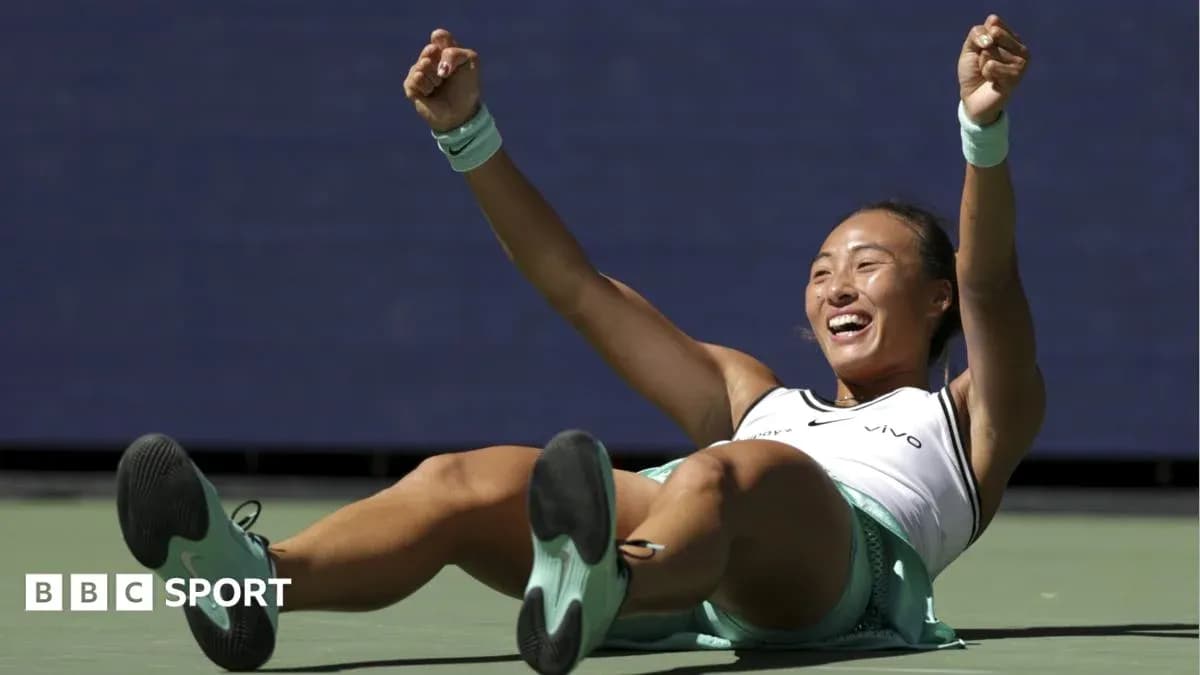
Zheng Qinwen walked into Arthur Ashe Stadium as a qualifier and walked out as the woman who took down a former champion and one of the sport’s modern forces. Again, she did it the hard way.
For the second match in a row at this US Open, the 23-year-old from China climbed out of a 5-0 hole in a set and turned apparent disaster into a surge of dominance. This time the victim was Iga Swiatek, the eighth seed and 2022 champion in New York, beaten 7-5 6-3 in a result that shakes up the women’s draw and rewrites the story of Zheng’s season.
From outside the top 100 to Ashe shock
Not long ago, Zheng was nowhere near this stage. Elbow surgery in July 2025 derailed her momentum and dragged the former world number four outside the top 100. The reigning Olympic champion arrived in New York not as a headliner, but as a qualifier trying to stitch her game back together under the harshest lights in tennis.
Seven wins later, including three in qualifying, she is back on the sport’s biggest stadium and back on the brink of the top 50.
The comeback thread has run through her entire fortnight. On Saturday, she trailed Madison Keys 5-0 in the deciding set of their third-round match. Keys had one foot in the last 16. Zheng responded by ripping through seven straight games to steal it.
That might have been a once-in-a-tournament escape. Instead, it turned out to be a dress rehearsal.
Swiatek races, Zheng roars back
Against Swiatek, Zheng again looked stranded early. The Pole, 25, settled quickly, jumped all over short balls and surged to a 5-0 lead in the opening set. The scoreline suggested a rout. The body language did not.
Zheng refused to fold. She tightened her baseline patterns, found heavier depth, and began to bully rallies with her forehand. Swiatek’s early clarity started to blur. Games that had flown by suddenly dragged into long exchanges, and the noise on Ashe grew with every Zheng winner.
The pressure finally told. Zheng reeled off seven of the next eight games to steal the first set 7-5, turning a 0-5 deficit into a statement. From there, the match belonged to her.
She carried that surge into the second set. Swiatek, who had marched into New York on the back of a WTA 1000 title in Toronto and a semi-final in Cincinnati, tried to reset, holding serve early and looking to reassert control. At 3-3, the contest sat on a knife-edge.
Then Zheng struck. In the seventh game, she stepped in and crushed a backhand return winner for a decisive break, the kind of shot that underlines not just form but belief. Two games later she broke again to close out the match 7-5 6-3, having won 13 of the last 16 games on the sport’s biggest regular stage.
“The more matches I play, the more rhythm I have on court,” she said afterwards, explaining the surge that has carried her from the qualifying rounds into the last eight. She brushed off any talk of fatigue. “People have asked me if I’m tired and when I arrived I was not tired at all. I felt really pumped for my match, trying to reach better levels here and enjoy this fantastic stadium.”
Olympic echo and a new New York storyline
This was not Zheng’s first strike against Swiatek. Her only previous win in eight meetings came in the semi-finals of the 2024 Olympics in Paris, a key step on her way to singles gold. That victory hinted at a rivalry that could shape the next few years. This one, on Ashe, felt like confirmation that Paris was no one-off.
Zheng’s run also links her to recent US Open history. The last qualifier to reach this stage in the women’s draw was Emma Raducanu in 2021, a run that ended with the Briton lifting the trophy. Zheng is still some distance from that finish line, but her path already belongs to the same category of improbable charge.
Next she will face either former US Open champion Naomi Osaka or second seed Elena Rybakina in the quarter-finals, a match-up that will test just how far this resurgence can stretch. Whoever emerges, Zheng will not arrive as a curiosity. She will arrive as a threat.
Swiatek’s Slam season falls flat
For Swiatek, the numbers tell a stark story. A fourth-round exit in New York means she will finish a season without a Grand Slam title for the first time since 2021.
Her best major result this year came in January with a quarter-final at the Australian Open. The French Open, once her fortress, ended in the fourth round. Her Wimbledon title defence collapsed in the third. In New York, she had not dropped a set through three rounds and looked primed for a deep run, especially after her North American hard-court form.
During the second set against Zheng, leading 2-1, she received treatment on her left thigh. She played on, but the sharpness that defined her summer hard-court swing never quite returned. The defeat underlines a season in which her week-to-week level has often outstripped her major results.
A year of qualifiers and a teenager on the rise
Zheng’s surge is part of a broader pattern in 2026. Qualifiers are not just filling draws; they are rewriting them.
At Roland Garros, Poland’s Maja Chwalinska began the French Open ranked 114th in the world and fought all the way to the final before losing to Russian teenager Mirra Andreeva. In New York, Andreeva is again deep into the second week, recovering from a set down to beat Anastasia Potapova and reach her first US Open quarter-final.
The women’s game is getting younger, deeper, and far less predictable. Big names still matter, but the gap between the established elite and the chasing pack has rarely looked thinner.
Zheng, with her Olympic gold, former top-five ranking and rebuilt elbow, is not a typical qualifier. She is a contender who had to start from the outside and is now forcing her way back into the sport’s inner circle.
The question now is simple: having dragged herself out of 5-0 holes and past a former champion, how much further can she push this New York revival?