Alexander Zverev: From Nearly Man to Major Champion
Alexander Zverev used to be the answer to a cruel tennis question: who is the best man never to have won a Grand Slam?
That label has been ripped up. He will close 2026 as a two-time major champion and the world number one, the oldest man in more than half a century to sit on that throne for the first time. French Open champion. US Open champion. The numbers finally match the talent.
Yet his story is not a simple rise-to-the-top fable. It is a career framed by brilliance, shadowed by serious allegations, and constantly teetering between control and chaos.
From nearly man to major force
By January, Zverev’s résumé was already weighty: Olympic gold medallist, two-time ATP Finals winner, former world number two, three Grand Slam finals. But the scar tissue ran deep.
The most painful cut came in New York in 2020. Two sets up on Dominic Thiem in the US Open final, Zverev folded in a fifth-set tie-break, double-faulting as Thiem cramped and the match slipped away. It was a collapse that seemed to confirm the nagging suspicion: on the biggest stages, his game tightened, his arm shrank, his courage deserted him.
He knew it. The tour knew it.
This year, he vowed to change that. Hit through the ball. Live with the errors. Play with risk, with bite, with variety. The timid version of Alexander Zverev had to disappear.
The turning point came away from the spotlight, on the courts of Mallorca in July 2025. Ten days with Rafael Nadal and Toni Nadal, ten days of blunt truths and new ideas.
“I wanted to see and then hear a new vision of what tennis in their mind looks like – and how my tennis, in their mind, looks like,” Zverev said. Nadal had faced him for a decade. Now, from the other side of the net and the stands, he could dissect him in a way few others could.
The result was a player who no longer played scared in the defining moments.
Paris, New York and a long-awaited breakthrough
Even then, the path to his first major was laced with tension. In the French Open final against Flavio Cobolli, Zverev’s body threatened to betray him again. Cramp crept in. The ghosts of 2020 hovered.
This time he didn’t blink.
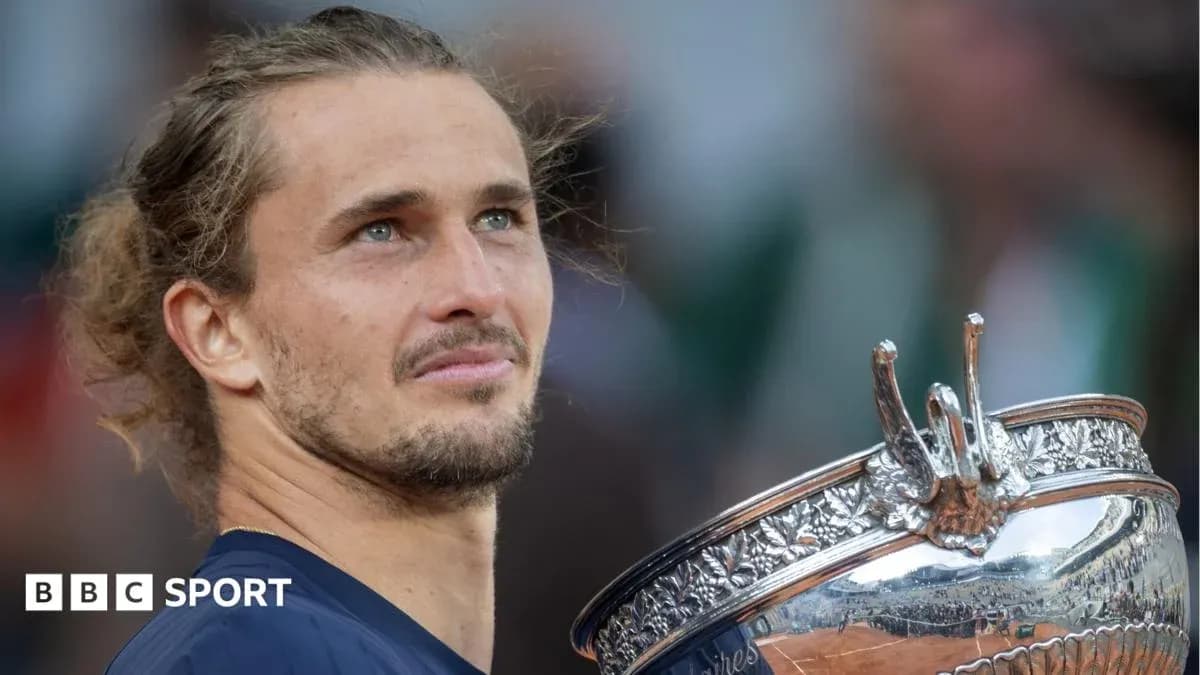
He tore through the deciding set 6-1, sealing the trophy that had hung over his career for years. The celebration was less explosion, more exhale. A burden gone.
The US Open title added confirmation, not surprise. By then, Zverev was playing with the authority of a man who finally trusted his game under pressure. The ranking system simply caught up with reality.
His season stretched across surfaces. At Wimbledon he fell one match short, losing in four sets to Jannik Sinner in a final where, by his own standards, he played his most complete grass-court tennis. He went after his shots, stepped inside the baseline, refused to retreat.
It still wasn’t enough.
Sinner has become his unsolved riddle. The Italian has beaten him 10 times in a row, a streak that sits like a warning sign over the next phase of men’s tennis. Carlos Alcaraz is in that conversation too. If all three stay fit, 2027 promises a three-way tug of war for the sport’s biggest prizes.
Zverev will have to keep playing with that same aggression, that same edge, if he wants to stay on the summit he has waited so long to reach.
Built by family, shaped by distance
Zverev’s rise has always been a family production. His father, Alexander Zverev Sr, has been a constant figure in the player box, guiding a son through the same world he once tried to navigate as a pro. His older brother, Mischa, joined the team after retiring, closing a circle that started when a toddler Alexander watched Mischa practise with Andy Murray as a junior.
The dynamic is unusual, and Zverev has never pretended otherwise. He says the relationship with his father works because they spend “zero time together” away from the court.
The parents, he recalls, were determined not to push him into tennis.
“They wanted me to play different sports so they didn’t have to coach me,” he once said. “They always told me ‘why don’t you play football, or field hockey?’ as that was the sport I loved.
“They are very smart. They’ve been through it. They’ve been tennis players themselves.”
The result is a player who grew up inside the sport, yet insists he was never forced into it. A prodigy who became a professional with his family around him, but with emotional distance built into the arrangement.
Allegations, investigations and a fractured image
For all his on-court success, Zverev’s public image has been shaped just as strongly by the accusations that trail him.
In October 2020, former partner Olga Sharypova accused him of physical violence and controlling behaviour. Zverev denied the allegations and called them baseless. No criminal proceedings followed, but the ATP commissioned an independent investigation, handled by third-party investigators.
Three years later, in January 2023, the tour announced its findings: “insufficient evidence to substantiate published allegations of abuse.” The report cited a lack of reliable evidence and eyewitnesses, along with conflicting accounts from Sharypova, Zverev and others.
The case did not end with a guilty or not-guilty verdict. It did, however, force the sport to confront its own structures. The ATP appointed a director of safeguarding and, in 2026, launched a new safeguarding programme, promising a global framework for preventing and responding to abuse, harassment, bullying, domestic violence and other misconduct.
The scrutiny did not stop there.
In October 2023, a German court issued Zverev with a penalty order and a €450,000 fine for bodily harm against another ex-partner, Brenda Patea. Again he denied the allegations and challenged the order, triggering a public trial in Berlin in May 2024.
A week into the proceedings, the court terminated the trial after a settlement between Zverev and Patea. The court stressed the decision was not a verdict and not a ruling on guilt or innocence. One decisive factor, it said, was the witness’s wish to end the trial. Patea has not publicly commented on the settlement.
On the day the settlement was announced, Zverev reached the French Open final. Asked later if he regretted settling before any formal declaration of innocence, he was defiant.
“That’s what dropping the case is. That is innocence,” he said. “They’re not going to drop the case if you’re guilty at the end of the day. I don’t know what translations you have, but that’s what it means.
“Done. We move on. I never ever want to hear another question about the subject again. That goes out to everybody.”
The questions, of course, have not gone away. Nor has the reaction. He was heckled at the 2025 Australian Open and in Munich, a reminder that for some fans the allegations are not easily parked or forgotten.
A volatile competitor
Zverev’s temper has also flared in full view. In 2022, at the Mexican Open in Acapulco, he repeatedly smashed his racquet into the umpire’s chair after a doubles defeat, coming close to striking official Alessandro Germani’s foot. He swore at the umpire, accused him of destroying the match, and was thrown out of the tournament for unsportsmanlike conduct.
The ATP later handed him an eight-week suspended ban for a “major offence”, warning it would be activated if he committed further acts of disrespectful or aggressive behaviour, or verbal or physical abuse, within 12 months. Zverev apologised, saying it was “difficult to put into words” how much he regretted the outburst. He served the probation without triggering the suspension.
The incident added another layer to a complex portrait: a player capable of sustained brilliance, but also of sudden, explosive loss of control.
The complicated standard-bearer
Zverev’s journey carries another dimension: he has lived and played with type 1 diabetes since the age of four. Managing his condition at the top of elite sport has demanded relentless discipline and planning, even as he has tried to project calm and swagger on court.
Now he stands as the man to beat, the sport’s statistical leader after years in Novak Djokovic’s shadow and in the slipstream of younger champions like Alcaraz and Sinner. His tennis finally looks like that of a world number one. His record finally matches the expectations that followed him as a teenager.
But the conversation around Alexander Zverev will never be about tennis alone.
He is the oldest first-time world number one in more than 50 years, a double Slam champion, an Olympic gold medallist, a player who rebuilt his game and his mentality with the help of one of the greatest of all time. He is also a figure at the centre of serious allegations, court cases, investigations and ethical debates that have forced his sport to rethink how it deals with safeguarding and misconduct.
On court, the next chapter is clear enough. Can he turn a breakthrough season into an era, staring down Sinner and Alcaraz in a rivalry that could define the post-Djokovic age?
Off court, the question is sharper, and far harder to tidy away: can the man now carrying men’s tennis ever fully escape the shadows that came with him to the summit?