Alexander Zverev: From Best Player to World Number One
Alexander Zverev used to carry one of tennis’s most uncomfortable labels: the best man never to have won a Grand Slam.
He ends 2026 as a two-time major champion and the world number one. Not the heir apparent. The man at the top.
A late-arriving number one
At 29, Zverev has become the oldest player in more than half a century to reach world number one for the first time. The route there was not subtle. A breakthrough French Open title in June, a US Open crown in September, and the ranking followed the trophies.
For a player diagnosed with type 1 diabetes at the age of four, the climb has always required more planning, more discipline, more work than most. His long-awaited major success felt less like a bolt from the blue and more like a debt finally paid on years of grinding, often painful near-misses.
Before this season, his résumé was already loaded: Olympic champion, two-time ATP Finals winner, former world number two, three-time Grand Slam finalist. But those finals told a harsher story than the bullet points.
None cut deeper than the 2020 US Open. Two sets up on Dominic Thiem, Zverev watched the match slip through his fingers, double faults creeping in as Thiem cramped and the fifth set bled into a tie-break. It became the defining image of his career: the man who could not quite finish.
The pattern hardened over time. On the ATP Tour, he could bully almost anyone, playing with aggression and swagger. On the biggest stages, that same game too often shrank, his racket arm suddenly heavy, his shot selection cautious.
This year, he decided the script had to change.
The Nadal intervention
The turning point came not under the lights of a packed stadium, but in the heat of Mallorca. In July 2025, Zverev spent 10 days with Rafael Nadal and Toni Nadal, searching for a different way to see his own game.
"I wanted to see and then hear a new vision of what tennis in their mind looks like - and how my tennis, in their mind, looks like," he said. It was not just a tune-up; it was a reset.
Nadal had spent a decade across the net from him. Now he watched from the other side, a former rival turned analyst. What did he see? A player who needed to hit through fear, not play around it. Zverev left Spain determined to hit the ball harder, take more risk, add more variety, and accept the consequences.
The change did not erase the nerves. In this year’s French Open final against Flavio Cobolli, the old tension returned. Zverev cramped. The anxiety flickered. The moment felt fragile again.
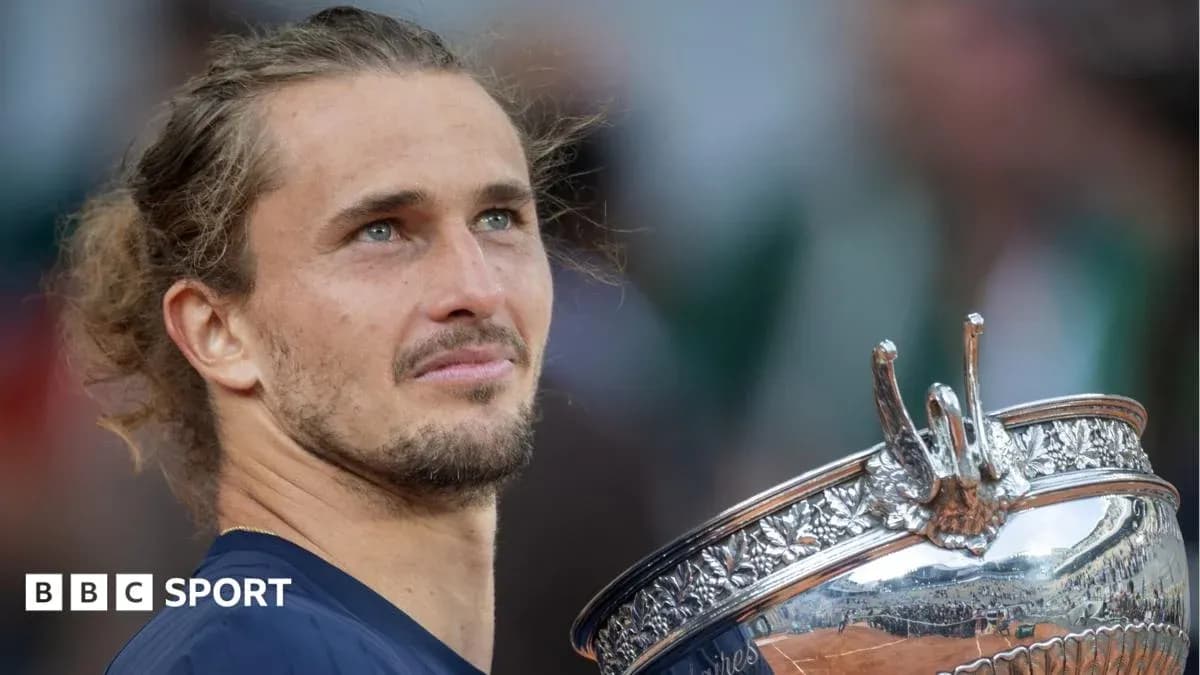
This time, he slammed the door. He ripped through the deciding set 6-1, refusing to retreat into safety, and finally held a Grand Slam trophy of his own. Roland Garros, of all places, became the site of his release.
A family business
Zverev’s rise has always looked like a family project. His father, Alex Sr, has been a near-permanent figure in the player box, guiding him from prodigy to champion. His brother Mischa, once a tour player himself, now sits alongside their father as part of the coaching team.
The symmetry runs deep. Years ago, a toddler Zverev sat courtside while Mischa practised with a young Andy Murray. The roles have flipped. Mischa now watches his younger brother contest the sport’s biggest matches.
The personal dynamic remains unusual for tennis. Zverev has often said his relationship with his father works precisely because they keep their distance away from the court, spending "zero time together" off it. His parents, he recalls, tried to nudge him away from tennis rather than into it.
"They wanted me to play different sports so they didn't have to coach me," he has said. Football, field hockey — anything but another family player to manage. But both parents were professionals themselves. They knew the road, and when it became clear Alexander would walk it, they knew how to guide him.
Grass, hard courts, and a looming rivalry
The French and US Open titles bookend the season, but Wimbledon might have showcased Zverev at his most complete. He reached the final and, in patches, played the most daring tennis of his year, only to fall in four sets to Jannik Sinner on Centre Court.
The defeat underlined both his progress and his problem. Zverev attacked, went for his shots, and still lost. Against Sinner, that has become a grim habit. The German has now lost 10 straight matches to the Italian, a streak that sits like a warning on the horizon.
Carlos Alcaraz lurks on the other side of the draw, another generational rival with the weapons to dominate the next decade. If all three start 2027 fit and firing, Zverev’s task is clear: turn a breakthrough season into a three-way fight for the sport’s biggest prizes, not a one-year peak.
The shadow over the number one
Zverev’s ascent has not played out in a vacuum. His status as the new standard-bearer for men’s tennis sits alongside serious off-court allegations that have followed him for years.
In October 2020, former partner Olga Sharypova accused him of physical violence and controlling behaviour. Zverev denied the accusations, calling them baseless. No legal case emerged, but the ATP commissioned an independent investigation, handled by third-party investigators.
In January 2023, the ATP announced it had found "insufficient evidence to substantiate published allegations of abuse". The report cited a lack of reliable evidence and eyewitnesses, and conflicting statements from Sharypova, Zverev and others. The governing body closed the case and, in response to the wider concerns, appointed a director of safeguarding and launched a new global safeguarding programme aimed at preventing and addressing abuse, harassment, bullying, domestic violence and other misconduct across the tour.
The scrutiny did not end there. In October 2023, a German court issued Zverev with a penalty order and a €450,000 fine for bodily harm against another ex-partner, Brenda Patea. Zverev denied the allegation and challenged the order, triggering a public trial in Berlin in May 2024.
A week into the proceedings, the court halted the trial after a settlement between Zverev and Patea. The court stressed the decision was not a verdict and not a ruling on guilt or innocence, noting that a key factor was Patea’s wish to end the process. She has not commented publicly on the settlement.
Zverev reached the French Open final on the day the settlement was announced. Earlier in the tournament, he had described the trial as a chance to prove his innocence. Asked later if he regretted settling before a verdict, he replied: "That's what dropping the case is. That is innocence. They're not going to drop the case if you're guilty at the end of the day." He ended with a blunt line: "Done. We move on. I never ever want to hear another question about the subject again."
Crowds have not always obliged. He was heckled in 2025 at both the Australian Open and the Munich Open over the allegations, a reminder that public opinion does not tidy itself away as neatly as a closed legal file.
Temper, lines, and limits
Zverev’s disciplinary record on court has also raised questions. In 2022, he received an eight-week suspended ban from the ATP after an explosive incident in Acapulco. Furious at a line call during a doubles match at the Mexican Open, he smashed his racquet into the umpire’s chair four times, one swing coming perilously close to the umpire’s foot. He swore at Alessandro Germani and accused him of destroying the match.
Tournament officials threw him out of the event for unsportsmanlike conduct. Zverev later apologised, saying he struggled to express how deeply he regretted his behaviour. The suspended ban hung over him: any further major offence for disrespectful or aggressive behaviour, or verbal or physical abuse, within 12 months would have triggered it. He stayed clear of that line, and the ban was never activated.
The complicated king of men’s tennis
So tennis arrives at a complicated place. The man at the top of the rankings is a player who has finally conquered his own doubts on the biggest stages, who has battled a chronic condition since childhood, who rebuilt his game with the help of one of the sport’s greatest champions — and who has spent much of his prime under the glare of serious off-court allegations and disciplinary flashpoints.
On court, the equation is simple. Zverev is now a French Open and US Open champion, a Wimbledon runner-up, and the world number one. He has the game, the experience, and the platform to shape the next era alongside Sinner and Alcaraz.
The question is not whether he belongs in that conversation. It is what kind of era men’s tennis will have with Alexander Zverev as its leading figure.