Alan Jones' Historic Win at the 1977 Austrian Grand Prix
The engines rose to a shrill, nervous howl on the grid at the 1977 Austrian Grand Prix, a mountain amphitheatre waiting to erupt.
On pole sat Niki Lauda, the iron-willed hometown hero, barely a year removed from the inferno at the Nürburgring that had burned his face and very nearly taken his life. Just behind him, James Hunt – glamorous, reckless, impossibly charismatic – the Englishman Lauda once admitted was the only man he ever envied. In third, Mario Andretti, the American colossus whose career would span everything from an F1 world title to IndyCar crowns and a Daytona 500 win.
And way back in 14th on the grid, in a car that had never won a race, waited Alan Jones.
No movie-star jawline. No rock-star swagger. Just a 30-year-old from Victoria, drafted into Formula One four months earlier to replace the late Tom Pryce after the Welshman’s tragic death in South Africa. He’d been called overweight. Laconic. Underprepared. The kind of driver you underestimated at a glance.
What he had, though, was pace. Raw, unvarnished, fearless pace.
On that overcast August afternoon at the Österreichring, the bloke who once sold Holdens at his dad’s suburban Melbourne dealership would ambush the sport’s aristocracy and rewrite his own story in one wild, rain-slicked afternoon.
The track was damp, the sky undecided. Half the field gambled on wet tyres, the rest rolled the dice on slicks. When the lights went out, Lauda’s Ferrari floundered on the greasy surface, Andretti pounced, slicing past both the Austrian and Hunt after a minor clash between the two headline acts.
Eyes went where they always went: to the superstar American in the Lotus, and to the charging Gunnar Nilsson, the Swede storming from 16th to second on wets, surfing the conditions as if he’d ordered the weather himself.
Almost nobody watched the Shadow in their mirrors.
Jones had quietly threaded his way from 14th to fourth, leaning on his slicks with a conviction others lacked. While more decorated names hesitated, he committed, carving through the spray and traffic with a calm that belied the stakes.
As the clouds thinned and the line dried, the early wet-tyre heroes paid the price. Nilsson’s rubber shredded, forcing him into the pits. Then came the gut punch for Andretti: the Lotus engine detonated, his car rolling to a smoky halt, his victory hopes evaporating with it.
Suddenly Hunt led. And right behind him, glued to his rear wing, was the unfashionable Australian in the black Shadow.
Lauda, now armed with fresh tyres and a car that finally bit into the tarmac, charged back through the field into third. The script seemed set: Hunt vs Lauda, the rivalry that would one day be immortalised in Hollywood, ready for another act. Only this time, their duel had an unlikely third man wedged between them, cheeks rounded, expression impassive, speaking only through lap times.
Then came the moment that changed everything.
Hunt’s McLaren burst into sparks and flame, the engine letting go in a violent cough of smoke. The car rolled to a stop by the side of the track, marshals sprinting in and drowning it under a cloud of extinguisher dust.
Out of that haze, the leader emerged.
Alan Jones, in a Shadow that had never won a thing, now headed the Austrian Grand Prix. Behind him, Lauda, the reigning world champion, hunted hard. The local crowd willed their man on. Jones held firm. Lap after lap, the Australian refused to blink.
When the chequered flag finally dropped, it was Jones who crossed the line first. His maiden grand prix victory. The first of 12 in his career. And the only win Shadow would ever taste in its eight years in Formula One.
The team spilled onto the circuit in disbelief, swamping their driver and their unlikely hero of a car. The track announcer’s voice crackled over the PA, excitement laced with uncertainty as history caught up with everyone at once.
“The first Grand Prix win for Alan Jones, and the first Grand Prix win for the hard-working Shadow team,” he declared. “And, we think, the first Grand Prix win for Australia in seven years.”
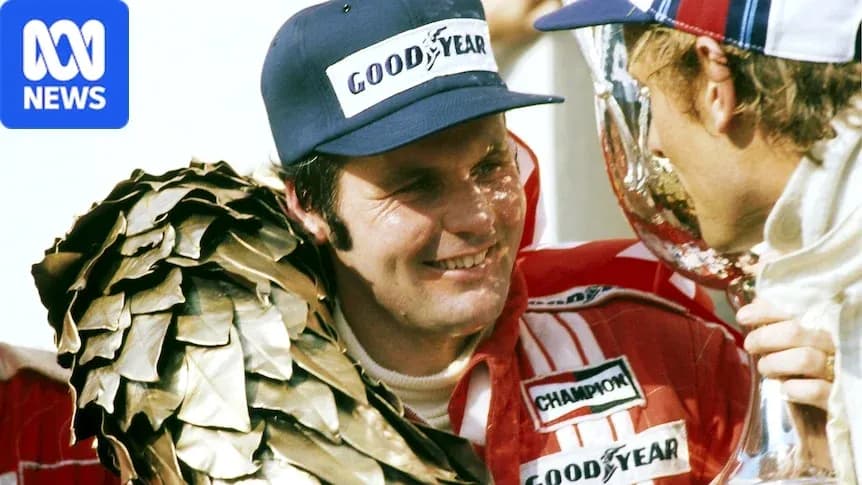
In pit lane, Jones disappeared under a crush of handshakes and backslaps. With his then-wife Beverley on one arm and a bottle of champagne in the other, he planted a long, unapologetic kiss on her before she urged him to get on with the real business and pop the cork. He took a deep swig, then was hustled towards the podium, draped in a golden wreath as a band struck up in the background.
That soundtrack would later become part of one of the sport’s great embellished tales.
“[The win] was a bit of a surprise to everybody,” Jones told Wide World of Sports co-host Daryl Eastlake in later years. “In fact they had trouble finding the Australian national anthem, so some drunk played Happy Birthday on a trumpet. That’ll give you an idea how prepared they were for me to win.”
It’s a wonderful line. Not quite accurate.
Audio from that day reveals trumpeters belting out tunes somewhere in the distance – La Cucaracha among them – before finally launching into Advance Australia Fair as Jones took his trophy. The official anthem at the time, God Save the Queen, never featured, despite having been reinstated as Australia’s national song in 1976 after Gough Whitlam’s earlier adoption of Advance Australia Fair.
Maybe, in the chaos and emotion, Jones heard only fragments: snatches of brass, a melody that blurred into the universal familiarity of Happy Birthday. Maybe he tuned it out entirely, lost in the shock of what he’d just done. Maybe he simply didn’t recognise a tune that had already been swapped in and out as the country’s anthem and would be again.
What can’t be disputed is what followed.
From that day on, Formula One organisers learned the Australian anthem properly. They had to. Jones kept dragging it onto podiums around the world as he carved his name into the sport’s golden era.
In an age when F1 stars looked like matinee idols or rock singers, Australia’s standard-bearer was a man who could have passed for your local bank teller. No polish, no pretence, just a relentless right foot and a refusal to be overawed.
That, more than the myths about trumpets and anthems, is the legacy that still stirs Australian motorsport fans: a quiet, unflashy bloke who turned up in a midfield car and, on a grey day in Austria, beat the gods of his sport on sheer talent alone.