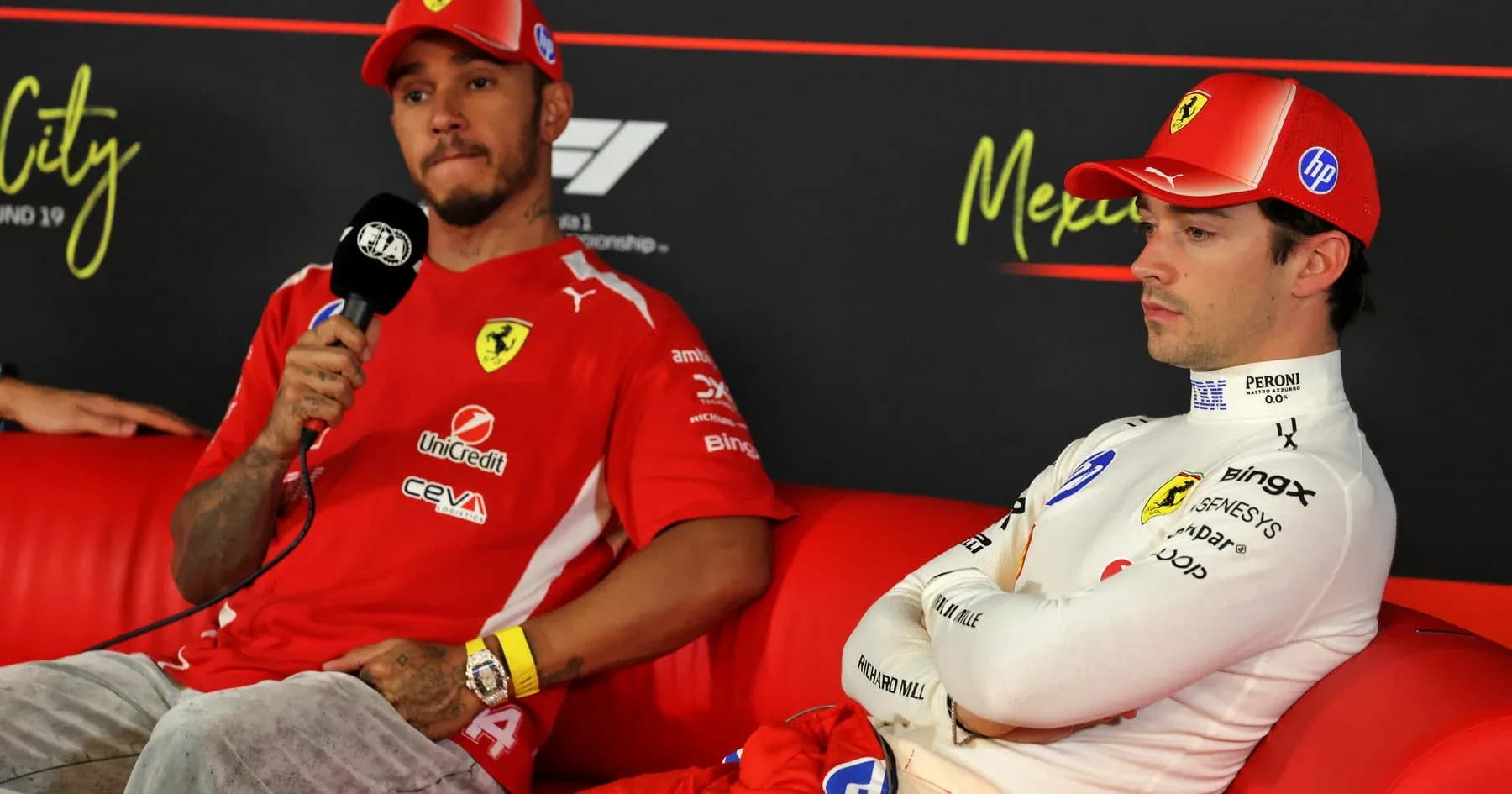
Charles Leclerc on Learning from Lewis Hamilton at Ferrari
Charles Leclerc has spent the past few weeks locked in a tense, political storm at Ferrari, but when he talks about Lewis Hamilton, the guard drops. The rivalry, the flashpoints, the noise around who really leads the Scuderia – all of it briefly fades. What remains is a driver openly studying a seven-time world champion from the other side of the garage.
Leclerc has never been the elder statesman in any Formula 1 line-up he has joined. At Ferrari, he first walked into Sebastian Vettel’s shadow in 2019 and 2020, watching up close how a four-time champion built a weekend, a season, a title bid. Now, with Hamilton in red, the Monegasque finds himself back in that role: the student, not the master – and he is fine with it.
“Having Lewis as a team-mate, you always learn a massive amount,” Leclerc said, speaking to media including RacingNews365. He wasn’t dealing in platitudes. He went straight into the detail of what separates Hamilton.
It starts long before the visor drops.
Leclerc talked about the hours inside the Ferrari garage and in the meeting rooms, the places where cameras rarely linger but championships are often shaped. There, he has been dissecting how Hamilton operates: how he structures a debrief, what he demands from engineers, where he places his energy, and crucially, what triggers his reactions.
“From inside the garage and in the meeting rooms, to understand how he works, what his priorities are, and what he's sensitive to,” Leclerc explained. That word – “sensitive” – is telling. Top-level drivers all feel the car differently, all obsess over different details. One might chase rear stability on entry, another lives and dies by traction on exit, another by how the front end bites in high-speed corners.
“I think from one driver to the other, it always differs: the sensitivities of a driver to one thing or the other,” he said.
Leclerc has been mapping Hamilton’s preferences against his own. Where does Lewis ask for changes? Which run does he sacrifice to prepare for qualifying? Which corner does he circle on the data traces? It’s a constant comparison, not out of insecurity, but out of ambition.
On track, that curiosity only intensifies.
“In terms of driving style, you always look at the other side of the garage to try and improve in the best possible way,” Leclerc admitted. For him, the learning is “all around” – not a single trick or magic bullet, but a complete picture of how a serial champion constructs a weekend.
The dynamic is complicated, of course. Ferrari’s season has thrown Leclerc and Hamilton into a high-pressure environment where every strategy call, every team radio, every qualifying tow is scrutinised for signs of hierarchy. Yet Leclerc’s words carry no hint of resentment. He sounds like a driver who knows that being measured against Hamilton, even in the most uncomfortable moments, can only sharpen him.
Alongside them in the press conference sat George Russell, a man who has already lived this experience. He spent three seasons sharing a garage with Hamilton at Mercedes from 2022 to 2024, and his perspective cut through the technical talk.
“Yes, a lot from Lewis, obviously. I joined [him] earlier in my career,” Russell said. On the racing side, he nodded towards Leclerc’s assessment. That part, he felt, had been covered.
So he went somewhere else: away from telemetry and tyre life, into the quieter corners of a driver’s life.
“We've learned a lot about movies since spending time with Lewis,” Russell said with a smile. Hamilton’s passion for cinema has become a running joke between them. The seven-time champion dives into films with the same intensity he brings to set-up sheets, and Russell admitted his own viewing record barely registers by comparison.
“He's quite into his movies and always shocked that I've not seen probably one per cent of what he's watched,” Russell added.
It was a small detail, but it revealed something often lost in the storm around Hamilton: the human being behind the statistics. For Russell, the years at Mercedes weren’t just about slipstreams, strategy calls and intra-team battles. They were about sharing a garage – and a grid – with a driver whose influence stretches far beyond the stopwatch.
“But no, he's a great guy, and, yeah, it's been a privilege to share the track together and share the garage,” Russell said. No embellishment, just a simple verdict from someone who has fought Hamilton in equal machinery.
Between Leclerc’s forensic observations and Russell’s softer, more personal touch, a clear picture emerges. Hamilton is not just a benchmark for lap time; he is a reference point for how to live the job, how to carry the weight of expectation, how to keep evolving deep into a career.
Ferrari, meanwhile, stands at a familiar crossroads. Two elite drivers, one legendary team, and a fanbase that never stops debating the same question: should there be a clear number one? The data pours in from both sides of the garage, the politics simmer, and every weekend adds another layer to the argument.
Leclerc is still learning Hamilton’s sensitivities. The real intrigue now is this: as the season unfolds, whose will Ferrari be more sensitive to?