Alan Jones: Champion of Formula 1's Deadliest Era
Alan Jones has died at the age of 80, and with him goes one of the last, clearest links to Formula 1’s most brutal age.
The Australian who became world champion in 1980, winner of 12 grands prix and the heartbeat of Williams’s first great team, built his legacy in a sport that often felt closer to Russian roulette than racing. His career is a highlight reel of courage and success, but threaded through it is a stark truth: almost every major step forward in his life in F1 was shadowed by tragedy.
Baptism at Montjuïc
Jones’s first day as a Formula 1 driver unfolded at one of the most grimly notorious races the sport has ever staged.
Spanish Grand Prix, Montjuïc Park, Barcelona, 1975. The barriers looked wrong before a wheel had turned. Marshals and drivers feared the guardrails weren’t bolted properly. Members of the Grand Prix Drivers Association refused to practice, staging a strike born of sheer self-preservation.
The race went ahead anyway. Rumours swept the paddock that the Guardia Civil would impound the cars if the event collapsed. In that atmosphere, with pressure and politics drowning out common sense, Formula 1 simply carried on.
Jones, in a Hesketh, scraped into the field in 21st. His debut lasted three laps before a collision put him out. On paper, an anonymous start. In reality, he had stepped into a nightmare.
On lap 26, race leader Rolf Stommelen’s Hill-Ford suffered a rear wing failure. The car speared off, vaulted the inadequate barriers and tore into the crowd. Five spectators were killed. Stommelen was badly injured. The race staggered on for four more laps before officials finally abandoned it.
Montjuïc would live in infamy. It also carried a different kind of history: Lella Lombardi finished sixth, becoming the first – and still the only – woman to score Formula 1 world championship points.
Jones’s introduction to the top tier of motorsport came on a day when the sport’s priorities were laid bare. Speed first. Safety somewhere in the distance.
A Seat Won Through Death
By the end of 1976, Jones had fallen out with Team Surtees and found himself on the outside looking in. No drive at the start of 1977. No clear way back.
His route back arrived in the worst possible way.
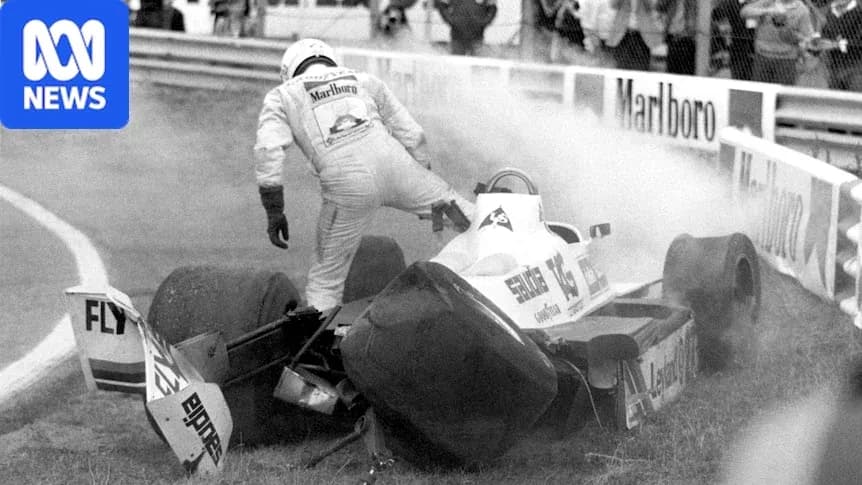
At Kyalami in South Africa, a minor fire turned into one of the most harrowing incidents in Formula 1 history. Shadow driver Renzo Zorzi pulled off the main straight with a fuel leak. A small fire flickered at the rear of the car. Two young marshals ran across the live racetrack carrying fire extinguishers. One car managed to swerve. Tom Pryce, Zorzi’s teammate, never saw them.
Pryce hit 19-year-old marshal Frederik Jansen van Vuuren at full speed. The teenager died instantly. The heavy extinguisher he carried smashed into Pryce’s helmet, killing the Welshman on the spot.
On the podium, race winner Niki Lauda was preparing to celebrate when a Goodyear representative quietly told him what had happened. Any sense of victory evaporated.
The needless deaths at Kyalami left a seat vacant at Shadow. Jones was called in for the next race in the United States. Opportunity, in that era, so often arrived wrapped in black.
He seized it. Later that year, in Austria, Jones delivered Shadow’s only Formula 1 victory – a breakthrough win that launched him from journeyman to genuine contender. It was a stunning drive, but its roots lay in a tragedy that never should have happened.
The Ferrari That Never Was
From 1979 to 1981, Alan Jones stood at the centre of Formula 1.
Williams had found its stride. Jones, relentless and uncompromising, became the spearhead. Eleven grands prix wins in three seasons, and the 1980 world championship secured his place among the elite. He was the hard edge of Frank Williams’s rising empire.
Yet his career could have taken a very different turn.
Ferrari had sounded him out earlier, telling Jones he was their second option if they failed to land Mario Andretti. The Italian team missed out on Andretti, who would go on to win the 1978 title with Lotus, and instead turned to a young Canadian with raw speed and a wild streak: Gilles Villeneuve.
Jones signed with Williams. Ferrari and Villeneuve became legend. Two parallel stories, both electrifying, both destined to collide with the darker side of the sport.
By 1982, Jones had stepped away from Formula 1. Ferrari, meanwhile, was hit by a double catastrophe.
Villeneuve died in qualifying for the Belgian Grand Prix at Zolder, launched into the air after striking the back of a much slower car. The Ferrari disintegrated. Villeneuve was thrown clear and killed.
Later that season, at Hockenheim, Didier Pironi – the man who had become Ferrari’s new title hope – ploughed into the rear of Alain Prost’s Renault in heavy spray. The impact shattered Pironi’s legs and ended his F1 career.
Jones would later say Ferrari approached him to fill in for the final rounds of the 1982 season. He hesitated. By the time he responded, the team had moved on and chosen another driver.
Once again, his path brushed close to tragedy without quite crossing it.
A Champion Surrounded by Loss
Across the span of Jones’s Formula 1 career, five drivers died on grand prix weekends. Two more were killed in testing. Australian Brian McGuire lost his life at Brands Hatch in 1977 while driving an F1 car outside the world championship.
Those numbers are stark. They also only hint at the atmosphere of the time. Every race carried an unspoken question: who wouldn’t be coming back?
Jones finally retired from Formula 1 in 1986, stepping away just as the sport began to confront its own record. Circuits changed. Barriers improved. Cars became stronger, survival cells more robust. The culture, slowly and painfully, shifted.
The sport went several years without a fatality, until the 1994 San Marino Grand Prix tore open old wounds. Roland Ratzenberger died in qualifying at Imola. A day later, Ayrton Senna was killed in the race. The shock forced Formula 1 into another wave of reform, this time with a harder edge and a clearer resolve.
Since then, only one driver has died as a result of a Formula 1 race incident: Jules Bianchi, who slid off a soaked Suzuka track in 2014 and hit a recovery crane attending to Adrian Sutil’s crashed car. His death underlined that complacency in this sport is never an option.
The response has been visible. Marshals and recovery vehicles now operate under tighter controls. Run-off areas are larger, barriers more sophisticated. The cars themselves have evolved again, most visibly with the arrival of the Halo – the wishbone-shaped titanium ring above the cockpit that many traditionalists initially resisted.
It has already justified its existence several times. Romain Grosjean’s inferno in Bahrain in 2020. Lewis Hamilton’s Mercedes pinned under Max Verstappen’s Red Bull at Monza in 2021. Guanyu Zhou sliding upside down and into the catch fencing at Silverstone in 2022. Incidents that, in Jones’s era, would almost certainly have ended very differently.
Alan Jones raced in a time when death was never far from the grid, and yet he helped drag the sport forward simply by surviving long enough to see it change. His world title, his wins, his blunt, uncompromising style – they all matter. But so does the context.
He was a champion forged in the fire of Formula 1’s most dangerous years. The question now is how long the sport he helped define can keep honouring that past without ever repeating it.