Andrea Kimi Antonelli: The Youngest Formula 1 World Champion
The world champion who won the garage first
Mercedes mechanics have learned to flinch when they feel a shadow on their shoulder. Not from the threat of a stray wheel gun or a runaway tyre, but from Andrea Kimi Antonelli’s fingers. The new Formula 1 world champion has a trademark greeting: a hug, a hello… and a sharp pinch to the nipple.
Nobody is safe. Nobody wants to be.
Because behind the 20‑year‑old Italian’s mischief lies the bond that has powered Mercedes back to the top – a relationship built not in boardrooms or briefing rooms, but in the cramped, noisy, oil‑scented space of a grand prix garage.
Chaos in the garage, calm in the cockpit
“When he comes into the garage, it's quite a show,” said Nathan Tupper, one of the power unit crew on the W17. Antonelli doesn’t just walk in; he storms in. He grabs people, pinches, slaps shoulders, tickles mechanics who are trying to focus. Chaos follows him like exhaust smoke.
“At the end of the day, he's 20 years old. That's just Kimi,” Tupper said.
Ash Jones, the second senior mechanic on his car, has seen it all. “There are so many practical jokes that it would be difficult to list them all. He comes over, says hello and then gives you a pinch. That's how he jokes around with us. He likes having a good relationship with everyone, laughing and having fun together."
The remarkable part is when it happens. This isn’t just on Thursday walkabouts or after a good result. Tom Mason, Antonelli’s number one mechanic, has watched him clown around on the brink of the most pressurised moments of a race weekend.
“It always makes me laugh watching him getting ready to get into the car before qualifying,” Mason said. “He's still joking around, grabbing the guys, tickling them. Even when the pressure is enormous, he's there having fun. He's incredibly relaxed.”
The contrast is striking. The same driver who shows ruthless maturity and racecraft on Sunday is, the moment he steps into the garage, a 20‑year‑old kid again. A kid with a championship‑winning right foot and a locker full of pranks.
Birthdays are open season. Mechanics have learned to fear the words “happy birthday” as much as a late‑night setup change. Antonelli has turned whipped cream into a team ritual, smearing it across faces to mark the day.
“When you work in Formula 1, you spend so much time away from home that sometimes you end up celebrating your birthday during a grand prix weekend,” said front‑end mechanic Callum Wooldridge. “It's not always easy. Sometimes you really miss being at home. Kimi started this thing with whipped cream in people's faces, and I don't think there are many other garages in the paddock where something like that happens. It's funny. It happened to me on my birthday in September last year.”
The jokes have done more than raise a few laughs. They’ve broken down the invisible wall that can exist between driver and crew.
“It's one of the best atmospheres I've ever experienced working with a driver,” said Jones. “With Kimi, you feel completely comfortable. It's like talking to one of the guys you work with every day. There's no awkwardness, no tension when you speak to him."
Race engineer Peter Bonnington has helped cultivate that mood. “Bono encourages us to interact with him, to have a laugh,” Mason said. “Kimi is very approachable and loves joking around with the guys. It's a really good environment to work in.”
The kid in the blue cap and the bent chassis
To understand how this world champion was shaped, you have to go back to 2024 and a different version of Antonelli – younger, smaller, hairier.
He arrived for an early test in Austria aged 17, wearing a blue cap and a mop of hair that refused to be contained.
“I remember all that hair coming out of his cap, looking a bit messy,” recalled mechanic Franck Bougeard. “He really looked like a little kid. And there he was, about to drive a Formula 1 car.”
The speed was obvious. So were the rough edges.
At Abu Dhabi, he crashed and damaged the chassis. Teams rarely bring a spare tub to such tests. That day, Mercedes did.
“Luckily, we'd brought a spare one, which is something we hardly ever do at those tests,” Bougeard said. “I don't even know why we'd brought it, but thank goodness we had, because we needed it.”
Then came Monza. Another crash. Another wrecked chassis.
“At that point I was starting to think, ‘brilliant, every time this kid leaves the garage, we're going to end up changing a chassis!’” Bougeard admitted. “He was very quick, but sometimes he pushed too hard. He needed to learn where the limit of the car was, and a few crashes were part of that process. That's exactly why we were there, to give him the opportunity to learn.”
What stayed with the mechanics wasn’t the sound of carbon fibre breaking, but the way the teenager walked back into the garage afterwards.
“After his accident at Monza, he returned to the garage visibly upset about the extra work he had caused,” Bougeard said. “He kept apologising. He was saying how sorry he was for having destroyed the car again. I told him it wasn't a problem and that the important thing was that he was OK. Then I asked him: 'What did your dad say?'”
The answer still makes Bougeard smile.
“He gave me a telling-off for half an hour!” Kimi told him. His mother had been in tears, terrified by the crash.
Here was a teenager fast enough to drive an F1 car, yet still living the most ordinary of family dramas: a father scolding him, a mother worrying, a son apologising to the people who had to pick up the pieces.
His father, Marco, features in another story from those early days. During a test in Abu Dhabi, after hearing that his son had hit the barriers, he sprinted towards the scene, even crossing the circuit.
“Marco was on the other side of the track. When Kimi crashed, he immediately set off to get to him,” Bougeard said. “I had to speak to him afterwards. I said: 'Marco, there are professionals here, there are ambulances. The last thing I want is for you to get run over by an ambulance while you're crossing the circuit!'”
Marco accepted he’d gone too far. But those incidents shaped what came next.
When Antonelli joined the race team in early 2025, the guilt hadn’t gone away.
“Whenever he made a mistake, he felt incredibly bad about it,” Mason said. “He kept apologising for the damage to the car and for all the work he'd caused us. Eventually, I told him he needed to stop worrying about that.”
Mason remembers the conversation clearly.
“I told him: 'You don't need to apologise to us. If something goes wrong, you don't have to worry about the car or the work we have to do. We're happy to do our jobs. As long as you give everything you've got, we'll do exactly the same for you.'"
The backdrop to all this was enormous change. Mercedes were saying farewell to Lewis Hamilton, the driver who had defined an era, and handing his car to an 18‑year‑old rookie.
“We didn't really know what to expect,” Mason admitted. “We'd worked with Lewis for so many years and knew his habits inside out. With Kimi, everything was going to be new. I wondered how many accidents he might have, how long it would take him to adapt and how much extra work he might create for us.”
The answers didn’t come easily. The 2025 season was bruising.
“Spa was particularly difficult for him,” Mason said. “But we weren't angry. If anything, we felt sorry for him because we could see how much he was suffering. He was so young and had an enormous amount of pressure on his shoulders."
What impressed Mason most wasn’t how Antonelli drove out of the lows, but how he behaved after them.
“He can have a terrible weekend, or a practice session where everything goes wrong,” he said. “When he gets out of the car, he's angry. You can clearly see it. But the next time you meet him, he's already completely different. He comes back into the garage full of enthusiasm, ready to start again. He doesn't carry that negativity around with him. It's almost as if he starts again from zero every time.”
That reset button matters.
“If a driver is constantly in a bad mood, the people working with him eventually end up feeling the same way,” Mason said. “With Kimi, it's the opposite. He's so positive that his enthusiasm rubs off on everyone. For me, having to coordinate the work of the guys, that's an ideal situation."
Two days, dozens of names
Ask anyone in the Mercedes garage what really sets Antonelli apart, and the conversation quickly moves from lap times to something more basic: names.
“He knows everyone in the garage,” said Jones. “Not just their names, but details about their personal lives too. If you tell him something about yourself, he remembers it.”
Mason recalls what happened just before Antonelli officially stepped into the race seat.
“When we found out Kimi was coming, I spoke to Rosa, his press officer,” he said. “I suggested organising something so that we could all get to know him. Rosa told me Kimi was really enthusiastic about the idea, but first he wanted to do something with the guys who'd worked with him during testing."
Antonelli refused to forget the crew who had watched him crash, learn and grow.
“He was very conscious of that,” Mason said. “He wanted to make sure he met up with the people from the testing programme first, the guys who had been with him up to that point. Then he would get to know everyone else.”
Once he did walk into the race team’s garage, the speed of his integration was startling.
“After a couple of days, he already knew everyone's name,” Mason said. “And that's incredible when you think about how much he had to learn at the same time: a new car, how the team operated, all the procedures, working with the engineers. Yet he still found the time to get to know every single person."
That instinct doesn’t come from nowhere. It runs in the family.
“You can be working away and suddenly someone comes up and gives you a hug from behind,” Tupper said. “You turn around and discover it's Marco. That's just how he is. They're a very open, affectionate family. They make you feel part of their world."
Wooldridge remembers the shy version of Antonelli who first arrived in 2025.
“He was still a little shy and needed time to settle in,” he said. “As the months went by, he opened up more and more. Today he's not shy at all. He jokes with everyone.
“But really, he's still the same person. He's just learned to feel at home. He's part of the family now. He behaves exactly like the rest of us. And the nice thing is that his attitude doesn't change depending on the results. Whether he's had a good day or a bad one, he's always the same kid."
Melbourne: one wrecked car, one small miracle
For all the laughter, life in the Mercedes garage is still defined by deadlines and danger. The season opener in Melbourne in 2026 underlined that.
Antonelli crashed heavily in FP3, leaving his car in pieces and his mechanics staring at an almost impossible repair job before qualifying.
“After qualifying, I went to speak to him,” Jones said. “He told me: 'I've no idea how you managed to get my car back on track.' He genuinely couldn't believe it!"
They did more than just get it running. Antonelli stuck it on the front row.
“He was incredibly grateful for what we'd done. He just kept thanking us,” Jones said. “That's something that has really stayed with me.”
Moments like that explain why the mechanics have ridden every twist of Antonelli’s rise as if they were strapped into the cockpit alongside him.
“When Kimi has a bad day, we feel bad too,” Wooldridge said. “Whether the problem is down to him or the car doesn't really matter. We're so close that we all go through the same emotions together. It's like being on a rollercoaster."
Ask them when they truly believed this rollercoaster could end in a world title, and the answers tell their own story.
For Jones, the turning point came at Monza – Antonelli’s home race – when he stormed from 19th on the grid to an outrageous victory. Wooldridge points to Austin, where an unexpected pole became a controlled, mature win.
Tupper’s mind goes back to China, the race after Australia, and Antonelli’s first grand prix victory. Bougeard, who met him as that messy‑haired kid in the blue cap, prefers to zoom out.
“It's incredible to think how much he's grown in such a short space of time,” he said. “We knew he had talent, but I never imagined he'd come this far, this quickly."
Still a kid, now a champion
Bougeard has a line that seems to capture Antonelli better than any stat sheet.
“It's difficult not to like him,” he said. “Even if you woke up one morning thinking you really didn't want to put up with Kimi that day, the moment you see him, you change your mind. He's got a great sense of humour and loves teasing people. He gives you the feeling that he's genuinely enjoying what he does."
That’s the paradox at the heart of Mercedes’ new champion.
He is still the kid with the messy hair who turned up to his first F1 tests looking like he’d wandered in from the kart track. Still the teenager who apologised again and again after destroying a chassis, while his father told him off and his mother cried. Still the 20‑year‑old who prowls the garage, pinching nipples, launching whipped cream ambushes and turning race days into something that feels, at times, like a family gathering.
But he is also the youngest world champion the sport has seen, a driver who has learned to shoulder pressure and carry a works team without losing the spontaneity that first endeared him to the people in black overalls.
His mechanics have seen every stage of that evolution. They’ve rebuilt his cars after those early crashes, shared his long flights home after painful weekends, tightened the last wheel nut before his first wins and lived through the suffocating tension of a title fight that, not long ago, felt wildly optimistic.
Then came Sunday night in Mexico City.
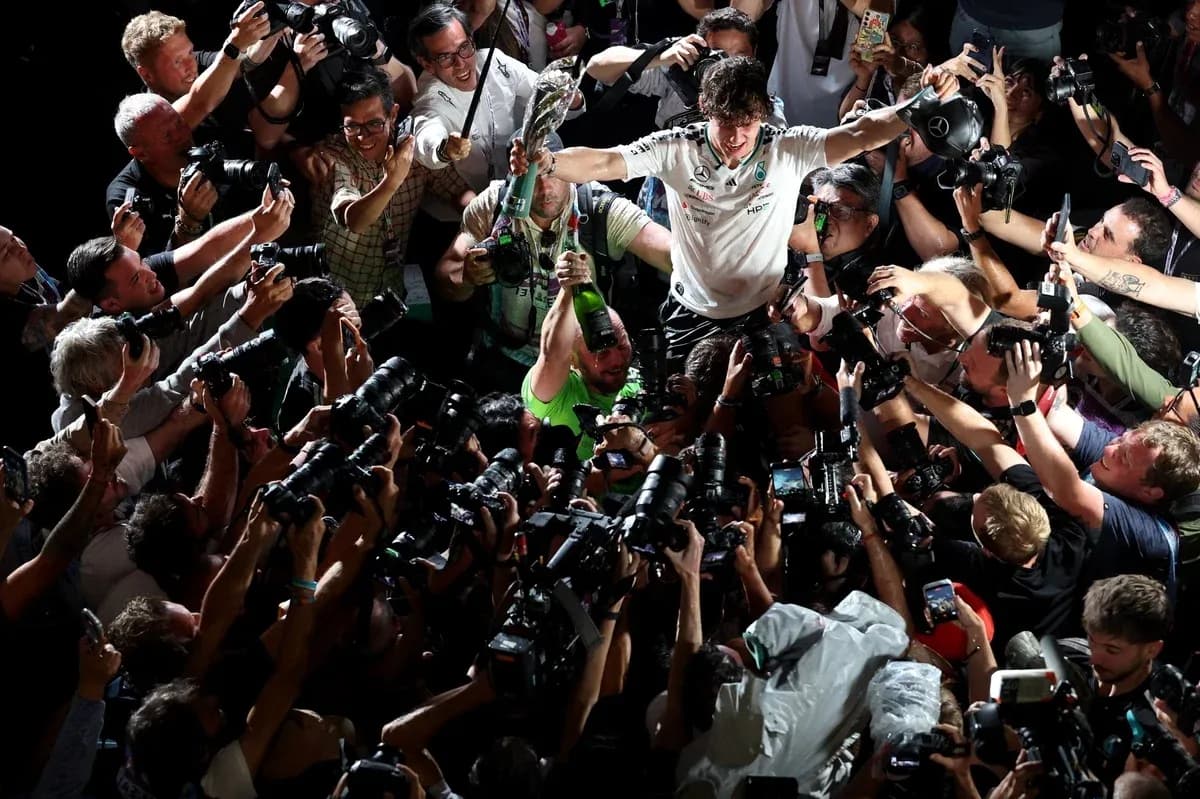
There were hugs. There were tears. There was the roar of a team celebrating a world championship – but there was something else too. The emotion of people who had watched a boy become a man in front of them, who had been grabbed, tickled, soaked in cream and, somewhere along the way, had fallen for him.
The trophy will sit in a cabinet. The journey that produced it is still unfolding. And the mechanics in that Mercedes garage know one thing for sure: the next time they feel a hand on their shoulder, they’d better be ready.