Aston Martin Enters Padel: F1's New Off-Duty Sport
Padel has quietly become the unofficial off‑duty sport of Formula 1. Drivers talk about it in press conferences, sneak in late‑night games on race weekends and, in Pierre Gasly’s case, even buy into teams. Now Aston Martin have decided that if the paddock is going to live on the padel court, they might as well bring the brand with them.
And they are not doing it halfway.
Aston Martin step onto the court
Ahead of the 2026 United States Grand Prix, Aston Martin announced a collaboration with racket sports specialists Padeltek, becoming the first F1 team to formally partner with a company focused on padel and pickleball.
The launch collection is tight and purposeful: three padel rackets, each with its own cover bag, with pickleball gear already pencilled in for 2027. To unveil it, Aston Martin didn’t just pose for photos. They booked a court in Austin and sent Jenson Button, Jessica Hawkins, Jak Crawford and Pedro de la Rosa out to play.
For Matt Chapman, Aston Martin’s Head of Licensing and Merchandise, the sport’s rise inside the paddock was too strong to ignore. It wasn’t just another logo opportunity.
“Padel was a particularly interesting opportunity given its incredible growth and the natural connection it has developed with the Formula 1 paddock,” he told F1.com. The appeal, he stressed, stretches far beyond a few drivers hitting balls between sessions. It is global, diverse and, crucially, opens doors to audiences that may never have tuned in to a Grand Prix.
Chapman was clear about one non‑negotiable: this could not be a lazy badge‑slap exercise.
“Authenticity was really important to us from the outset,” he said. The team wanted equipment that looked and felt like Aston Martin, but also stood up to the demands of serious players. That meant leaning on Padeltek’s technical know‑how and fusing it with the team’s design language. The brief was simple and demanding: unmistakably Aston Martin, but built to win points, not just sit on a shelf.
Rob Bloom, Aston Martin’s Chief Marketing Officer, sees a deeper link than shared branding. For him, the crossover runs straight through the mentality of both sports.
“There’s a natural crossover between the two sports, particularly when you consider the competitive mindset and the importance of quick thinking, precision and reaction times,” he told F1.com. For a paddock that spends its weekends living on the edge of performance, padel has become a way to keep that competitive fire burning in a looser, more social setting.
It is also, as Bloom put it, a way to bring people together: drivers, engineers, mechanics, even fans. A different kind of paddock, bounded by glass walls instead of pit garages.
Why padel fits F1 so well
Strip padel down and its appeal to racing drivers makes perfect sense.
The sport blends tennis and squash, played almost exclusively in doubles on an enclosed court wrapped in glass and fencing. The scoring mirrors tennis, but players serve underarm and swing solid rackets. The walls are live, so the ball can ricochet back into play, keeping rallies fast, frantic and unforgiving of slow reactions.
Communication, anticipation, trust in your partner – padel leans on all of it. So does Formula 1.
Mike Dale, Editor of The Padel Paper, has watched the sport’s boom up close and sees a clear pattern in who is picking it up.
“Padel has indeed become really popular with current and ex-sportsmen and women,” he told F1.com. The clubs springing up tend to be smart, high‑end venues – exactly the kind of places that sit comfortably with the glamour of F1. But the real hook, he argued, lies on court.
Padel is forgiving to newcomers, brutal to egos. If you have basic athleticism and decent hand‑eye coordination, you can feel competent very quickly. For elite athletes used to mastering skills at speed, that instant feedback is addictive. You don’t spend weeks shanking balls into the net; you’re in proper rallies within a session.
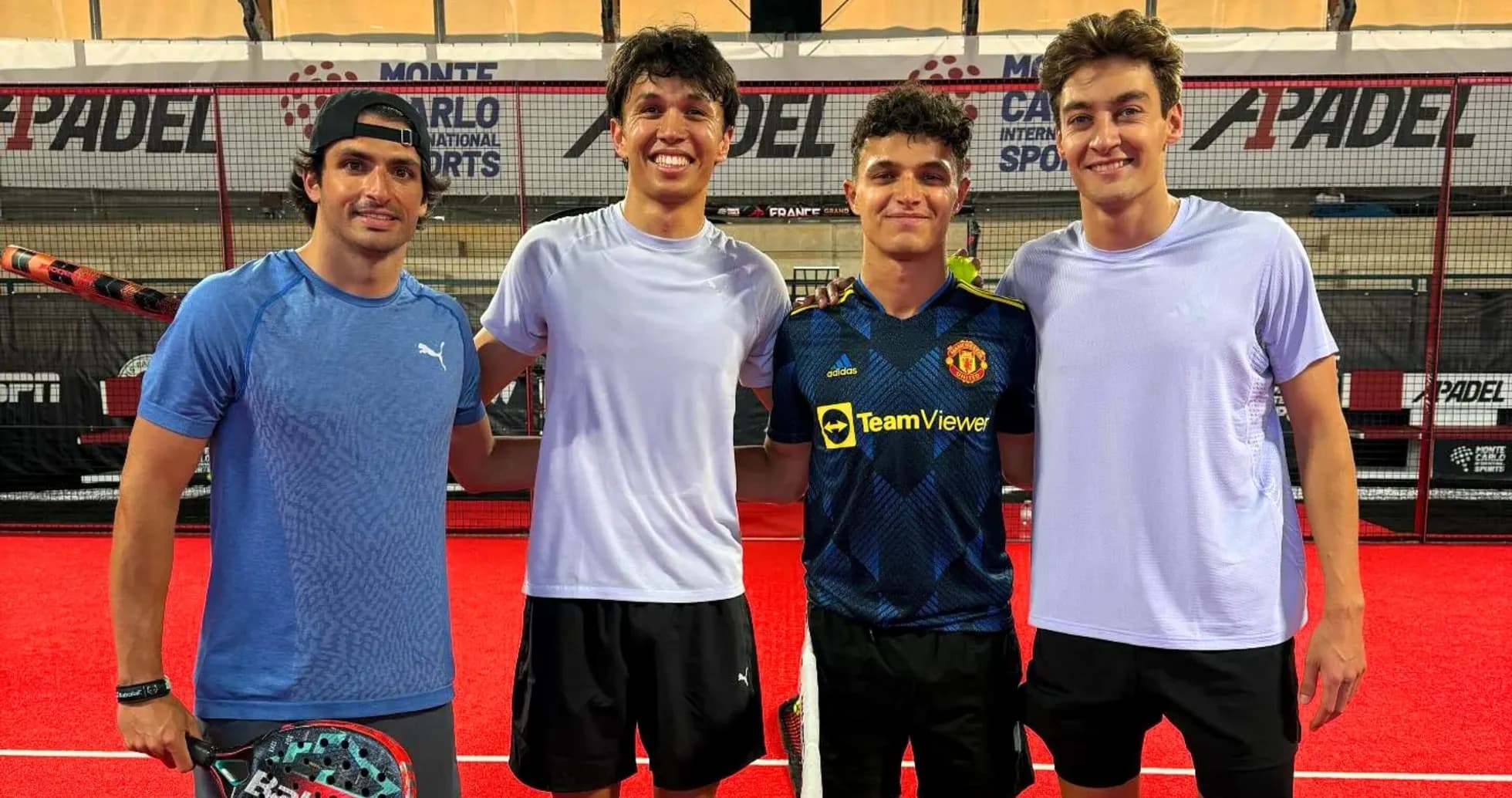
That mix of accessibility and intensity has pulled in a long list of F1 names. Lando Norris, Oscar Piastri, Carlos Sainz and Charles Leclerc are regulars. Ahead of the 2026 Singapore Grand Prix, Norris and Gabriel Bortoleto were spotted squeezing in a game, while Alex Albon revealed that the drivers have even created a group chat to arrange late‑night matches during race weekends.
The setting might be relaxed. The mindset is not.
Fernando Alonso has been playing for well over a decade. During the 2023 Mexico City Grand Prix weekend, he revealed that he and George Russell were unbeaten as a pair. “I’ve been playing padel for, 12 or 15 years,” Alonso said, noting that Russell was a relative newcomer but already “strong”. Their verdict on the partnership? “We are unbeatable at the moment! We play once and it’s 100% dominant wins!”
Russell framed it as both a competitive outlet and a coping mechanism for the long season. As the calendar stretches and the travel load bites, padel has become his way to switch off without losing that edge: a hobby, yes, but one with a scoreboard.
Piastri summed up the mood among the younger drivers with a smile: “We take it far too seriously, yes. But it’s very good fun and a good way of, you know, just keeping yourself awake.”
Gasly goes from player to owner
For most drivers, padel is a release. For Pierre Gasly, it is also a business.
The Alpine driver is an investor in 10Padel, a team competing in the Hexagon Cup, an international padel competition that has drawn a growing list of high‑profile backers. Gasly is not just lending his name; he is betting on the sport’s future.
“Padel is something I really enjoy in my daily life, and I believe it’s a sport with incredible business potential,” he told Reuters in February 2026. “I’m happy to be a part of its growth through my team.”
It fits a broader pattern for Gasly, who has spoken openly about using Formula 1 as a platform to explore life beyond the cockpit.
“Formula 1 opens many opportunities. While I wake up thinking about F1 and fall asleep thinking about it, there’s more to life. I want to discover other things and mix them with my passions,” he said.
In that sense, 10Padel is both an investment and an outlet – a way to turn a leisure obsession into something more structured and enduring.
Can F1 push padel to the next level?
The relationship between Formula 1 and padel is no longer a paddock in‑joke. Drivers are evangelising the sport on social media, Gasly is running a team, and Aston Martin now has its own line of rackets. The question is where that momentum leads.
For Bloom, the Aston Martin–Padeltek partnership is a blueprint for how teams can live in fans’ worlds outside the grandstands and TV broadcasts.
“Formula 1 has an incredibly diverse fanbase, and for Aston Martin, it’s about finding authentic ways to meet fans on their terms – that means in their communities beyond motorsport. Padel is a great example of that,” he said.
The idea is simple: if fans love a sport themselves, meeting them there deepens the bond. A padel racket becomes more than a souvenir; it is a way to feel part of the team every time you step on court. As Bloom put it, collaborations like this let Aston Martin join “the conversations and communities that matter” to their supporters, wherever those interests sit.
Dale sees the same effect from the padel side. Each new link with F1 – a driver investor, a branded collection, a courtside photo that goes viral – lifts the sport’s visibility.
“These F1 and padel partnerships help raise padel’s profile even more,” he said, pointing to a “massive investor buzz” around new clubs, technology, equipment and apparel launching almost daily.
The paddock has already fallen for padel. With teams now stepping in formally, the next serve might belong to the fans.