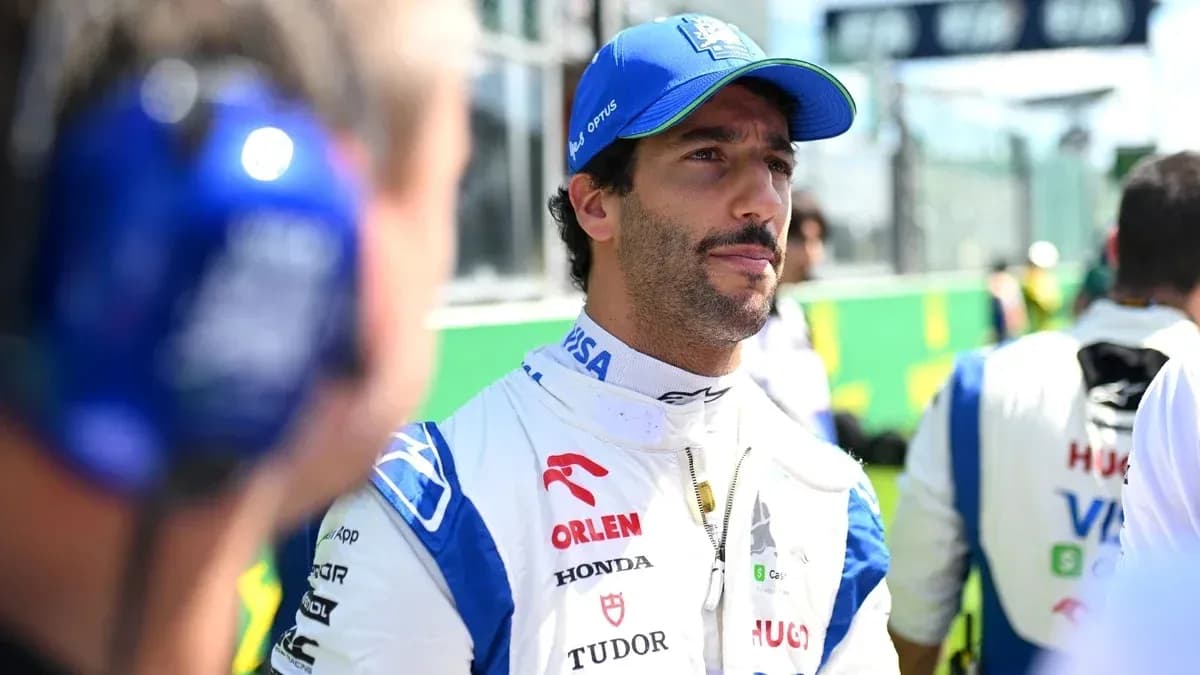
Daniel Ricciardo Reflects on His F1 Journey and Burnout
Daniel Ricciardo has always been one of Formula 1’s great talkers – easy smile, easy charm, the paddock’s resident optimist. On the Beyond The Grid podcast last month, he sounded different. Calmer. Older. Like a driver who has finally had the time to sit with the wreckage of his last few seasons and really look at it.
Two years out of the sport’s full glare have done what no debrief or simulator session ever could. They’ve given him distance.
The fall after the fairytale
Ricciardo’s final act in F1 was never meant to look like this. Losing his McLaren seat, drifting back to Faenza in the hope of forcing a Red Bull return, only to find the door closed and the speed gone with it – this was not the script he had in mind.
The raw numbers are brutal. Since that shock Italian Grand Prix win at Monza, the victory that briefly felt like the start of a rebirth, he never stood on the podium again in his final 70 races. One glorious afternoon, then a long, grey trudge.
Red Bull’s call to back Liam Lawson for the second RB seat underlined the finality. Ricciardo’s F1 story did not end on his own terms. And he knows it.
By the time he reached his last race, the 2024 Singapore Grand Prix, the emotional tank was almost empty.
“By that point, I was done getting knocked down; I was, I guess, getting beat up,” he admitted. He still felt the urge to prove something – mainly to himself – but the internal monologue had turned into a tug of war. One side screaming that he was strong enough, good enough, that he’d get through it. The other side whispering a darker truth: “I don’t love this anymore, I don’t really want to be here.”
He would try to sleep it off. Wait for that one good race, that one spark, that one weekend where the old fire flickered back into life. Sometimes it did. Briefly.
Chasing a fairy tale that never came
Ricciardo doesn’t pretend he was above the fantasy. He wanted the storybook ending.
“I still wanted the fairy tale, of course; I wanted to get back with Red Bull Racing and all of that, and I would have loved to have been team-mates with Max again and tried to race at the front again,” he said.
But beneath the dream, the reality gnawed at him. The grind was heavier. The performances harder to summon. The mental burden greater than at any point in his career.
“I knew deep down I was getting more burned out by it all,” he said. “Because of a lot of factors, it wasn’t as easy for me anymore to perform and compete at the level that I once did.”
He watched older drivers still operating at a ferocious level and understood that everyone’s curve is different. His was bending downward, and he could feel it.
“There was just a lot of pain, process, a lot of things that just were happening and had happened over the years, that I think just built up, and it was just very hard for me to shut all that out and do it.”
The moments he almost walked away
What’s striking now is how many times Ricciardo nearly quit long before Red Bull made the decision for him.
“The fear I had is, in hindsight and learning how content I am not having that anymore, what if they kept extending contracts for me, would I keep doing it, was I ever going to turn the tap off?” he said.
He can point to specific days when the thought of walking away wasn’t just a passing frustration but a fully formed decision.
“Monaco 2022 after the race, I’m sitting in my apartment, talking to my team, and I was like, ‘I don’t want to do this anymore, I’m done’,” he revealed. It wasn’t the first time. “I’ve had this conversation more than once over the years – Silverstone 2015 was another time.”
Both weekends were personal flashpoints. Monaco 2022, at a circuit where he had once dominated, he qualified only 14th and finished 13th for McLaren, four years on from his crowning win there. In Britain in 2015, a deleted lap time for track limits left him 10th on the grid, he tangled with Romain Grosjean at the start, then limped around the lower pack before an electrical failure finished the job.
Those were the days when the mask slipped, when the relentless self-belief that fuels elite drivers cracked just enough for doubt to seep in.
Surrounded by belief, starved of his own voice
Ricciardo is clear: if the paddock had left the decision entirely to him, he might still be out there, still trying to convince himself.
“You have people around you that tell you, ‘You’re great, you can still do it’, and you end up also believing a lot of these voices – I know they don’t mean harm, but you don’t really get a chance to have your own thoughts much,” he said.
That chorus of encouragement can be intoxicating, especially for someone who built his identity on late-braking heroics and audacious moves. Yet it also drowned out the quieter, more uncomfortable truth.
“I think that would have probably just continued and maybe I would still be racing – and that’s also a scary thought,” he added.
He doesn’t pretend to be at peace with the way it ended. “I still don’t like how it ended,” he said. But there’s a twist. “There’s also a part of me which is grateful they pulled the trigger, because I wouldn’t want to be doing it now.”
Humiliation, hidden in plain sight
If the sporting failure hurt, the emotional fallout cut deeper.
“You start racing at such a young age, and over the years you build, I guess, a ruthlessness – but that also is inward as well,” Ricciardo said. “You can be very harsh on yourself and expect a lot from yourself.”
He doesn’t sugarcoat his view of his own decline. “Failing – that was my view of it, failing, not performing to the level I needed to at the time, or not being able to finish out the season, or whatever – it’s then a sense of humiliation. I failed, and I didn’t do what I once could.”
The months that followed were a blur of public smiles and private collapse.
“Trying to deal with that, those next few months, I understood it as I was just hiding from the humiliation,” he said. People would see him out, laughing, drink in hand, playing the part. Inside, it was something else entirely.
“I was just hiding from what I really felt deep inside, which was a lot of pain and sadness. ‘It’s gone. I was once this kid that was hoping to fight for a world title and winning races; it’s gone’.”
For a driver who built his brand on joy, that admission is as stark as any statistic.
Stepping away to breathe
So he did something that doesn’t come naturally to racing drivers: he stopped.
Ricciardo stayed away from the paddock, from the constant noise of media and expectation. He prioritised being alone.
“In terms of driving, I was burned out, let alone emotions and all that, I was just tired,” he said. “I just knew I needed time from everything – even people.”
He went travelling, often solo. Hiking. Long trips with no cameras, no lap times, no engineering briefings. Just time.
“I just know that I needed to breathe on my own,” he said.
That space didn’t erase the past, but it did something more important. It allowed him to remember why he ever climbed into a kart in the first place.
The fan who found his way back
Last May, he walked into the Indianapolis 500 not as a driver, not as a guest of a rival team, but as a fan. No helmet. No pressure. Just noise, speed and spectacle.
“Being a fan again reminded me that I do love motorsports,” he said.
The eight-time grand prix winner who once dreamed only of world titles found himself in the grandstands, feeling the old thrill from the other side of the fence. It didn’t pull him back to F1. It did something subtler: it reconnected him with the sport without the suffocating weight of expectation.
What comes next for Daniel Ricciardo – Le Mans, another chapter elsewhere, or a life fully beyond the cockpit – remains an open question. For the first time in a long time, he sounds like a man who’s finally willing to let that question breathe.