F1's Evolving Narrative: How AWS Transforms Fan Engagement
At Circuit of the Americas, the story starts long before the lights go out.
On a quiet Austin morning, with no engines fired and no rubber laid down, Ruth Buscombe sat over a coffee at Soho House and summed up the weekend ahead in one line: COTA is where “F1 remembers to be fun.” No laps on the board. No title yet for Kimi Antonelli. Yet the narrative that millions would watch on Sunday was already taking shape.
Seven days later, Antonelli would seal the championship in Mexico. In Texas, he came within two points of wrapping it up early, winning the United States Grand Prix from pole on a razor‑sharp one‑stop strategy. The result looked simple on television. It was anything but behind the scenes.
Because the modern F1 story is no longer just written in garages and pit walls. It’s also written in code.
Opening the black box
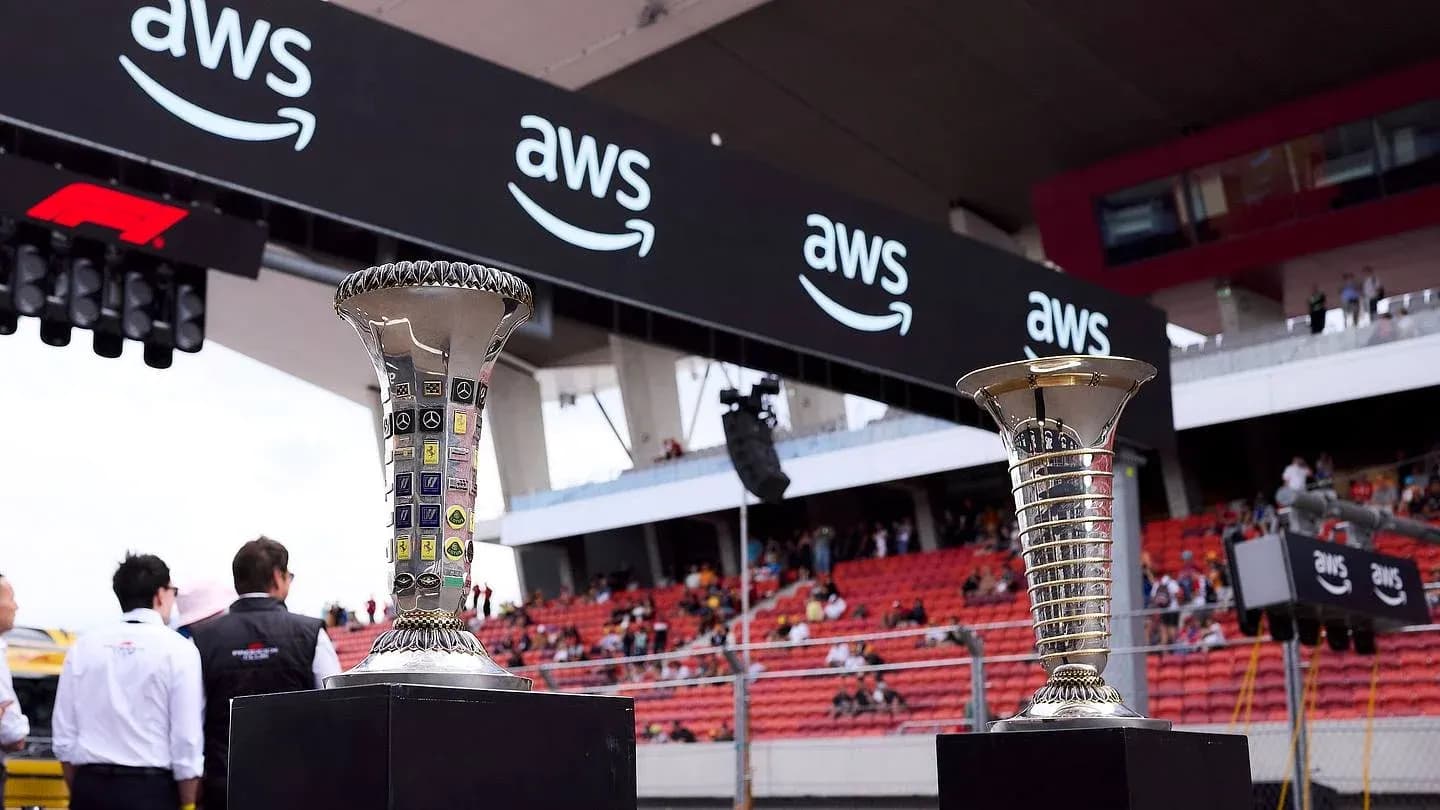
Amazon Web Services, F1’s technology partner since 2018, now sits at the heart of how that story reaches fans. The numbers are dizzying: two dozen F1 insight graphics, systems crunching millions of data points per second, and a broadcast layer that reaches 1.8 billion viewers worldwide in 2025.
In Austin, as at every stop on the calendar, AWS feeds on a blend of historical data, live telemetry and human expertise from people like Buscombe to prise open what used to be the sport’s black box. Strategy, tyre choices, race pace, track evolution – all those mysteries that used to live only in the heads of engineers now get translated into something a casual viewer can understand at a glance.
What fans see at home is the polished surface. The real intrigue lies in how that surface is built, who chooses what makes the cut, and how radically that process has shifted in just a few years.
COTA, casuals and a new kind of fan
Buscombe has been coming to Austin since the first F1 race here in 2012, long before Liberty Media rewired the sport’s relationship with the U.S. audience, before Apple TV joined the F1 ecosystem, and before AWS spotted a glaring gap in the broadcasts.
COTA matters to her because the place has character – a swagger that drivers, teams and fans all feel. But the American races matter for another reason: who’s watching.
The United States Grand Prix routinely drags in millions of casual viewers, many of them tuning into a full race weekend for the first time. This year, a chunk of that audience arrived not via F1’s own platforms, but through Apple TV.
That crowd is the sport’s future.
“Our sport is watched by millions of people worldwide. 43% are under 35. 42% are female, and the biggest growing demographic is females aged 11 to 25. So many of our fans haven't been watching for the last 30 years. They haven't even been alive for the last 30 years,” Buscombe points out.
That is the gap AWS is trying to fill. On the F1 app, it powers personalization. On the broadcast, F1 Insights effectively play the role of a race strategist on your sofa – breaking down why a car is quick or struggling, why one tyre compound beats another, and what sits behind a bold or conservative call on the pit wall.
“We want it to be that if you're turning on Formula 1 for the first time, or you've watched it for 20 years, you can learn something. To learn a sport is to love it. Once you understand the story, you can fall in love with it,” she says.
For AWS, that “falling in love” moment comes when a fan stops feeling like a spectator and starts feeling like a participant. In the COTA paddock, they showed what that future could look like with a prototype called AWS Insight Track.
It’s essentially a choose‑your‑own‑strategy simulator. Ask it, “What if Charles had pitted for hards instead of mediums?” and it rewrites the race. Wonder what might have happened if Lando Norris had stopped two laps earlier? It will show you. Suddenly, the fan is in the strategist’s chair, running the what‑ifs the teams agonise over in real time.
Insight Track isn’t on the market yet. But it’s a clear signal: this isn’t just about helping people love F1. It’s about letting them argue with their team’s “bad strategy calls” armed with the same type of tools.
From 300 sensors to one graphic
The tech that already has gone mainstream is Strategy Insights, powered by AWS Track Pulse. Those familiar graphics – pit window predictions, tyre life estimates, pace deltas – all start in the most brutal environment possible: on the car.
“There are 300 sensors on the car, 1.1 million data points per second per car per race, and on top of that, there are 20-plus weather stations capturing things like temperature, humidity, and wind speed. Every 150 meters, there are timing loops, so you get to see where the cars are on track at any particular time,” explains Michael Aghataher, who heads the F1 partnership at AWS.
All that information pours into F1’s Event Technology Center. From there, the feeds split: to Biggin Hill, to AWS for processing, then back again. The entire loop must complete in under 1.5 seconds, before a broadcast director makes the next call.
“Formula 1 then gets to determine how they can use this to maximize fan engagement, either through Track Pulse or through F1 Insights powered by AWS, which is the suite of graphics that the F1 production team uses to educate fans about what's happening on track,” Aghataher says.
The system faced a serious stress test at Sepang earlier this season. F1 hadn’t raced there in the AWS era, so there was almost no recent track data. The teams were guessing. So was Buscombe.
“I don't have a Formula 1 car, just like our fans at home don't. I prepared all of my technical analysis, all of my projections and all of my strategy based on the AWS tools that we had during the race weekend,” she recalls.
To viewers, it looked seamless. That’s the point. The complexity stays backstage. The clarity goes on air.
Earning its place on the screen
At the end of this pipeline sits Dean Locke, F1’s director of broadcast and media. His team ultimately decides which of these insights actually appears on your television.
Their reach is wider than F1TV or Sky Sports. They also run in‑venue channels at the track, pulling in around half a million viewers every weekend. More feeds, more content, more competition for space.
Locke treats every graphic as if it’s fighting for its life.
“Each graphic on the screen has really got to earn its real estate. I watch other sports and sometimes I'm not sure what the graphic is telling me, so we go through a rigorous process of: 'is this earning the real estate on the screen, is it telling the story, and is it completely understandable?'” he says.
Strategy Insights, launched only a few races ago, has already become a prime example of what he wants.
“The team is sitting in the gallery and all of a sudden I hear them go, 'hold on, why have they not stopped or why have they done this?' If you're asking it in the gallery, the fans are asking that at home, and we have to explain that. We have the data to use to create that story,” Locke explains.
The broadcast team is not just looking inward. They steal ideas shamelessly – from film, gaming, other sports, even from the upcoming F1 movie. New camera techniques, new visual languages, new ways to put the viewer in the car. The constant question: how do you take those cinematic tricks and make them work live, at 300 km/h?
The answer, more often than not, runs through AWS.
From racing purists to fashion and fandom
The partnership that began in 2018 as a straightforward tech deal has grown into something far broader.
“What we hadn't predicted was the explosion that came following 2020 with Drive to Survive. We entered the partnership for the racing purists and that has expanded into fandom, lifestyle and fashion, so we get eyeballs on our partnership that we didn't anticipate at the beginning,” Aghataher admits.
Drive to Survive exposed something: people wanted more story, not just more speed. Track Pulse arrived in 2021 as a response. As F1’s boom carried through 2023 and beyond, especially among casual fans, the demand shifted again. F1 Strategy Insights, launched in 2026, is the latest answer.
Aghataher now describes AWS as the “intelligence layer” sitting across the sport, forced to evolve at the same pace as its audience.
That layer has expanded beyond F1’s own walls. The FIA has named AWS its Official AI, Cloud, Computing, Machine Learning, and Cloud Infrastructure Partner across all its championships. The same tools that explain a tyre call at COTA can now help scrutinise track limits, speed violations and more.
The reach is total. From the stewards’ room to the sofa.
Writing tomorrow’s race today
Which brings us back to that quiet moment at Soho House in Austin. No cars on track. No title decided. Just Buscombe, coffee in hand, already sketching out Sunday’s narrative.
The same technology that helped her explain Antonelli’s one‑stop masterclass now runs through every corner of the sport. It’s being refined race by race, season by season, to tell the story better, faster, clearer.
“To learn a sport is to love it. Once you understand the story, you can fall in love with it.”
That line could sit on an AWS slide deck. It might as well sit over the entrance to the paddock.
Because in a world where 300 sensors whisper a million data points a second, the real contest isn’t just on track. It’s over who can turn that noise into the story that makes the next generation fall in love.