FIA President Ben Sulayem's Stance on Alonso's Future in F1
Mohammed Ben Sulayem has drawn a line in the sand. For him, the idea of Fernando Alonso slipping quietly out of Formula 1 in an uncompetitive car is simply “not acceptable”.
The FIA president, speaking in Madrid, made clear he does not want to see a two-time world champion and one of the sport’s defining figures bow out while mired at the back.
Alonso, 45, is out of contract with Aston Martin at the end of the season and has already said his decision on whether to continue in F1 will come “not soon”. The timing is awkward. The car is slow. The project feels stuck.
Aston Martin sit 10th in the constructors’ championship, paying the price for a misfiring chassis and a Honda power unit currently assessed as the weakest on the grid. For a driver who once fought Lewis Hamilton and Michael Schumacher at the sharp end, this is a brutal comedown.
Ben Sulayem, though, is not ready to watch Alonso fade away.
“There is no way we can allow Fernando to leave – Alonso, a great champion – to leave just because of the circumstances,” he said. “That's not the way to leave the stage. He has to be successful and then he leaves whenever he wants, not because he was forced to leave because of the performance.”
Those comments land in a paddock already wary of the FIA president’s reach. His tenure has been marked by rows over governance, including criticism that he has weakened internal checks and balances. So when he starts talking about what “we” can allow, people listen closely.
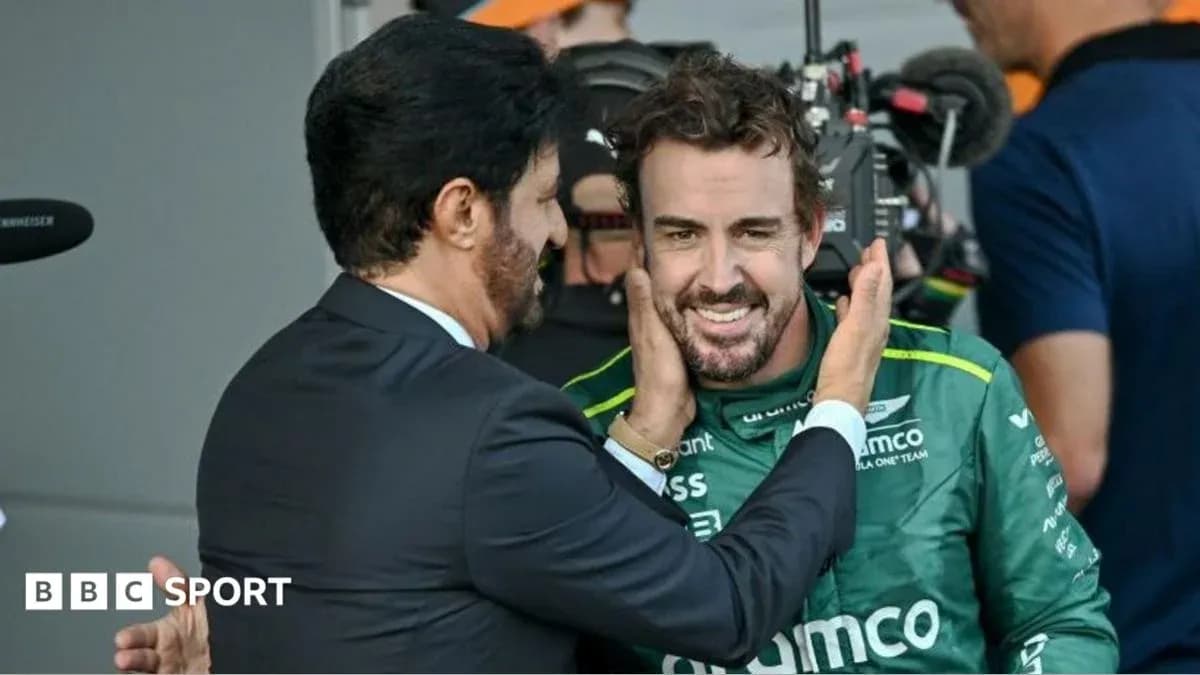
Ben Sulayem described a recent exchange with Alonso that clearly struck a chord with him.
“I will be speaking to him,” he said. “I said to him, I saw him very sad, and I said, ‘Fernando, I understand, it's not acceptable that you are coming to your own country and now after two times a world champion…’”
The frustration is shared. The Spaniard arrived at Aston Martin to front a bold project, one that briefly looked like it might carry him back to the podium on a regular basis. Instead, the team has slid backwards, and the Honda partnership has yet to deliver the firepower required.
Ben Sulayem then revealed the FIA had already moved within the rules to open a door for improvement.
“We did something earlier, in May, legally for the team towards the engine to go and improve,” he said. “And then I said to him: ‘I am not going to tell you what we are going to do. Please tell me what you want because you are the driver and come and tell me what do you want us to do to improve these results.’”
At that point, the FIA felt compelled to step in and clarify. A spokesperson stressed that Ben Sulayem was referring specifically to F1’s additional development and upgrade opportunities system – known as Aduo – rather than any bespoke favour for Alonso or Aston Martin.
Under Aduo, engine manufacturers whose power units are judged to be more than 2% down on the class-leading design are granted extra scope to upgrade. Honda currently falls into that category, giving Aston Martin some hope that the power deficit can be chipped away.
“It is a comment about the Aduo process and that he hopes Fernando Alonso stays in the sport,” the spokesperson said. “That is all.”
Even so, the optics are delicate. The FIA is supposed to sit above the competitive fray, administering the rules with independence and objectivity. A president talking about “not allowing” a driver to leave, or asking what he can do to “improve these results”, inevitably raises questions about where passion ends and overreach begins.
Pressed on that tension, the FIA line was firm: this is about emotion, not intervention.
“He is passionate about the drivers, having been one himself, and I really would not read too much into this,” the spokesperson added.
Strip away the politics, and the core of Ben Sulayem’s message is simple: Formula 1, in his eyes, should not lose Fernando Alonso like this. Not stuck in 10th place. Not nursing the slowest engine. Not trudging away from his home races looking “very sad”.
Whether the sport can offer him a competitive route out is another matter entirely.