Kimi Antonelli's Monza Masterclass: From 19th to Victory
Kimi Antonelli came home to Monza and tore the script to shreds.
From 19th on the grid to victory at the Temple of Speed, the 20-year-old Mercedes driver turned what looked like a damage-limitation exercise into a statement win that shook the championship. His seventh triumph of the season stretches his lead in the standings to 66 points over team-mate George Russell and, on this evidence, that gap might only grow.
From engine penalty to masterclass
The day had started badly enough. An engine penalty dumped Antonelli down to 19th, forcing Mercedes into a bold call: hard tyres from the start and a one-stop plan. Grind through the field. Survive the chaos. Make the strategy count.
Then came the red flag.
Charles Leclerc’s crash on lap 3 tore up the early race script and, at first glance, wrecked Antonelli’s plan. The restart shuffled strategies and left him on the back foot on medium tyres. The carefully plotted one-stop on hards suddenly looked like the wrong answer to the wrong race.
Inside the Mercedes garage, the computers still leaned towards caution. Toto Wolff explained that the models showed the one-stop strategy with a slight edge, with a two-stop only threatening late on without quite closing the gap. That was the theory.
Out on track, Antonelli wrote something else.
Fighting through the pack
The real difference, Wolff insisted, had nothing to do with software.
“The decisive factor was the ability to fight through the traffic,” he said, placing his young driver in the company of Lewis Hamilton, one of the sport’s greatest hunters in traffic. When the field bunched up, Antonelli didn’t hesitate. He attacked.
Lap after lap, he picked off rivals with a calm brutality that has become his trademark this season. No fuss. No panic. Just clean, clinical overtakes, the kind that drain resistance from a race. Once driver and car clicked into that rhythm, nothing seemed able to stop him.
By the closing stages, the comeback no longer felt like a surprise. It felt inevitable.
Wolff’s conviction – and a father’s instinct
Wolff admitted he had gone into the race with a quiet certainty. One of his drivers, he thought, would win at Monza. Either Russell, or the young Italian who grew up dreaming of this circuit.
“I thought one of the two would win. Either George or Kimi, because he’d be flying here at Monza,” Wolff said. “I could sense that yesterday.”
He was not alone. Antonelli’s father, watching his son’s form build through the sessions, had the same feeling. Across the weekend, the mood around Mercedes shifted. Sector times, long runs, body language – all the little tells pointed in the same direction. Something special was brewing.
But this is still a mechanical sport. One glitch, one misjudged stop, one stray safety car can wreck even the most promising weekend. That is why what Antonelli delivered on Sunday carried such weight. He took all the moving parts, all the risk, and imposed his will on the race.
From “deer in the headlights” to title favourite
This version of Kimi Antonelli is a long way from the raw, rattled rookie of last year.
Wolff did not sugar-coat that first season. It went to plan in the broad sense, but it was rugged. There were flashes of brilliance, then long, barren stretches. At one point, Antonelli went nine races without scoring a point. Spa, Wolff recalled, was “awful” for the youngster, a weekend that left him visibly shaken.
Monza, ironically, had already been a turning point once. It was here that Wolff first sat him down and delivered a blunt message: wake up. The faith, though, never wavered. Mercedes stayed committed, convinced the talent would surface once the turbulence eased.
The transformation came after the 2025–26 winter break. Antonelli returned sharper, harder, and far more complete. He exploded out of the blocks with a level of performance that, by Wolff’s own admission, nobody inside the team had fully anticipated.
The pressure from media, the glare of attention, the scrutiny of every mistake – he absorbed it. As Wolff put it, the “system” inside Antonelli processed and stored all of it, then turned it into fuel. Each setback became data. Each race, an upgrade.
“Like an AI agent”
Wolff reached for a modern metaphor to capture the speed of that evolution.
To him, Antonelli is “like an AI agent” – constantly learning, constantly improving, feeding off experience at a rate that leaves even seasoned observers surprised. At 20, with his cognitive and intellectual ceiling still rising, that capacity to adapt may be his most dangerous weapon.
The energy, the mentality, the behaviour: Wolff admitted he had not seen a package quite like this for some time. Inside Mercedes, they see a driver who no longer just reacts to a race, but bends it to his will.
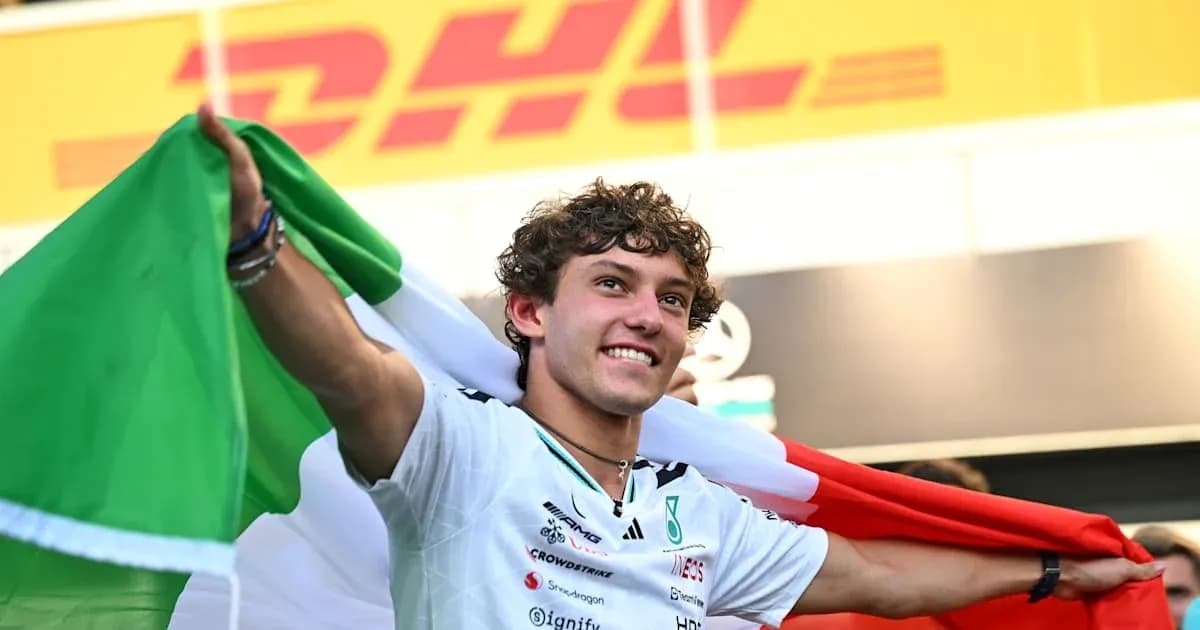
On Sunday at Monza, in front of his home fans, Antonelli did exactly that. From last-row penalty to the top step of the podium, he turned a potential setback into the defining drive of his season.
The championship gap now stands at 66 points. The question for the rest of the grid is brutally simple: if this is what Antonelli looks like at 20, how much longer can anyone keep him in sight?