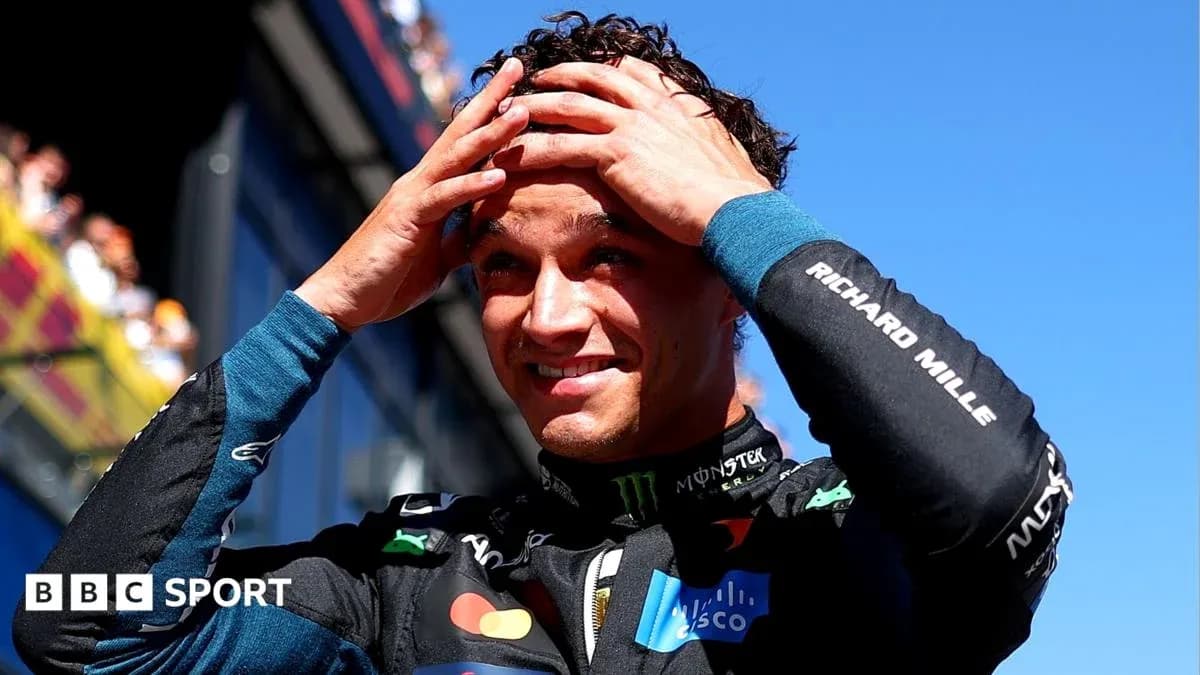
Lando Norris Claims Stunning Pole Position in Madrid
Lando Norris didn’t just steal pole in Madrid. He ripped it out of a race that looked nailed on for Mercedes and Kimi Antonelli, and did it with a lap so sharp even his own team were stunned by what they saw on the data.
On a brand-new street track that has already earned a reputation as “very high risk” and “less margin than Monaco”, Norris found perfection – and then very nearly threw it away in the final corner.
A lap on the edge
The numbers alone are outrageous. Between his two laps in the final part of qualifying, Norris found 0.701 seconds. From nowhere, McLaren were on pole at the Madring, on a day when the car had never truly looked like the one to beat.
Then comes the other statistic, the one that really underlines how ferocious this lap was. Norris beat runaway championship leader Antonelli by 0.011 seconds. Yet he reckons a mistake at the last corner cost him more than three-tenths.
“I thought I was in the wall,” he admitted of that final turn, a moment of over-excitement that almost wrecked the lap of his season. He over-pushed the entry, brushed right up against disaster, and still emerged on top.
McLaren team principal Andrea Stella, a man who has watched telemetry for 450 grands prix and worked with Michael Schumacher and Fernando Alonso, did not hold back.
He called it “a masterpiece” and “one of the most impressive laps” he has seen, and then pointed to the sting in the tale: Norris had lost around 0.35 seconds in that final corner.
“Which means,” Stella said, “that it would have been a pretty convincing pole position without this issue.”
Precision at full risk
What made the lap stand out on the screens back in the garage was not just the time, but the manner of it.
“The thing that makes the lap unique when you look especially at the telemetry is the precision,” Stella explained. “The braking, the speed you carry in entry, the striking of the kerbs, the going on power. Everything is executed with a pretty unique level of precision.”
Norris felt it from the cockpit. He talked about that elusive feeling drivers chase, when the picture in their head of the perfect lap suddenly matches what they are doing on track.
“Most tracks, you know what is perfect, what you really want to achieve in a perfect lap,” he said. “A very good day is when you get pretty close to that.
“Until the last corner, I think I matched that perfection level in pretty much every corner.
“So, yeah, it's a dream to achieve a lap like that. So it was easily one of the best laps I've ever done.”
He ran through it like a craftsman describing his tools: kerb hits, brake points, the way the car danced on the limit.
“Everything came together perfectly. I got the timing of everything so dialled in, with the kerb hits, how you hit the kerb, brake points, all of these things. It's so easy to make a mistake on a day like today and a track like this, but really I just got it right on the most important lap I had to do.”
The satisfaction was obvious. “Very excited, very pleased and it's not often you achieve a lap like today and it's a pretty awesome feeling when you do.”
No delta, just feel
There is another detail that underlines how Norris operates on days like this. While most of the grid lean heavily on the live “delta” display on the steering wheel – the reference that shows whether they are up or down on their previous lap – Norris switches it off.
“I don't need my delta,” he said. “I can feel when I do what I need to do and when I get a good exit, when I'm on the limit of things.
“When I'm kind of a bit uncomfortable in corners is normally when it's going pretty well. So, I could feel it and I feel like I just made all the right things. My feet were doing what I wanted, and that's normally when things are going well.”
On a tight, unforgiving layout like Madring, that instinct mattered.
A brutal new arena
The circuit itself is an oddity: a street track looping around an exhibition centre near Madrid’s international airport, 15 minutes from the city in light traffic, and a world away from the glamour of downtown.
As a driving challenge, though, it bites hard. The walls sit close, but the real menace comes from the way the barriers angle back towards the racing line on corner exits. Make a tiny error on the way in, and the punishment arrives when you’re already trying to get back on the power.
George Russell called it “very high risk” and said there was “less margin than Monaco”. That’s not a throwaway line from a driver who has seen plenty.
Despite two red flags in final practice – one triggered by Lewis Hamilton, another by Haas rookie Oliver Bearman – qualifying itself passed without incident. Few expected that. The tension was obvious before the session; the silence from the medical car and recovery trucks as the clock hit zero told its own story.
The race might not be so calm.
Pole with a handicap
This is Norris’ third pole of the year. The previous two, in Hungary and the Netherlands, turned into dominant wins. On those weekends McLaren were the class of the field.
This time, the picture is different.
“Tomorrow is going to be a very tough day,” Norris warned. “It's not going to be as straightforward as in Zandvoort and Budapest. There we were the quickest car. Yes, I'm on pole now, but we're not in the quickest car. It took a perfect lap to get me on pole by 0.011secs today.”
He also did it after losing almost all of second practice to a gearbox problem. While rivals pounded round on heavy fuel, building up long-run data, Norris sat in the garage.
That absence cuts two ways. It magnifies the quality of the qualifying lap. It also leaves McLaren lighter on information for the one thing that may define Sunday: tyre life.
Strategy on a knife-edge
The new surface at Madring is smooth and high-grip. The pit lane is the longest of the year – Norris joked that it was “6km long”, split in half by a building – so on paper, nobody wants to pit twice. A one-stop race is the default.
The tyres might not agree.
Degradation has looked brutal when drivers push early in a stint. Teams are already weighing whether they can afford to tiptoe in the opening laps to keep the race on a single stop.
Antonelli summed up the likely mood: “Probably is going to be grandmother driving in the first 10 laps – we saw how steep the degradation can be, especially if you push too early.”
The temptation to attack will be huge. The penalty for doing so could be fatal to a race strategy.
No way through
If there is one factor that swings the balance back towards Norris, it is this: overtaking here looks like a nightmare.
The straights are short. Many of the braking zones arrive while the car is still turning in. That combination kills the classic late-braking move.
Max Verstappen, who starts third, did not sugarcoat it: “There are no corners where you can pass.”
Drivers like the challenge. Norris called the layout “a little bit of everything”. High-speed sweeps, tight technical sections, walls closing in. As a qualifying playground, it works.
As a racing venue, it needs work.
Verstappen was clear that the corner entries must change if this place is to produce proper battles. “You can't overtake. So, in some places, the braking zones, like, they need to learn that it should never be that you have to steer, that you have to combine under braking, because it doesn't allow any kind of overtaking.”
Antonelli has already had a taste of how stubborn the traffic can be.
“It's going to be tight,” he said. “I spent two laps behind the Williams, trying to painfully get past. But it's just really difficult.
“And when you're behind, it's tough. Yeah, the only thing you can do is try to put pressure on the car in front, trying to make them do mistakes or make them deg a bit more.”
For Norris, that difficulty is pure opportunity. If he survives the launch and the first lap, the track might do half the defending for him.
The real work starts now
He knows it will not be easy. The McLaren is not the outright fastest car here. The margins are fine. The variables – tyre wear, battery deployment, track evolution – are many.
“It's a long race, it's a new track,” Norris said. “You've got to know what corners to push, what corners not to push, all of these different things, what the battery's then going to do.
“There's a lot of stuff that I've got to spend my time doing tonight. So, it's probably going to be a late one to try and get ahead of the game in some sorts. But the main part of the job was done today, so that's the bit I'm most happy about.”
The masterpiece lap has put him in position. Now comes the question that will define his weekend in Madrid: can he turn one of the best qualifying laps of his life into a win against a quicker car, on a track where nobody really knows how a race will unfold?