Lando Norris Claims Pole Position with Stunning Last Lap at Spanish Grand Prix
Lando Norris climbed out of the car convinced he’d blown it.
“Sorry, I fucked up man,” he told his race engineer Will Joseph over the radio, cursing himself for a wild snap of oversteer at the final corner. Joseph urged him to wait. Norris doubled down: “Fucking idiot.”
Seconds later, that “idiot” was on pole position for the Spanish Grand Prix.
A lap from nowhere
Nothing about the weekend hinted at McLaren owning Saturday. Mercedes had controlled every practice session, Ferrari lurking just behind. In Q1 and Q2, the fight at the top belonged to the Silver Arrows and Red Bull. McLaren, the papaya cars, were always a couple of tenths short, nibbling at the frontrunners but never quite biting.
Q3 began the same way. After the first runs, Norris sat only sixth, 0.446s off Lewis Hamilton’s benchmark. McLaren looked set for respectability, not shock.
Then came the final attempt.
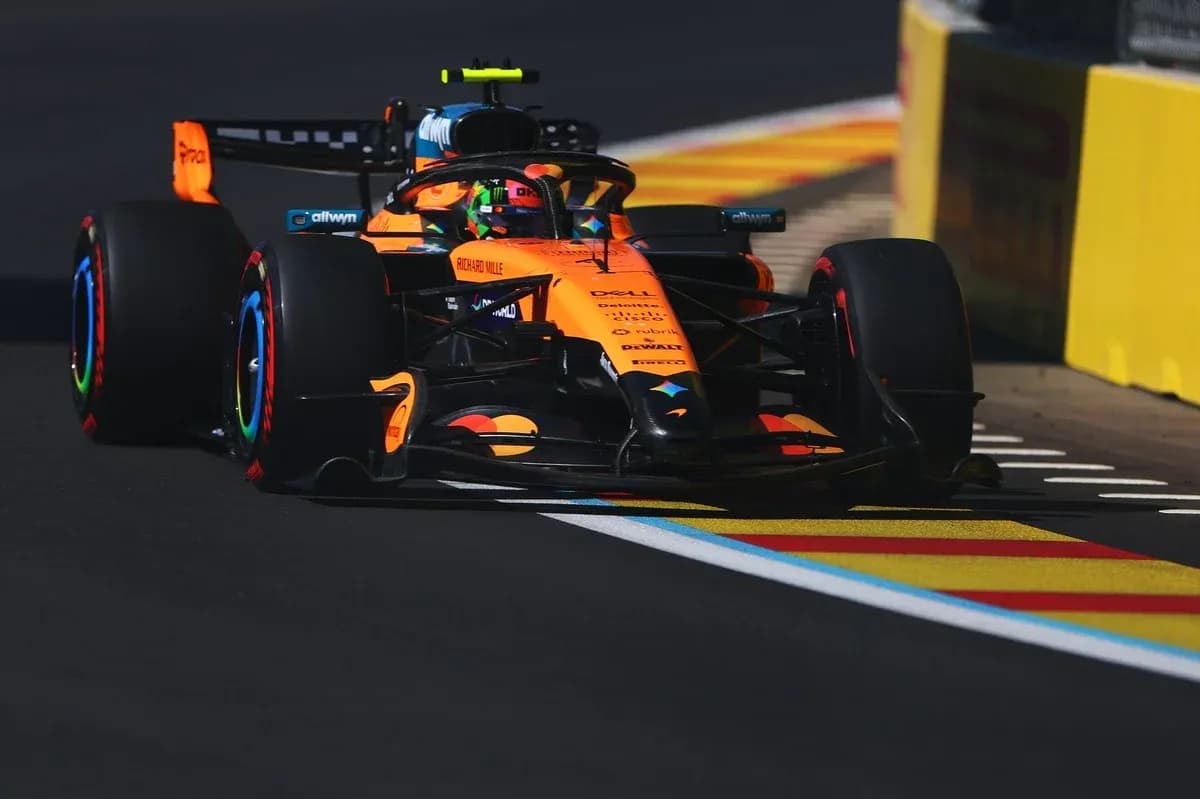
Norris found 0.701s on that last lap. Not a small gain. A transformation. He threaded the McLaren through Barcelona’s high-speed sweepers and fiddly low-speed sections with a precision that stunned even his own team principal, and snatched pole by 0.011s from Kimi Antonelli – a driver who, up to that point, had looked untouchable.
The margin? The kind you measure with a blink. The impact? Massive.
“One of the most impressive laps”
Andrea Stella has watched telemetry in 450 grands prix. He has seen title deciders, championship-defining laps, generational talents at full tilt. Yet he called Norris’s effort “one of the most impressive laps” he has ever witnessed.
It wasn’t just the result. It was the context.
“We were not honestly performing to the level of scoring a pole position,” Stella admitted. At no point had McLaren shown the outright pace to be the best car. Sector one, in particular, hurt: low-speed corners, kerbs, the kind of details that expose a nervous chassis and punish any driver who dares to lean on it.
“For the drivers it was a very difficult car to nail a lap,” Stella said. There were flashes of speed, “spells of potential,” but nothing that suggested a complete lap was in the offing when it mattered most.
Oscar Piastri’s qualifying underlined that struggle. The Australian could do no better than seventh, 0.470s slower than his team-mate. Same car, same session, same conditions. A gulf.
Norris bridged it with a lap that Stella described in almost forensic admiration: the braking points, the speed carried into the corners, the way he attacked the kerbs, the timing back on the throttle. “Everything is executed with a pretty unique level of precision,” Stella said. “Metre-by-metre.”
The mistake that made the masterpiece
That’s what makes the final corner so striking. The lap, by Norris’s own account, had been “just perfect” up to that point. Good exits. Clean kerb usage. Every tiny detail in a circuit that rewards detail freaks.
Then, at the very end, chaos.
“By the last corner, I just had a bit of a, I don’t know, a little moment,” Norris explained. “I think I got a bit excited in the car and I just overpushed the entry and, honestly, I thought I was in the wall.”
He caught the slide, somehow kept it out of the barriers, and blasted across the line convinced he’d thrown away a front-row start, never mind pole. The apology to Joseph came instantly, the self-criticism just as fast.
But the numbers told a different story.
Stella revealed that Norris lost more than three tenths of a second in that final sector “issue”. Three and a half tenths, gone in one corner. The same corner that had him thinking the car was destined for the barriers.
And still, he was fastest.
“The most impressive thing is the fact that it's a pole position despite having lost three-and-a-half tenths in the last quarter,” Stella said. Strip away the mistake and the lap would not just have been pole. It would have been emphatic.
On the limit – and then some
Why did the error happen? For Stella, the answer lies in just how hard Norris had pushed everywhere else.
“He just paid the price of the fact that the lap was coming, like, one second faster than any other lap,” the Italian explained. That pace dragged more from the tyres than usual. They were “tired” by the time Norris reached the final corner, and he drove into it with the same ferocity he’d used elsewhere.
“He oversteered in entry, and this means that he loses completely the racing line,” Stella said. Nothing clever, nothing calculated. Just a driver deep in attack mode, asking too much from rubber that had already given him almost everything.
“I don't think he knew [he was going to be in trouble]. I think he just was in attacking mode, but it was a bit too much for what the tyres had left.”
Pole, then, was not the product of a cushioned lap in a dominant car. It was the opposite: a ragged masterpiece, carved out on the edge of control in a machine that, over the weekend, never looked like it belonged at the very front.
Stella called it a masterpiece. The telemetry backed him up. The stopwatch sealed it.
In a season defined by relentless marginal gains and data-driven perfection, Norris found pole position the old-fashioned way – by driving beyond what the car, and the tyres, were supposed to allow.