Madrid F1 Debut: A Spectacle Without Racing
Madrid’s big F1 debut had everything. Noise, colour, a packed crowd, a fresh backdrop for a championship that’s constantly chasing new horizons.
What it didn’t have was a race.
For all the fireworks and fanfare, the Madring delivered a Sunday procession that felt painfully old-fashioned in all the wrong ways – a modern street track that somehow forgot the most basic requirement of modern Formula 1: give the drivers somewhere, anywhere, to race.
A blank sheet, wasted
What jars most is how avoidable it all was.
A new circuit in 2026 should be a designer’s dream. No legacy corners to protect, no immovable grandstands to tiptoe around. You start with a blank sheet and ask the most obvious question: where do we create the big stops, the long runs, the places where a driver can send it?
Madrid didn’t answer that. It sketched out an engaging, technical lap for one car on low fuel and fresh tyres. Great for qualifying. Great for F2 and F3 chaos. But when 20 heavy, aero-sensitive F1 cars lined up on Sunday, the track simply didn’t offer them a way to attack.
The ingredients around it were almost mocking. Strong transport links, a buzzing city, a layout that looks good on TV, a genuine sense of occasion. None of it matters if the only way past is through the pitlane or a strategy miracle.
Everyone could see this coming when the layout first appeared. The simulations, the onboards, the sector profiles – all the clues were there. Yet the design stayed as it was. The stakeholders stayed quiet. And the race played out exactly as predicted.
Tradition, for all the wrong reasons
Gary Anderson’s verdict was laced with a particular kind of irony. Madrid, he noted, has joined a very modern F1 tradition: adding another circuit where overtaking is almost impossible.
It’s almost impressive how consistently the sport manages this.
The Madring looks like a blast to drive. The drivers clearly enjoyed the challenge of threading the car through its narrow kinks and sweeps. It also avoided the crashfest some had forecast, even if Ollie Bearman’s FP3 accident exposed another issue: how slowly the place can reset after an incident.
Getting Bearman’s car away was straightforward. Fixing the Tecpro barriers was not. Watching a couple of marshals try to manhandle equipment designed to stop a 900kg car at speed was unintentionally comic and painfully time-consuming. In an era where every second of live TV matters, that kind of delay grates.
Then came the other modern quirk: the lottery of the VSC and safety car.
Lando Norris, by general consensus in the paddock, did enough to deserve this win. He had the pace, he had the car, and he had the race under control. Then Lance Stroll went off, the VSC came out, and the deck was reshuffled. Norris’s advantage vanished in a rulebook heartbeat.
This isn’t a new complaint, but Madrid underlined it. When a simple procedural quirk can swing a race that offers so few on-track opportunities, the frustration multiplies. As Anderson put it, the fix is not complex. The will to fix it seems to be.
A driver’s circuit that forgot the racing
From a pure driving standpoint, Jack Benyon had it right: as a qualifying test, Madring is superb.
On one lap, it crackles. High commitment corners, a rhythm that rewards bravery and precision, a layout that forces drivers to lean on every ounce of grip and confidence. It looks spectacular on onboards, and it’s clearly been drawn with the question, “How do we push these drivers to the limit?” front and centre.
But racing isn’t a time trial. And this is where the design unravels.
Street circuits are rarely generous with width, but this one pinches in all the wrong places. The spots where you’d want a car’s width of margin – the big braking zones, the natural overtaking points – are cramped or compromised. Drivers are forced into combined braking and turning, which looks dramatic but kills the clean, straight-line stops you need to launch a proper move.
The frustrating part is how close Madrid feels to being genuinely good. Shift a few walls. Flatten a couple of awkward braking zones. Carve out one or two straights that feed into clear, square-off corners. The character of the lap doesn’t have to die for the racing to live.
Macau was the obvious comparison all week. It’s another narrow, punishing street track where overtaking is scarce outside its key straights. But Macau is largely shackled to existing roads. Madrid wasn’t. It had room to breathe, to adjust, to build in the kind of zones where F1 cars can do what they’re built to do.
That freedom wasn’t fully used. That’s the missed opportunity.
The spectacle that never sparked
Matt Beer is no street circuit snob. If you can find charm in Valencia and nostalgia in mid-1990s Vancouver CART, you’re predisposed to cut these places some slack.
Madrid tested that patience.
On the surface, the event ticked plenty of boxes. Reports from trackside spoke of a vibrant, well-run weekend. Onboard, the cars looked alive, dancing over bumps and brushing walls. From a distance, Madring had presence.
The race itself sagged.
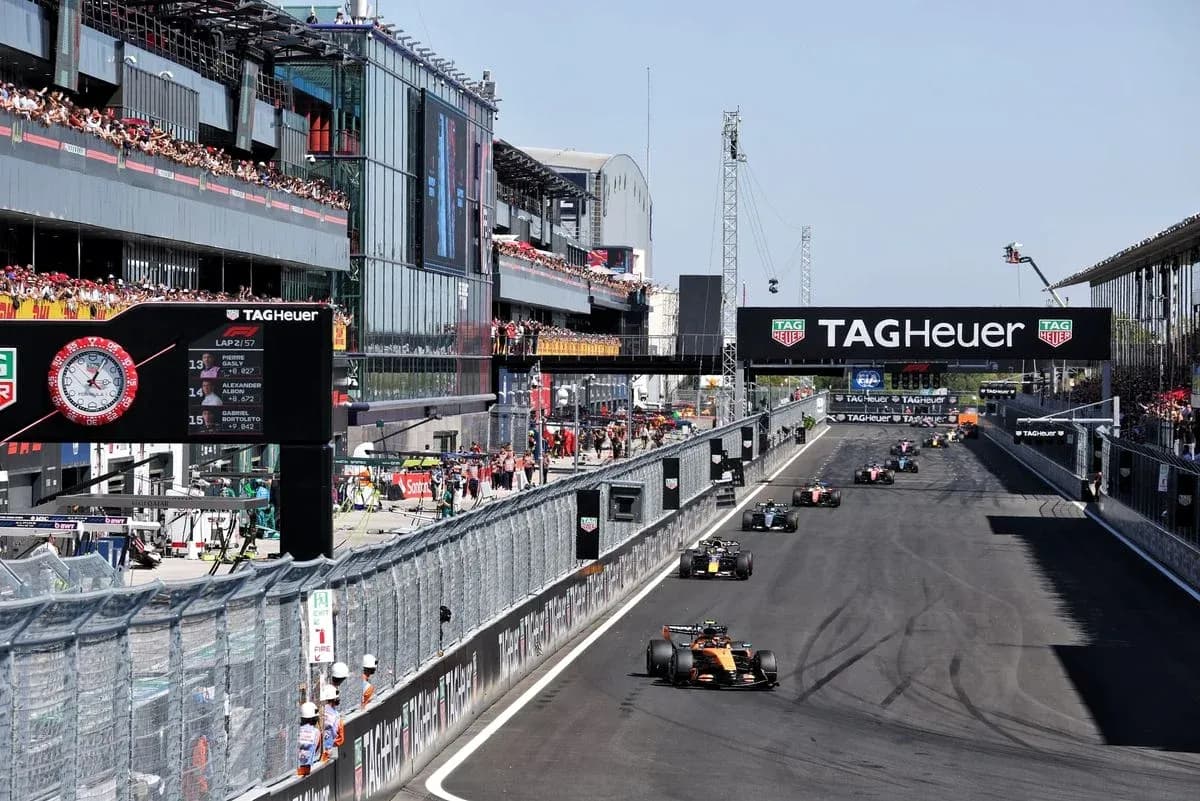
A McLaren as quick as Norris’s should not spend its afternoon trapped in a holding pattern once delayed. Charles Leclerc, running a no-stop strategy for so long, should not be able to cling on in front of faster cars with such ease. Yet that’s what the layout and the tyre behaviour allowed: long trains, limited jeopardy, and a field frozen into place.
Too many drivers were stuck in traffic they had no realistic way of escaping. Strategy became the only real weapon. Creativity behind the wheel had nowhere to go. Any hope of late-race intrigue was quietly smothered.
This doesn’t feel like a lost cause. A more aggressive tyre compound choice could transform the dynamic, forcing degradation, opening up pace offsets, and stretching strategies into conflict rather than alignment. A handful of targeted circuit tweaks could do the rest.
Because here’s the thing: people wanted to like this race. The setting, the novelty, the onboard footage – all of it invited optimism. But as the laps ticked by and the order calcified, that optimism drained away.
Boredom is the harshest verdict a new Grand Prix can receive. Madrid’s first F1 Sunday flirted with exactly that.
So the question now is blunt: does the sport accept another pretty, processional stop on a 24-race calendar, or does it use this as the jolt to finally demand that new circuits are built first and foremost for racing, not just for a fast lap and a postcard shot?