Madring Circuit: A Dangerous Gamble for Formula 1
The warning signs were there long before Formula 1’s trucks rolled into town.
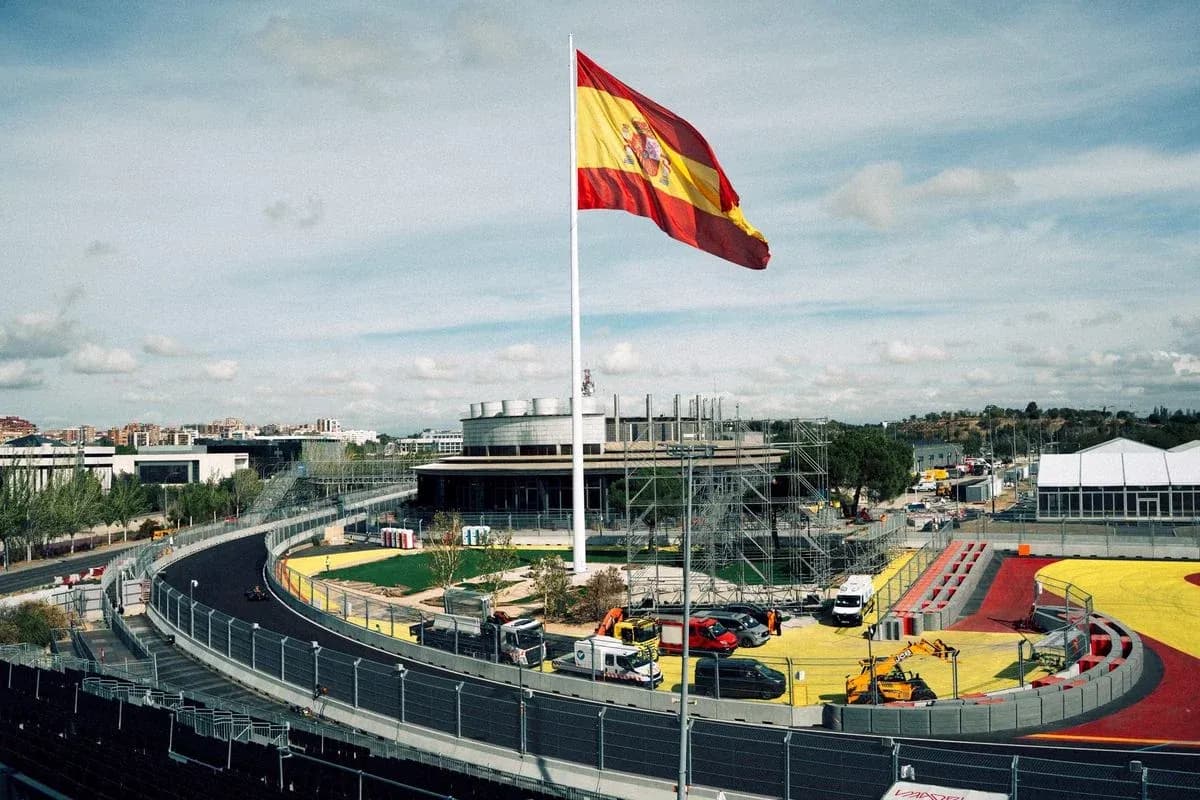
Madrid’s brand-new Madring circuit, the sport’s latest gamble in a booming calendar, already has a reputation – and it’s not a gentle one. Inside the paddock, one phrase keeps coming back: “car killer”.
This weekend will reveal whether that label is overblown or painfully accurate. Right now, the evidence is stacked on one side.
A track that bites back
The first proper dress rehearsal came not with F1 machinery, but with Formula 3. Two days of testing. Nineteen red flags. Three broken chassis. A pile of bent suspensions and repair invoices that had junior teams shaking their heads.
“OK, they’re Formula 3 drivers, but it’s a track that kills cars,” Williams team principal James Vowles told Spanish outlet Sport. The Race understands several F3 outfits were deeply unimpressed at how much they had to spend just to get through a test.
Yet that chaos was precisely why the session happened. The circuit’s organisers pushed for F3 to run there first, desperate to avoid a repeat of Las Vegas’s infamous debut, when loose drain covers destroyed Carlos Sainz’s Ferrari and shredded F1’s image on opening night.
Ferrari did squeeze in an F1 filming day back in July, but the surface and finishing were still rough. The F3 test was the first real stress test. It confirmed what the simulator laps had hinted at: this is no generic street track.
It’s narrow, old-school, and lined with walls that never seem to move away from you. Drivers compare it to a mash-up of Monaco, Macau and Jeddah. That’s not a comfort blanket. That’s a warning.
What worries teams most is not one notorious corner, but the spread of incidents. Those 19 red flags were scattered across the lap. There is no single “danger zone” to tiptoe through. There are many.
In an era of tight cost caps and carefully planned development programmes running to 2026, nobody wants to write off a chassis on a Friday. Or a Saturday. Or at all.
‘You have to push… or you’re nowhere’
Audi-backed F3 championship leader Freddie Slater left Madrid both exhilarated and wary.
“Because the corners that are there, they're so tight and they're not forgiving and also the walls come at you on the exit of the corners,” he told The Race. “They don't go away from you like most tracks.
“You're always coming out of the corner and trying to drive away from it instead of maximising, so it's a very tricky track to get in the rhythm of things.
“You have to push otherwise you're slow. So I think that's why it creates so many crashes because if you don't push you're just not on the limit.”
Then came the punchline.
“But honestly it's probably one of the best tracks on the calendar in my opinion… it’s got that old-school feeling to it. Kind of like some of the old-school UK tracks, Macau, places like that.”
Risk and reward, welded together.
The lap begins with a slow chicane reminiscent of Jeddah’s opening complex, then explodes into a flat-out run through Turns 3 and 4. That builds into the first major flashpoint: a high-speed second chicane that punished the F3 field relentlessly.
The wall waits on exit. The kerbs are vicious. And the temptation is enormous.
“That's where there's so much laptime because there's uphill section after that,” Slater said. The reward is massive time gain up the hill. The cost, if you misjudge it, is a wrecked car and a red flag.
This isn’t the forgiving, kerb-skimming fantasy of some sim laps. It’s a real-world version of the old Singapore Sling, only nastier: get the trajectory slightly wrong and you’re heading straight for the barrier.
To make it worse, the run into that chicane is one of only two full-throttle “straight mode” zones on the lap. Drivers will arrive at around 340km/h. Nobody wants an engine mode glitch there.
Survive that, and the circuit throws you under an underpass and uphill into another complex that claimed plenty of F3 victims. No let-up. No breather.
La Monumental: spectacular and savage
On paper, the headline act is La Monumental, the 24% banked corner that towers over anything Zandvoort can offer. In reality, the corners feeding into it might be even more treacherous.
A tight chicane, then a rapid right-left at Turns 10 and 11. Easy to misjudge, easy to overstep. Get it right and you’re fired into the banking. Get it wrong and your lap – or your car – is gone.
Pirelli’s chief engineer Simone Berra has already circled La Monumental in red. He calls it “the most severe turn” on the calendar, and the numbers back him up: tyre energy loads there are 20–30% higher than at Zandvoort’s banked section.
There’s a blind exit. It’s grip-limited, not power-limited, so the tyres and suspension take a pounding as the car digs for traction.
“It feels like I'm in an IndyCar [on an oval],” Slater said. In F3, it’s “just about flat”. In F2 and F1, that will be a much more marginal call.
The line choice is not obvious. Drivers experimented lap after lap during the test, hunting for a groove that didn’t bottom the car out over the crest and didn’t bleed speed on exit. From the outside, it looks straightforward. Inside the cockpit, it’s anything but.
And remember: this is only halfway around the lap.
The back end of Madring is no cool-down zone. Tight, technical corners, including a punishing right-hander at Turn 17, keep the pressure on. There is almost no room to back off and regroup. Go conservative, and you’re simply slow.
Monza F3 sprint winner Taito Kato summed it up succinctly: “If you want to gain laptime, you have to push until you’re close to the wall, so it’s risky but fun to drive.”
Dangerous, or just demanding?
Word of Madrid’s brutality spread quickly. At Monza, Carlos Sainz said drivers on the parade lap were swapping first impressions, and “everyone seemed quite shocked by the track that Madrid has come up with”.
Sainz, an ambassador for the event, meant it in a positive sense: shock that F1 has added a venue with genuine character, not another anonymous boulevard with painted run-off and copy-paste corners.
He also didn’t sugar-coat expectations. The F3 test may have been a car graveyard, but F1 machinery is a different beast. Still, Sainz admitted “we are all expecting safety cars, red flags and yellow flags in qualifying”.
Audi F1 driver Gabriel Bortoleto called it “a very interesting track, dangerous track, but at the same time very challenging”. Sergio Perez, by contrast, anchored the debate with a simple comparison: “I don't think it's any more dangerous than Jeddah, to be honest.”
Jeddah, of course, has had its own share of huge shunts, including Mick Schumacher’s 2022 qualifying crash that wrote off his Haas and ruled him out of the race. So “not any more dangerous than Jeddah” still leaves a wide margin for brutality.
What Madring does offer is a chance for drivers to make a real difference. It’s intensely technical, with a stack of low-speed corners demanding precision, bravery and rhythm. Arvid Lindblad called it “a real drivers’ track”, and the consensus points towards a qualifying session on a knife-edge, with Monza-style surprises very much on the cards.
The flip side? That same layout could strangle the race.
Qualifying thriller, Sunday question mark
Everything points towards a spectacular Saturday. For Sunday, the mood is far more cautious.
Tight corners. Very few long straights. A lack of heavy braking zones. Those are not the ingredients of an overtaking feast.
Energy recovery opportunities are plentiful, so battery deployment won’t be as decisive as at some venues. Think Hungary rather than Monza, Silverstone or Spa. Procession risk is very real.
Alex Albon didn’t bother dressing it up: “I don’t think there’s going to be any overtaking. I hope you guys got your fix in [Monza] and ignore next weekend.”
Chaos could still rip up any script. Safety cars, red flags, awkward restarts – this place has all the ingredients for that. And the undercard will be busy: F2 and F3 will stage five races between them, with F3’s title on the line and a grid full of young drivers desperate to impress.
There’s a precedent here. When F1 first went to Baku in 2016, GP2 produced one of the wildest weekends in its history, with 17 retirements across two races. F1, watching the carnage, dialled back the risk. The grand prix itself was tame. The now-familiar Baku chaos only arrived in later years.
Sainz, who raced there that weekend, remembers it well.
“We tend to be a bit more disciplined,” he said, pointing out that F1 drivers carry the responsibility of representing “a thousand people at the factory” and must protect scarce parts. The cars are faster and, in theory, easier to crash, but the mindset is different.
He also expects the field to help shape the event in real time. One FP1 session might be enough to trigger changes.
“Even by watching an FP1 live, we could almost sometimes text the race director and say this kerb there doesn't make sense, it's going to generate a crash or a bad moment,” Sainz said. Drivers, the FIA and race control will be learning together.
Still, with so many walls and so little margin, it feels inevitable that someone will pay a heavy price this weekend. There are not many places here to get it wrong and get away with it.
Madrid’s audition
Sainz has urged his colleagues to hold off on snap verdicts. He wants a “good debrief” after the race, a clear-eyed look at what worked and what needs changing.
F1, he says, must judge whether the level of chaos is “a bit too much”. Some things “will go greatly, and other things… don’t go as well”.
Miami is the cautionary tale and the inspiration. Its 2022 debut was, in Sainz’s words, “a bit of a disaster” before evolving into what he now calls a “great grand prix”. He wants Madrid to be given the same patience.
Patience, though, is not something every city gets. The calendar is crowded. Bids for new races keep coming. Even with a 10-year contract, Madrid knows this first impression matters.
What Madring already guarantees is drama on Saturday: a car-killing, wall-brushing, old-school qualifying session where bravery will be measured in millimetres and tenths.
The real test is whether Sunday can match that tension with actual racing – or whether F1’s newest showpiece becomes a spectacular one-lap theatre that turns into a slow-motion parade when the lights go out.