The Madring: F1’s New Bold Circuit in Madrid
Formula 1 rolls into unknown territory this weekend, and it does so in some style. The Madring, wrapped around the IFEMA Exhibition Centre on the edge of Madrid’s main airport, is the championship’s first brand-new venue since Las Vegas in 2023 – and it wastes no time making a statement.
Half street track, half permanent-style facility, the circuit snakes out from the exhibition halls towards a spectacular, sculpted ribbon of asphalt that drops and climbs with an 8% gradient between Turns 7 and 8. On paper it looked dramatic. Up close, it feels like a track built to test nerve as much as lap time.
Drivers won’t turn a wheel in anger for another day, but the early walkabouts and F3 running have already painted a clear picture: this is a layout with teeth.
La Monumental: the amphitheatre corner
All eyes, inevitably, are on La Monumental.
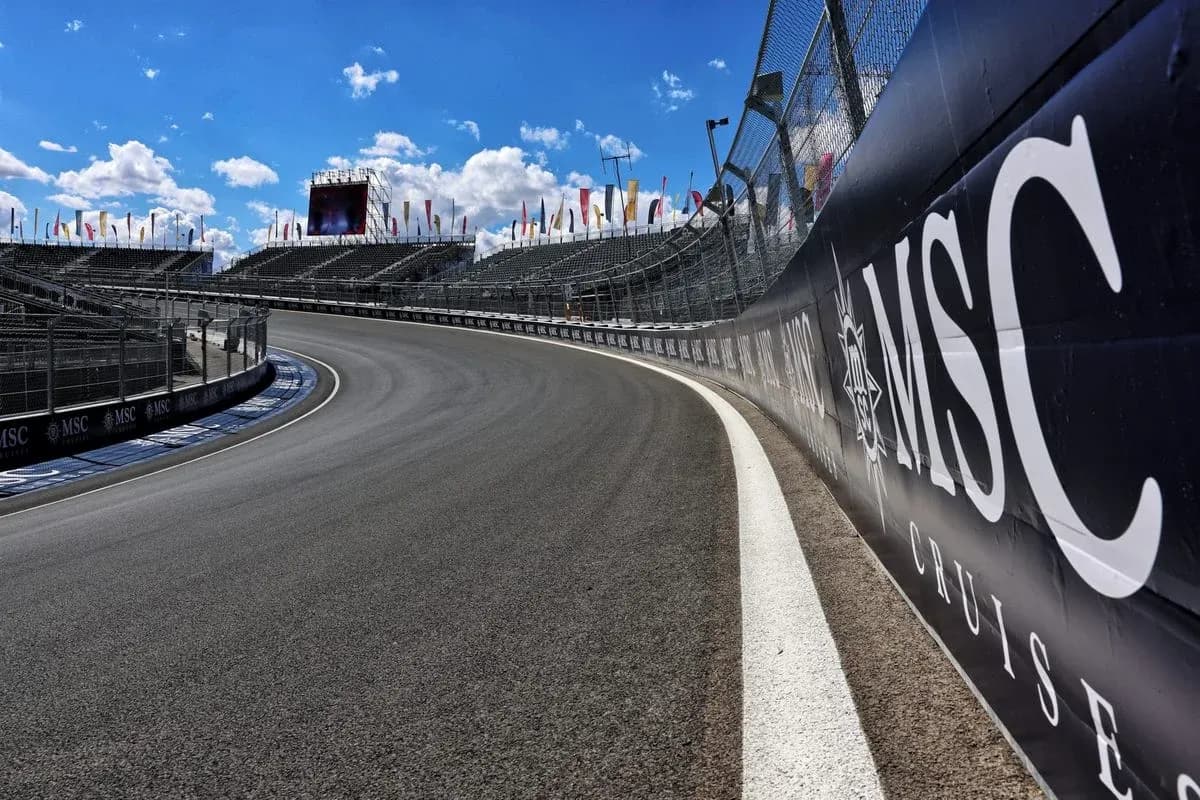
The long, banked corner has dominated every conversation since the first drawings were leaked. Teams, drivers and tyre supplier Pirelli have all circled it as one of the most technically demanding turns of the season, and now that the tarmac is down around its 550-metre sweep, it looks every bit the headline act.
Grandstands rise steeply above the banking, enclosing the turn in a wall of concrete and steel. A vast hospitality complex fills the inside, turning the corner into a bowl of noise waiting to happen. It carries the same enclosed, gladiatorial feel as the start-finish straight at Interlagos – that sense that the crowd is almost on top of the cars.
The big unknown is how many ways there are through it. If multiple lines prove viable on the banking, La Monumental won’t just be spectacular. It will be decisive.
The hidden sting at Turn 5
The Madring is not short of places to get it wrong. La Monumental will punish over-commitment, while the heavy-braking Turn 17 right-hander, approached off a fast left-hand kink, will ask drivers to balance aggression with precision.
Yet the real trouble spot may sit in a far less glamorous part of the lap.
Turn 5/6, a chicane at the end of the circuit’s fastest stretch from Turn 3, has already left its mark – literally. F3 testing has sprayed rubber and tyre scuffs across the exit, and the evidence is still there in the black arcs on the asphalt.
The chicane demands a sharp change of direction just as cars arrive at full speed. The kerbs need respect, but it’s the exit that truly bites: the barrier angles in to create a pinch point, narrowing the available road just as drivers try to get back on the power. Misjudge it by a fraction and there’s nowhere to go.
Silky surface, tight margins
For a street-based circuit, the Madring breaks from recent tradition in one crucial area: it’s smooth. Very smooth.
Track walks have revealed an asphalt surface far removed from the bone-rattling bumps that have plagued other temporary venues. Teams are unlikely to be forced into awkward compromises on ride height just to protect the cars from unseen ripples.
The boundaries, though, are unforgiving. In many sections, the walls themselves define track limits, hemming drivers in and leaving little room for error. Where there is space, painted kerbs step in to push cars back from the concrete.
To help keep things under control, the FIA has laid down the familiar ribbed paint lines seen at Jeddah, Miami and Austin, giving drivers a visual and tactile cue as they dance on the edge of the white lines. The circuit may be new, but some of the tools to tame it are tried and tested.
A paddock on a different scale
If the track is bold, the paddock is outrageous.
Teams arriving at IFEMA have spent as much time working out where they are as what set-up to run. The traditional straight run of garages has been ripped up; instead, the pit complex is broken in two by a 150-metre void between Williams and Racing Bulls, filled by the media and TV pen.
Behind the garages, the layout fragments again. Trucks and engineering offices are scattered through and around the exhibition halls, while team hospitality has been pushed into its own dedicated zone. Some outfits, slotted into air-conditioned indoor spaces, will work in cool, controlled conditions. Others – notably McLaren and Mercedes – operate outside, in the full glare of the Madrid heat.
The gaps between neighbours are just as striking. Williams and Racing Bulls, usually side by side, now sit a two-minute walk apart. For a paddock used to tight, linear order, this is a sprawling, unconventional maze.
A punishing pitlane and a tricky rejoin
The scale of the IFEMA complex has one more major consequence: the pitlane is enormous.
Measured between the two speed-limiter lines, it runs to 562 metres – one of the longest in Formula 1. And that’s before you add the extra distance on the way out, where the exit threads along a concrete barrier to the right before feeding the cars back in at Turn 3.
It’s a rejoin that will demand absolute focus. Drivers will be accelerating hard, tyres still building temperature, as they skim the wall and blend into the racing line of cars already at full speed.
Pirelli expects a pit stop to cost around 25 seconds, a figure softened slightly by the fact that the lane does not rejoin at Turn 1 but later in the lap. Even so, that number will loom large on every strategy wall.
A new circuit always brings intrigue. The Madring adds a sense of theatre – a track that looks built not just to host Formula 1, but to test how far the sport is willing to push its drivers on unfamiliar ground.