Mark Webber and Oscar Piastri: The End of a Unique F1 Partnership
Mark Webber and Oscar Piastri: a defining Australian F1 partnership is over. Seven years of tight-knit guidance, careful protection and rapid ascent have been brought to a clean, if surprising, halt.
No feud. No drama. But a seismic shift all the same.
The end of a rare, old‑school alliance
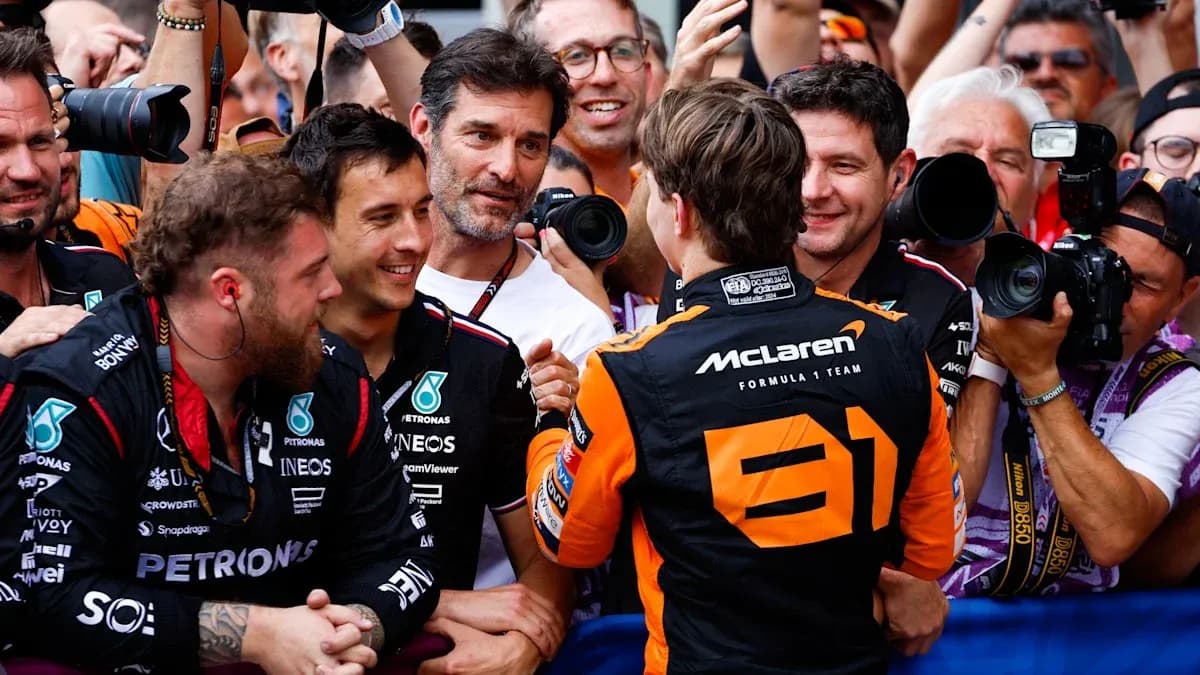
Webber has been stitched into Piastri’s story from the moment the young Melburnian started carving through the junior ranks. Through JAM Sports Management – the agency Webber founded with his wife Ann Neal and administrator Jason Allen in 2019 – the former Red Bull star didn’t just broker deals. He helped build a career.
It was an unusually intimate arrangement for modern Formula 1. While today’s drivers tend to disappear into sprawling agencies that juggle sponsors, media and contracts across multiple sports, Piastri had something different: a former grand prix winner and the architect of that winner’s own career, working almost exclusively on him.
Neal’s role in that cannot be overstated. She spent seven years grinding through Europe to get Webber into F1 back in 2002, using a hard-earned network to secure funding and seats. That same tailored, protective model was then applied to Piastri, this time from the other side of the world. It worked. Spectacularly.
The partnership carried Piastri from junior promise to F3 and F2 titles in consecutive rookie seasons, and then into Formula 1 as one of the most polished graduates the series has seen in years. Webber’s presence – in the garage, in the debriefs, in the quiet conversations between sessions – became part of the Piastri package.
Now it’s gone.
A natural evolution – or a risky break?
The first sign of change came at the start of this season. Webber began to step back from regular trackside duties, choosing to focus more on Piastri’s commercial world than on the week‑to‑week grind of the paddock. The shift seemed logical. Piastri, now an established grand prix winner and a championship contender in 2025, no longer needed hand-holding through every F1 nuance.
As the McLaren driver’s experience deepened, the nature of the guidance he required changed. The detailed race‑by‑race mentoring that defined his early F1 years gradually gave way to a more conventional structure.
In Webber’s reduced trackside absence, other familiar faces moved into the foreground. Pedro Matos, Piastri’s race engineer from his Formula 2 days, and performance coach Emma Murray – whose client list includes Dustin Martin, Scott McLaughlin and Cate Campbell – assumed greater responsibility for his race‑weekend preparation. The inner circle shifted from mentor-led to performance-led.
Now the shift is complete. The two camps have formally split, ending a seven-year association with JAM Sports Management.
A dip in form at the worst possible time
The timing raises unavoidable questions. Since Webber eased off his trackside involvement, Piastri’s form has stalled. The 2026 campaign has been a grind, not a coronation.
After rising to genuine title contention in just his third season, the expectation was clear: this year, Piastri would go toe‑to‑toe with Lando Norris for supremacy inside McLaren and, by extension, for the championship itself. Instead, his season has sagged.
He sits seventh in the drivers’ standings, under heavy pressure from Red Bull’s Isack Hadjar, who is closing fast. Piastri’s last win remains the 2025 Dutch Grand Prix. He has only two podiums this season, and none since Miami in May. For a driver tipped to be a perennial winner by now, that’s a stark return.
Across the garage, Norris has rediscovered his edge in the new engine regulations. A gritty victory in Brazil – his third of the year – has lifted him to sixth in the championship, just 33 points behind second‑placed Max Verstappen. Piastri may be only one spot back in seventh, but the gap between them is enormous: 94 points.
The numbers paint the contrast sharply. Norris’s average grand prix finishing position sits at 4.1. Piastri’s is 6.8. The head‑to‑head tally in all races stands at 16–4 in Norris’s favour.
Correlation is not causation, but the narrative is hard to ignore: as Webber’s direct influence has receded, so too has Piastri’s sharpness at the very front.
Life after Webber
Off the track, the implications are just as significant. Webber’s management style was famously protective of Piastri’s time away from the circuit. With McLaren controlling much of his race‑weekend schedule, JAM’s value often lay in what it kept off his plate – the sponsor days that didn’t happen, the media commitments trimmed, the mental clutter filtered.
That layer of protection will now be reimagined by a new team.
Piastri has not yet revealed his fresh management structure. There is no contract emergency: he is tied to McLaren until the end of 2028, so immediate negotiations are not driving this break. The change is about how he operates, not where he races.
What will shift is the rhythm of his working life. A new agency or advisory group will bring different priorities, a different reading of how hard to push the commercial side, how much to open him up, how much to shield him. For a driver still moulding himself into a long‑term title force, those margins matter.
What won’t change is history. Webber and Neal played a decisive role in turning a talented Australian karter into a multiple grand prix winner and a central figure in F1’s next era. Piastri knows it, and has never been shy about saying so.
Now he steps into the next phase without the figures who helped build the path beneath him. The safety net has gone. The question is simple and brutal, the kind that defines careers in this sport:
Can Oscar Piastri prove he no longer needs it?