Monza: A Temple of Speed and Racing History
The story of modern Formula 1 begins on Italian soil. Monza, 1950. Giuseppe Farina, in an Alfa Romeo, charging towards history in front of his own people. He wins the Italian Grand Prix and with it the sport’s first world championship. No one else has ever clinched the title on home asphalt since. From the very start, this place wrapped itself around the mythology of the sport.
Three years later, the names on the grid read like a roll call of racing royalty. Farina again, this time in Ferrari colours. Juan Manuel Fangio in a Maserati. Alberto Ascari in another Ferrari on the far side. Between them, those three men would carve up the first eight world titles. At Monza in 1953, Fangio took the win, but Ascari walked away with the championship. The circuit already had its own way of deciding who got the glory and who settled for the bigger prize.
By 1956, the track’s notorious banking framed the drama. Fangio, Stirling Moss, Peter Collins – giants of their era – were thrown high onto the steep concrete curves. Moss, in a Maserati, won that day. Fangio and Collins shared second after the Briton handed over his Ferrari mid-race, sacrificing his own shot so his Argentine team-mate could secure the points that delivered a fourth world title. Monza rewards bravery, but it has always demanded something in return.
Sometimes, the cost was unbearable. In 1961, Ferrari’s Wolfgang von Trips arrived on the brink of a championship that seemed inevitable. Two laps into the race, he collided with Jim Clark’s Lotus. Von Trips’ car flew off the track and into the crowd, killing the German and 14 spectators. The image of him before the start – calm, composed, unaware – sits in brutal contrast to what followed. The title he was about to claim never came.
Monza is also a place where racing becomes family history. In 1967, Graham Hill sat in the Lotus pits, fiddling with his helmet and visor, surrounded by his family. His wife Bette, their children, and a six-year-old Damon Hill at the front of the group. The boy in the picture would one day become a world champion himself, in 1996. A casual family moment frozen in time at a circuit that rarely does gentle.
On track, the old layout turned races into high-speed dogfights. Before the chicanes, slipstreaming ruled. In 1969, Jackie Stewart’s Matra beat Jochen Rindt’s Lotus, Jean-Pierre Beltoise’s Matra and Bruce McLaren’s self-run car in a drag race to the line. The top four covered by less than two tenths of a second. At Monza, the stopwatch sometimes struggles to keep up.
A year later, the atmosphere darkened again. Nina Rindt sat in the pits in 1970, stopwatch in hand, timing her husband Jochen during practice. Not long after that serene scene, Rindt died in a crash on the approach to Parabolica, almost certainly because of a suspension failure on his Lotus. Weeks later, the points he had already banked carried him to the title. Formula 1’s only posthumous world champion. Monza does not forget that.
The finishes stayed wild. In 1971, BRM’s Peter Gethin won a race that still defies belief on paper. He crossed the line just ahead of Ronnie Peterson’s Lotus, Francois Cevert’s Tyrrell, Mike Hailwood in a Surtees and Howden Ganley in another BRM. Five cars separated by six tenths of a second. A photo finish stretched to breaking point.
Away from the official schedule, the track found room for its own kind of theatre. In 1973, team owner Frank Williams organised a race around the circuit for drivers and team members. James Hunt led the pack at the start, bare-chested runners trailing behind, but it was Williams himself who took the £750 prize. Even the off-track contests at Monza carried a competitive edge.
By 1976, the circuit became the stage for one of the sport’s most remarkable comebacks. Niki Lauda arrived still bearing the raw scars of his near-fatal crash at the Nürburgring just six weeks earlier. The Austrian Ferrari driver climbed back into the car at Monza in obvious pain, refusing to surrender his title fight with McLaren’s James Hunt. Lauda finished fourth, extending his lead, but by the end of the season Hunt edged the championship by a single point. Lauda’s courage that day, though, remains one of Monza’s defining images.
Tragedy struck again in 1978. At the start, a multi-car accident erupted behind the leaders. Ronnie Peterson’s Lotus smashed into the barriers and caught fire. Trapped in the wreckage with severe leg injuries, he had to be pulled out by fellow drivers. His condition initially did not seem life-threatening, yet delays and complications followed. The next morning, Peterson died from an embolism. On the same day as the crash, his team-mate Mario Andretti clinched the world title and later summed up the brutal duality of the sport: “Unfortunately, motor racing is also this.”
Monza has always belonged to Ferrari as much as it does to Formula 1, and nowhere was that clearer than in 1988. McLaren had dominated the season, winning every race – except this one. Ayrton Senna, leading in the closing stages, moved to lap Jean-Louis Schlesser, standing in for Nigel Mansell at Williams. Schlesser clipped the Brazilian’s McLaren, sending him off with two laps to go. The error opened the door for a Ferrari one-two, Gerhard Berger ahead of Michele Alboreto, just weeks after Enzo Ferrari’s death. The crowd’s roar carried grief and pride in equal measure.
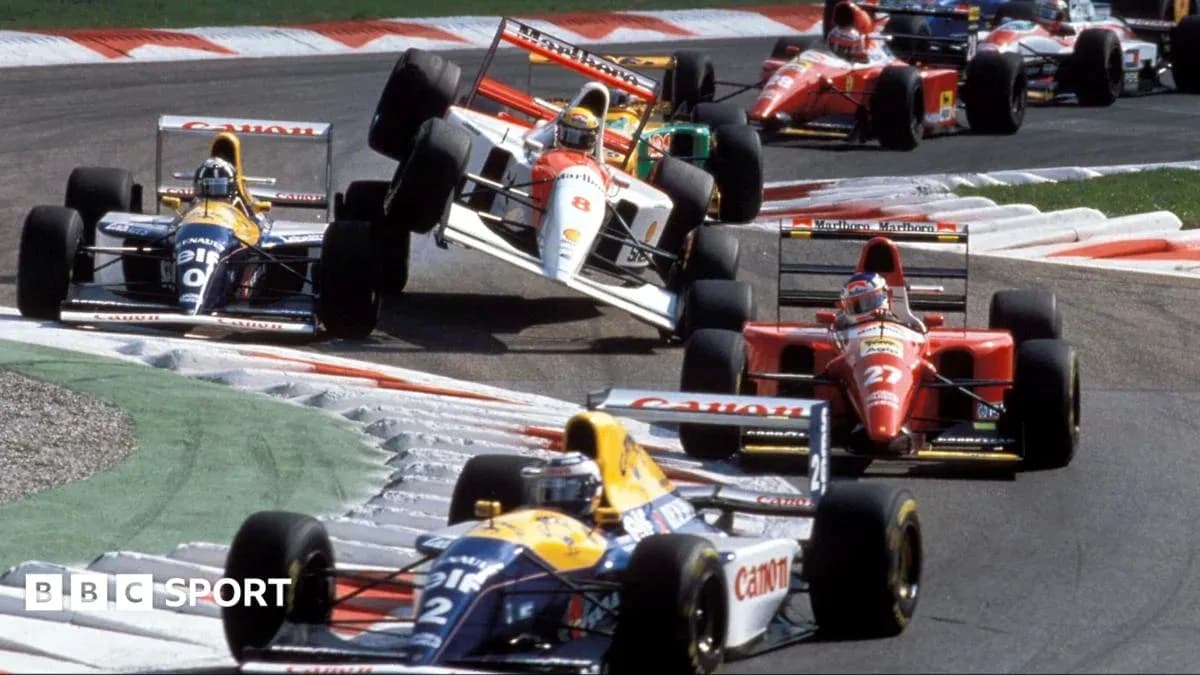
That same chicane caused more chaos in 1993. At the start, Senna again tangled with a Williams, this time driven by Damon Hill. Both cars survived the clash. Hill recovered, regrouped, and went on to win, turning a fraught opening into a decisive afternoon.
The same year delivered one of Monza’s most surreal sights. Christian Fittipaldi’s Minardi clipped team-mate Pierluigi Martini as they sprinted to the finish line. Fittipaldi’s car flipped, somersaulted through the air, and landed upside down, still sliding across the track. Remarkably, both drivers walked away unhurt. Fittipaldi’s momentum carried him across the line to take eighth, one place behind Martini. At Monza, even the crashes obey the timing beam.
In 1999, the circuit reduced a champion to tears. Mika Hakkinen, leading comfortably in his McLaren, spun off and retired. He sat by the trees, helmet off, devastated, convinced he had just thrown away the title. The mistake did not cost him in the end; he regrouped and beat Ferrari’s Eddie Irvine to the championship. The image of him weeping at Monza, though, captured the raw pressure that comes with chasing greatness here.
For Ferrari, the turn of the millennium marked a different story. In 2000, Michael Schumacher won at Monza, triggering a tidal wave of red on the start-finish straight as the tifosi flooded the track to celebrate. That victory became a key step on the path to his first of five consecutive titles with the team. The circuit, the driver, the car – all in perfect alignment.
The modern layout, chicanes and all, has not tamed the chaos. The first corner remains a funnel of risk. In 2011, the opening lap again turned into a mess of cars pointing in every possible direction, drivers jostling for space where there simply wasn’t any. Monza squeezes them all into a single, unforgiving decision point.
Even in the hybrid era, with safety standards transformed, the track still finds ways to shock. In 2021, during a season crackling with tension between Max Verstappen and Lewis Hamilton, the two title rivals collided at the first chicane. Verstappen’s Red Bull launched over the Mercedes, the rear of his car landing on Hamilton’s cockpit. The halo device took the impact and likely spared the Briton serious injury. A brutal collision, a modern safety miracle, and another indelible image for Monza’s archive.
From Farina’s first title to Verstappen and Hamilton locked together in the gravel, Monza has never been just another stop on the calendar. It is a place where speed exposes everything – courage, frailty, genius, and the thin line that separates triumph from disaster.