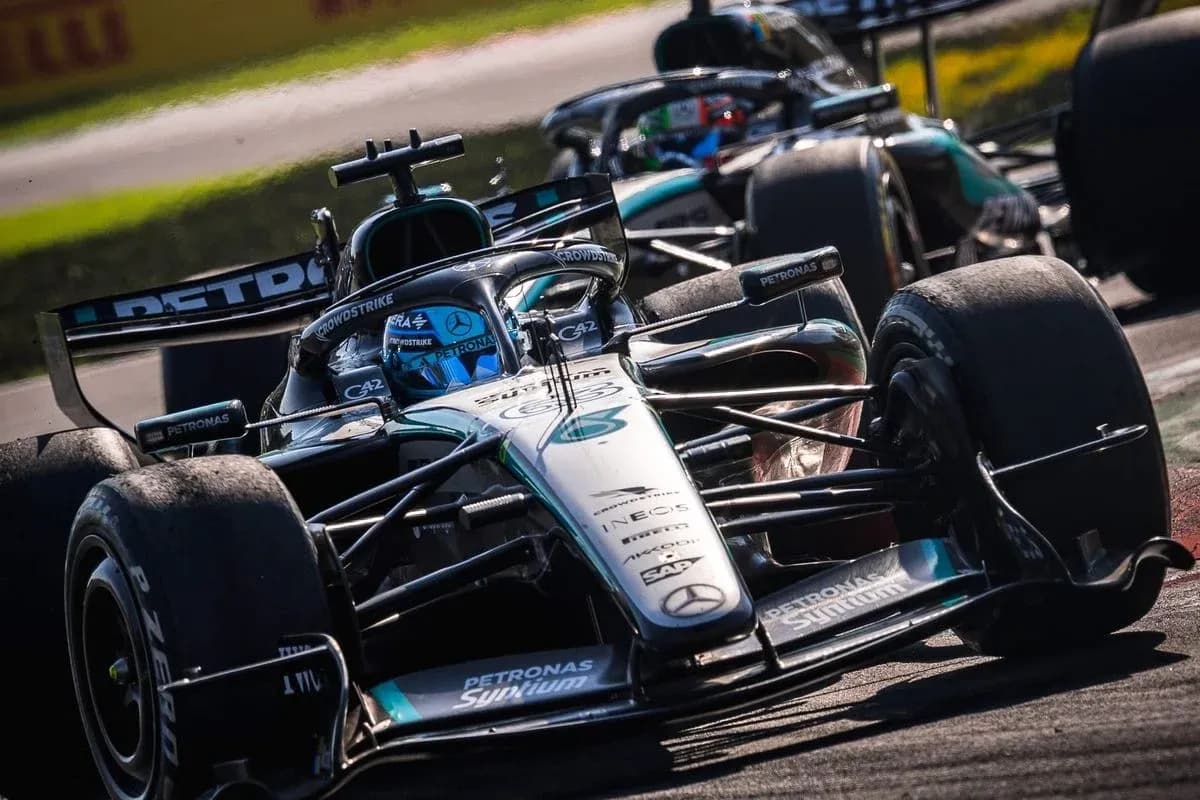
George Russell's Strategic Engine Penalty Decision in Formula 1
George Russell is set to play the long game with his looming Formula 1 engine penalty, holding off until Mercedes’ upgraded ADUO-spec power unit is ready – a move that may not come until the United States Grand Prix.
It is a calculated gamble, and a clear sign of how tight the margins have become at the sharp end of the championship.
Penalty now, or power later?
Early reliability troubles have boxed Mercedes into a corner. Both Russell and team-mate Kimi Antonelli have already blown through their in-season allocation of several key power unit components just to keep their campaigns on track.
Antonelli took the hit first. At Monza, he bolted in extra power unit elements, dropped to 19th on the grid – and still came through to win. On a circuit built for slipstreaming and straight-line recovery drives, the logic was obvious.
For Russell, Baku looked like the natural moment to copy the move. Long straights, heavy braking zones, overtaking chances everywhere. Take the penalty, slice through the field, limit the damage.
But Mercedes has changed tack.
The team now intends to delay Russell’s engine change to sync it with its upcoming ADUO upgrade, a new specification being readied under F1’s Additional Development and Upgrade Opportunities framework. That extra development freedom has given Mercedes a chance to boost its power unit late in the season – and turned Russell’s penalty into a strategic headache.
Boxed in by the rules
Russell has already maxed out his allocation of several major components: internal combustion engine, turbo, energy store, and control electronics. Any fresh unit in those categories over the next races will trigger grid penalties.
Switch now, and he takes a hit.
Switch again later for the upgraded ADUO spec, and he takes another.
Speaking at the Spanish Grand Prix, Russell made it clear there was only one logical path.
The plan, he said, was always to pair his engine penalty with the ADUO step. Anything else would mean serving two separate penalties for essentially the same problem. Asked whether he regretted not following Antonelli’s route at Monza, Russell was blunt: taking a penalty there and then another for the ADUO upgrade “makes zero sense”.
So Mercedes waits.
ADUO upgrade shifts the calendar
Internally, the team had initially targeted the next run of flyaways – Azerbaijan, Malaysia, Singapore – as a possible window for introducing the new spec. That timing would have allowed Russell to take his penalty on a fast street track and immediately cash in on the extra performance.
The timeline has slipped.
The upgraded unit, understood to feature an improved turbo among its changes, is now expected to arrive for the triple-header in the Americas: United States, Mexico, and Brazil, starting in Austin on October 23-25.
When that package lands, it will not be just Russell who benefits.
Antonelli, the championship leader, will also gain access to the ADUO-enhanced power unit. His situation is slightly more flexible: in Italy, Mercedes limited his change to the internal combustion engine, battery, and control electronics. That decision preserved his allowance on the turbo, MGU-K, exhaust, and ancillaries.
In practical terms, Antonelli can still take a fresh turbo and several other elements without incurring a penalty. Russell cannot.
One shot at getting it right
That is why the timing matters so much. Russell has no remaining headroom. The moment Mercedes commits to new components for him, the penalties start. If the team mis-times the ADUO introduction, he risks serving a grid drop on an old spec, then another when the upgrade finally appears.
For a driver in the thick of a title fight and a team trying to claw back every fraction of performance, that is unacceptable.
There is another layer to consider. Any improvement Mercedes brings to its works cars must also be made available to its customer teams. Under the rules, those customers receive a single upgraded unit at the first event where the new spec appears. That obligation locks in the timing: once Mercedes is ready to roll out the ADUO power unit, it has to commit across its network.
So Russell waits, counting races and components, knowing that when the penalty finally comes, it needs to be for something that makes his car faster, not just legal.
The question now is simple: when the upgraded engine finally arrives, will the cost in grid places be repaid on Sunday – or remembered as the moment Mercedes left itself too little time to cash in?