The Singapore Grand Prix: A Year-Long Preparation for a Three-Day Event
By 1am on Monday, the Padang is quiet. The last guitar riff has drifted into the night, the grandstands are empty, and the shriek of Formula 1 engines is a memory. On television, the Singapore Grand Prix is over.
On the Marina Bay Street Circuit, it is anything but.
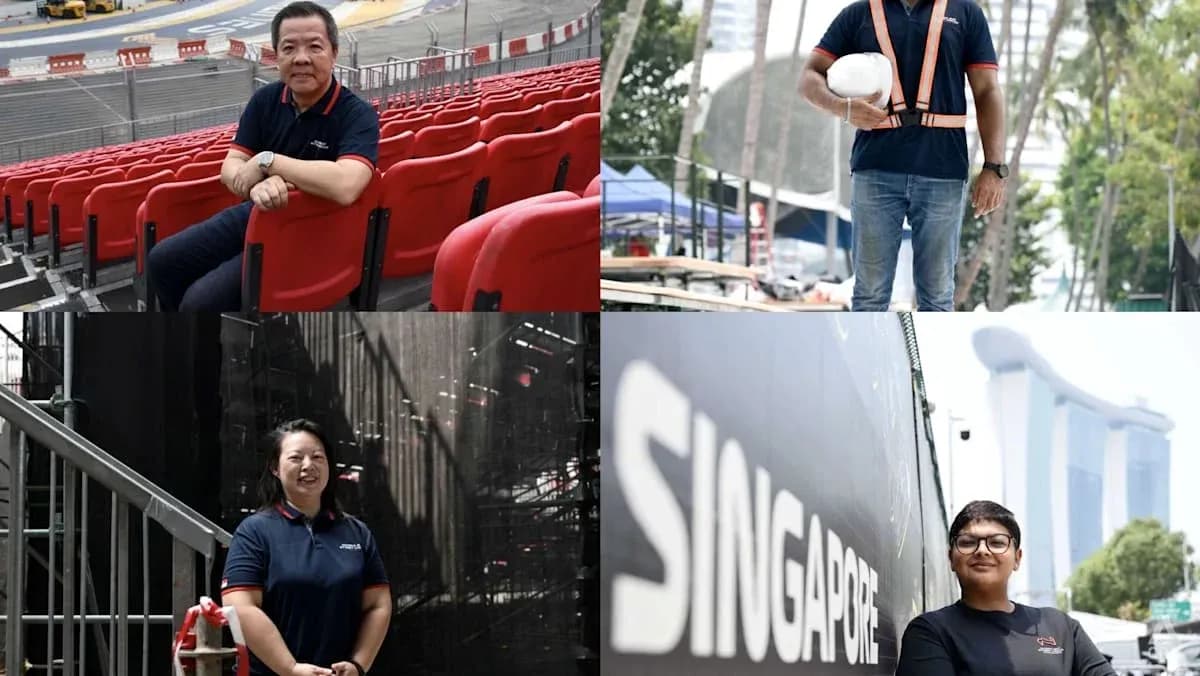
In the shadows of the city skyline, senior manager Shiv Raj Panday and his technical crew are staring at a far more unforgiving clock. They have four and a half hours to peel back parts of a world-class racetrack and hand the roads back to a waking city. By 5.30am, the same tarmac that hosted cars at over 300 km/h must be ready for buses, taxis and office workers.
That is the other Singapore Grand Prix. The one that lasts 362 days a year.
A Three-Day Race, A Year-Long Grind
To most, the Singapore GP is a three-night spectacle: cars, fireworks, concerts and selfies against the Marina Bay backdrop. Inside the offices of race promoter Singapore GP, it is a permanent campaign.
The moment the chequered flag falls, the reset begins.
Raj, one of 70 full-time staff, spends months on feasibility studies before a single barrier goes up. “We will take at least about two, three months to plan, before commencing set-up and build of the circuit,” he explains. Space is tight, the city is alive, and every square metre inside the circuit park has to work harder each year.
He knows the terrain well. Before joining Singapore GP, he spent more than a decade on the other side, working for one of the race’s contractors from 2010 to 2023. The routine is familiar, the pressure never less.
This has been the rhythm since 2008, when Formula 1 first lit up Marina Bay. Only the COVID-19 cancellations in 2020 and 2021 broke the cycle. The latest contract, renewed in January 2022, locks Singapore in until 2028. This year’s race, from Oct 9 to 11, will be the latest it has ever been held in the calendar.
On paper, that is a date. In practice, it is a deadline.
Tickets That Never Sleep
Step into the world of ticketing director Clarence Lai and the idea of a “race weekend” becomes laughable.
“The amount of time spent preparing for the event is enormous,” he says. For him, ticketing is an “endless” loop. The super early bird sales for one race launch in the week of the previous year’s event and barely pause until the engines fire up again.
His team controls who gets in and how: public tickets, accreditation for vendors and contractors, access to every grandstand and hospitality deck. They pore over seating capacity, decide where new grandstands are needed, and interrogate every detail of the customer experience.
Scams used to be a constant menace. Duplicate PDF tickets, shady third-party sellers, disappointed fans at the gates. Last year, Singapore GP switched to mobile ticketing. The move cut down on fraud and tightened control. It also added another layer to Lai’s already dense brief.
The complications do not end when the tickets sell out. On a temporary street circuit, nothing is permanent. Grandstands go up one and a half months before the race, exposed to wind, rain and the occasional late design tweak.
A stand might sit in the same spot year after year, but when it is rebuilt, rows can go missing, layouts can shift. Lai’s team walks every section, checks every seat, every label, every bolt.
“It's unlike a fixed venue, let's say, the National Stadium. The seats are always there, so most of the time you won't go wrong, it will not disappear,” he says. At Marina Bay, everything can disappear. Then it must reappear, exactly as promised to thousands of paying fans.
Sprint Weekend, Sprint Thinking
While the engineers and ticketing teams juggle steel and numbers, marketing and partnerships senior director Sasha Rafi is fighting a different battle: attention.
She has been at it since October 2007, one of the earliest hires. Back then, Formula 1 was an abstract idea to many Singaporeans, and the race had to be sold both at home and abroad. Today, the Marina Bay night race is one of the sport’s most recognisable stops. The challenge has shifted.
Now, Sasha and her team are trying to convince fans to come back. Again. And again. In a calendar of 24 races, Singapore has to stand out every single year.
“Even before the race takes place, we are already planning for next year,” she says. Her team dissects every edition: what worked in marketing, what did not, how sustainability played out, how stakeholders from government to private partners responded.
They scan the worlds of tech and entertainment, track how people spend their money, and keep one eye on geopolitics. A war, a financial shock, a travel clampdown—any of it can ripple into ticket sales.
This season brings a new card to play: the sprint.
Singapore will host one of six sprint races on the F1 calendar. Sprint qualifying falls on Friday, the sprint itself on Saturday—a 100 km dash, roughly a third of a full race distance, about 30 minutes of flat-out running with no pit stops.
To match that format, Sasha’s team has rolled out a two-day sprint bundle. For years, Singapore offered three-day passes or single-day tickets. This is different.
“When we look at the sprint bundle, it is one of the only few times that we have a two-day ticket package. We've always had three-day or single-day (packages),” she says. The idea is simple: reach fans who do not want to commit to all three days but will not miss the sprint.
The long game does not stop there. Super early bird tickets for the 2027 race will go on sale this year. The carousel keeps spinning.
Engineering a Circuit Around a City
If Marina Bay were a permanent circuit, life would be easier. It is not. It is a living, breathing city centre that refuses to stand still.
Operations director Melissa Phua, with Singapore GP since 2008, lives in that tension. Her job stretches from safety planning to human traffic management, and even into the classroom.
Each year, Singapore GP trains and employs nearly 1,000 students from the Institute of Technical Education and Republic Polytechnic. They become grandstand and gate officials, front-line staff responsible for the welfare of thousands of patrons.
Their work is visible only when it goes wrong. Phua’s key performance indicators are measured in what does not happen: no crushes, no dangerous bottlenecks, no ugly scenes at the exits.
“I think part of our KPI is also in making sure that they leave safely. We would hate to see complaints from patrons who were not happy after the event or we didn’t meet their satisfaction,” she says.
The biggest test comes after the nightly concerts at the Padang. The crowd surges towards MRT stations, chasing the last trains home. The circuit park, with its fencing, barriers and redirected streets, can feel like a maze—even to locals.
“It's about making sure that ushers are there and we are there on the ground, making sure that nobody gets yelled at or gets crushed.”
The cityscape adds its own quirks. When the track closes, familiar streets become unfamiliar corridors. “Even for ourselves, when we close up the track, it can be unfamiliar at times as the path isn't as straightforward,” Phua admits.
The 2022 edition, delayed by an hour because of heavy rain, underlined how quickly carefully drawn plans can be tested.
Racing the Dawn
Back on the tarmac, Raj wrestles with time and traffic.
The Connaught Grandstand, perched at the end of Esplanade Bridge, sits along a live road. Public vehicles still use it. His team must thread construction work into the narrowest windows.
In the early hours of race week Wednesday, they shut the road, rush in the structures, and clear out again before the morning commute. The same urgency drives the post-race teardown. By dawn on Monday, key sections like Esplanade Drive must reopen. The city does not care that a global sporting event just ended. It wants its roads back.
Those constraints also shape where and how people watch the race.
The removal of the Bay Grandstand created a headache for Lai. The team has yet to fully replace the lost seating capacity. Every year, they hunt for new vantage points and smarter layouts. This season, the grandstand at Turn 2—just after the pit straight—will be merged from two stands into one larger structure, with extra viewing platforms alongside to claw back capacity and improve sightlines.
The track itself is not immune to change. In 2023, the layout shifted to run behind the Floating Platform, as one of Formula 1’s largest grandstands made way for the development of NS Square. For Sasha, it was another reminder that the Singapore race of 2026 will look and feel very different from the one she helped launch in 2008.
From Elitist Curiosity to City Ritual
When Sasha first started, Formula 1 in Singapore felt distant, almost foreign. “When I first started, Formula 1 wasn't something that was known to most Singaporeans. It was seen in the first few years by some as an elitist sport,” she recalls.
Singapore GP set out to change that perception.
They built a product that stretched beyond the paddock: sports fans in the grandstands, corporate guests networking in hospitality suites, locals turning up for the concerts and atmosphere as much as the racing. They layered entertainment over the on-track action.
“We were the first circuit in Formula 1 to actually inject entertainment into the racing experience that you get over the weekend,” Sasha points out. It worked. The race became a weekend in the city, not just a grid of cars.
That evolution continues under the surface. Infrastructure shifts, global conditions fluctuate, fan expectations rise. The Marina Bay circuit is torn down and rebuilt every year, both physically and conceptually.
What does not change is the clock.
When the lights go out on Sunday night and the world’s cameras turn away, the real sprint begins—against rain, against fatigue, against the first wave of Monday traffic. The question, as always, is not whether Singapore can stage a Grand Prix.
It is how long it can keep raising the bar in a sport, and a city, that never stands still.