Abhishek's Dominance in Delhi: A T20 Exhibition
Abhishek walked out in Delhi with numbers weighing on his shoulders and a World Cup hangover still lingering in the background. He walked back having turned all of that into rubble.
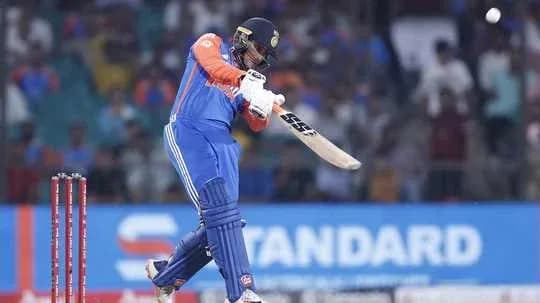
His first scoring shot set the tone. Fazalhaq Farooqi went full and wide, Abhishek opened up his shoulders and lifted an inside-out six over cover that sliced through the night. It looked audacious. It was actually a statement. From that moment, Afghanistan were chasing him, not the other way around.
India’s target – 157 on a flat, friendly Delhi pitch – never looked like a puzzle. Not once Abhishek started swinging with purpose.
A chase turned into a one-man exhibition
The real ignition came after India lost his opening partner early in the third over. The situation asked for a sighter, a bit of consolidation. Abhishek chose violence.
Azmatullah Omarzai’s first over disappeared. A clean swing sent him soaring over long-off, deep into the stands. Then Abhishek rocked back to a short ball and muscled it through square leg. Omarzai’s lengths weren’t terrible; they were just being read a fraction earlier and punished a lot harder.
Farooqi returned for the fifth over and walked into a storm. Twenty-six runs later, he had the look of a bowler who had run out of questions. Abhishek stepped forward to a slower short ball and launched it over the leg side for six, then carved a flat-batted four through the off side. Every small variation looked obvious to him. Every mistake looked fatal.
Afghanistan’s pace attack never found the extra gear it needed. No surprise bouncer that hurried him. No yorker that cramped him. Just a left-hander in rhythm, picking length early and swinging with complete conviction.
By the time Ibrahim Zadran turned to his spinners, the damage had already started to feel irreversible.
Spin, too, finds no hiding place
Mohammad Nabi came on to apply a brake. He leaked boundaries instead. Two crisp fours to close the Powerplay took India to 82/1, with Abhishek blazing away on 41 off just 15 balls. It was batting with the volume turned up to maximum.
Rashid Khan, Afghanistan’s trump card, fared no better on arrival. Abhishek greeted him with another inside-out boundary over cover, the same shot that had lit up his innings at the start. Same arc, same authority.
Noor Ahmad finally drew something different from him: a forward defence. Twice. In a T20 innings that felt like a highlight reel, those prods were almost jarring. They also underlined the point that this wasn’t blind hitting. He knew when to pause, when to reload.
His fifty came with a nudge to the leg side off Rashid, and the switch back to attack was instant. A little shimmy down the track, a clean swing over midwicket for six, then a fierce hit to deep cover. Fifteen off the over from Afghanistan’s most experienced bowler. The contest, if it ever was one, had tilted completely.
There was nowhere left to turn. Noor, too, was dragged into the maelstrom. A short ball disappeared over deep midwicket. The fuller one that followed was launched high over deep extra cover, an 83-metre statement that showcased the full range of his hitting.
By the time Abhishek was done, Afghanistan were reduced to spectators in their own defence.
Records fall in the slipstream
The numbers behind the carnage told their own story.
Abhishek hammered 82 runs, with seven sixes and seven fours, and became the second-fastest player to 6000 T20 runs. His fifty came in under 25 balls yet again – his 14th such rapid half-century in T20s. No one else is close; Suryakumar Yadav sits next on that list with nine.
Against pace, he plundered 28 off nine balls at a strike-rate north of 300. Against a spin unit that usually forms Afghanistan’s heartbeat, he smashed 54 off 23 at nearly 235. Those aren’t just good numbers; they’re an assault on a bowling plan.
And still, it never quite felt reckless. He dismantled Afghanistan methodically: first pace, then spin, then anyone else who dared. Loose balls vanished. Good balls were turned into scoring opportunities by footwork and anticipation. He wasn’t guessing; he was dictating.
An innings bigger than the scorecard
Strip away the fireworks and this knock carried a different weight.
Abhishek walked into this series under pressure. His T20 World Cup at home had started in nightmare fashion – three ducks on the trot before he found some rhythm in the back half of India’s title defence. The months that followed didn’t bring much relief. Across his previous six T20I innings, he had managed only two scores in double digits, with a highest of 16. Across 10 T20Is in this World Cup cycle, he had 191 runs. Respectable, not irresistible.
All the while, India’s bench only grew louder. Sanju Samson’s experience, Vaibhav Sooryavanshi’s fearless strokeplay – both hovered as genuine options at the top. With three of India’s most dangerous T20 openers jostling for two spots, Abhishek’s lean run could easily have turned into a revolving-door moment.
It didn’t. The management backed him. They trusted the body of work, the domestic dominance, the game-changing ceiling. Nights like this are why.
From the balcony, Varun Chakaravarthy, who has seen this version of Abhishek from dangerously close range in domestic cricket, watched with a mix of admiration and sympathy. He admitted he felt for Afghanistan’s spinners. He knew exactly how unforgiving this version of Abhishek can be.
Delhi simply got the international edition.
On a night when 156 should have offered at least a contest, Abhishek turned it into a personal showcase and a timely reminder. The question now is not whether he keeps his place. It’s how many games India can afford to start without his kind of fearlessness at the top.