India's Quicks Seal Historic ODI Series Win Against New Zealand
New Zealand’s seven-year streak of unbeaten home ODI series is over. It ended under the lights at Mount Maunganui, with a stuttering chase, a pitch that refused to settle, and an Indian seam attack that refused to blink.
Set 210 to square the series, New Zealand never quite escaped the grip of the game. They were bowled out for 187 in the penultimate over, losing wickets whenever a partnership hinted at control. The pressure kept circling back. Each time they tried to push, India’s seamers pushed harder.
Arshdeep leads a ruthless pace pack
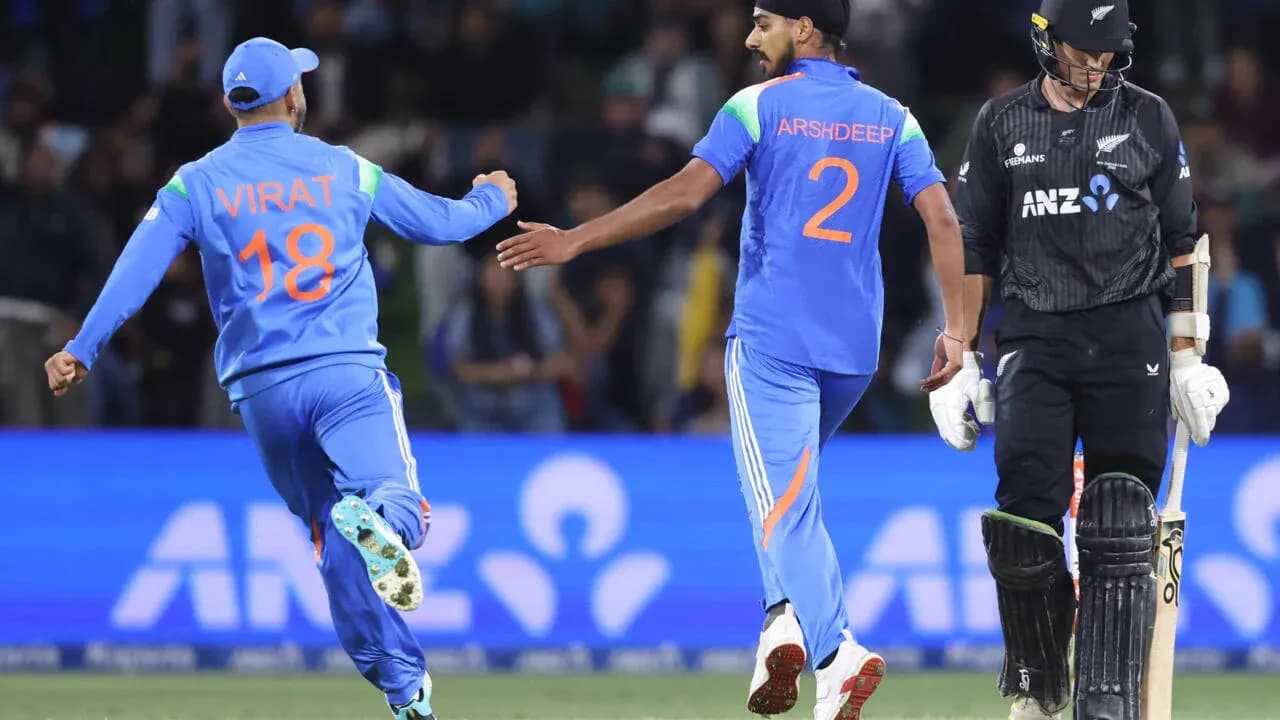
On a surface that kept the bowlers interested all night, Arshdeep Singh was again the spearhead. The left-armer finished with 3 for 30 from his 10 overs, giving him eight wickets in a low-scoring series that belonged almost entirely to the quicks.
He struck early, and he struck where it hurt.
Game-four centurion Will Young, who had brutalised India for 89 runs in that one-sided win, was checked on 22. Nick Kelly followed for 24. Both fell to Arshdeep, and with them went New Zealand’s early stability. From that point, the chase felt less like a procession and more like a negotiation with risk.
Dean Foxcroft tried to hold the innings together. His 31 was the top score in a line-up that never found a rhythm. New Zealand’s reply kept stalling, then restarting, then stalling again. When Kristian Clarke, looking to spark a late surge, fell to Arshdeep for 16, the game swung decisively India’s way. The tail had too much to do, on a pitch offering too much to the bowlers.
India’s captain Shreyas Iyer later spoke of belief. Watching his quicks, it was clear where that belief came from.
India scrap to 209 after early collapse
This was never a night for batting records. It was a night for survival, then opportunism.
India’s 209 from 42.1 overs looked light on paper. Out in the middle, it felt like a total with teeth.
New Zealand had set the tone with the ball. Jacob Duffy and Mitchell Santner shared six wickets, three each, as India lurched from 34 for 3 after early damage to their heavyweight top order. Rohit Sharma and Virat Kohli, the names that usually dictate the mood of an Indian innings, fell cheaply. The crowd sensed a repeat of Friday’s demolition, when India had been skittled for just 89 and beaten by a massive 244 runs.
This time, the middle order refused to fold.
Axar Patel and Ishan Kishan dug in, then countered. Both made 46, crucial runs that dragged India from crisis into contention. They didn’t dominate the attack; they survived it, absorbed it, and picked their moments. Those twin 46s did not look glamorous on the scoreboard, but in the context of a series where batsmen fought for every run, they were the backbone of the innings.
New Zealand chipped away, using the conditions well. Duffy’s discipline, Santner’s control, and the collective squeeze restricted India to 209. On many days, at many grounds, that would not be enough. At Mount Maunganui, under a fickle sky and on a two-paced surface, it was very much a score to defend.
A series for the bowlers
By the end of the night, there was no debate about who had owned this series. The batsmen had been passengers for long stretches, hanging on while the bowlers dictated.
India had surged to a 2-0 lead through two rain-affected matches. Game three never got going, washed out before it could add anything to the narrative. Then came New Zealand’s brutal response in game four, routing India for 89 and winning by 244 runs to drag the contest to a decider.
The finale stayed true to the script: low totals, high tension, seamers ruling the contest.
“This whole series wasn’t a series for batsmen,” Iyer said afterwards. “The way the bowlers bowled, they stood up to the occasion.” His words matched the numbers, and the story of every innings across the past week.
New Zealand’s captain saw it much the same way, from the other side of the result. Santner admitted he had backed his side to chase 210, but the pitch turned on them.
He called it “two-paced”, a surface that held one ball and hurried the next. India’s attack read those cues better, and punished any misjudgment. “I thought they bowled really well again tonight. All four seamers were able to chip wickets away through the middle,” Santner said. The key, in his eyes, was timing: “They brought Arshdeep back on at the right time.”
New Zealand’s innings never escaped that sense of being “squeezed”, as Santner put it. The bouncer was used smartly. The fields were aggressive without being reckless. The chase never looked entirely doomed, but it never looked entirely comfortable either.
Santner injury clouds Test build-up
There was another twist for New Zealand late in the evening, and it had nothing to do with the scoreboard.
Santner, who had already contributed with three wickets, took a blow to his right hand while batting. He will need an X-ray on Monday, leaving his availability for the upcoming two-match Test series against India in doubt.
For a side that has just lost its first home ODI series in seven years, the prospect of their captain and senior spinner being sidelined is an unwelcome complication.
The first Test starts in Wellington on Thursday. India arrive there with a T20 series win in their pocket, a hard-fought ODI triumph secured in difficult conditions, and a pace attack that has just dismantled New Zealand on their own turf.
New Zealand, bruised but never short on resolve at home, now have four days to regroup, reassess that injury report, and find an answer to an Indian seam unit that suddenly looks very comfortable in their backyard.