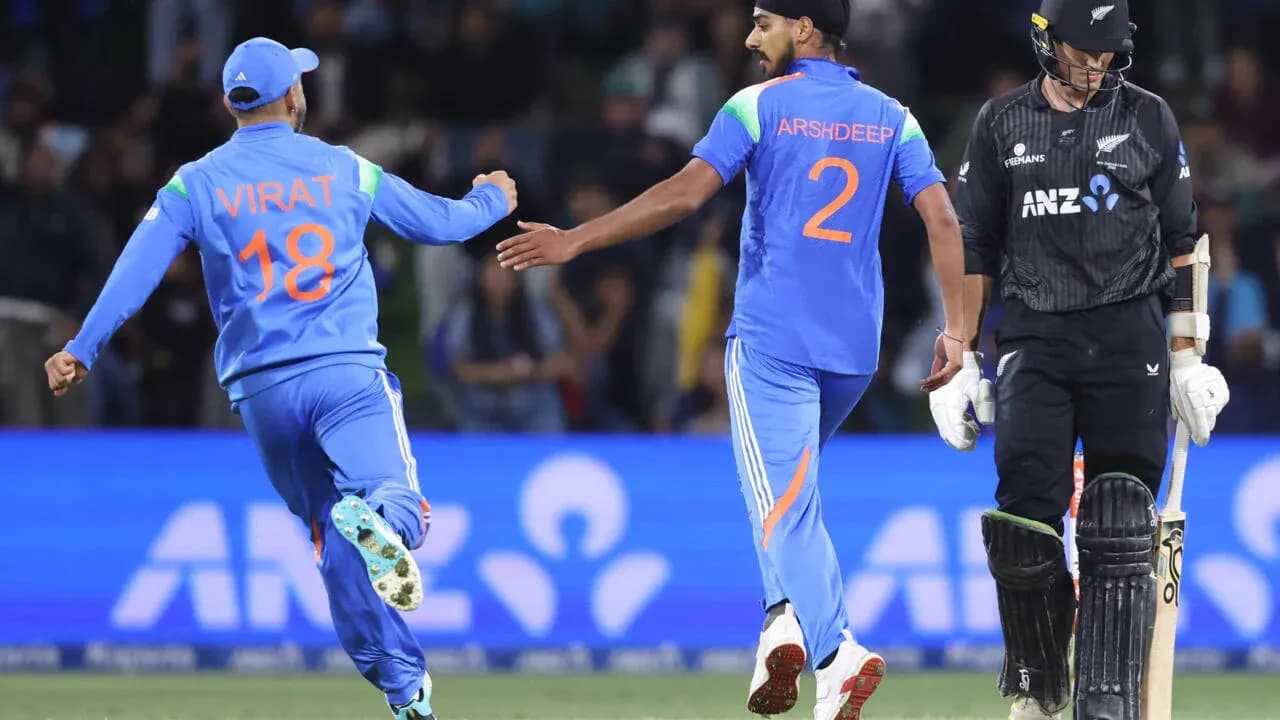
India secures first away ODI series under Gambhir
India 209 (Axar 46, Kishan 46, Santner 3-47, Duffy 3-60) beat New Zealand 187 (Foxcroft 31, Arshdeep 3-30, Axar 2-28) by 22 runs
Gambhir’s first away mark, carved in seam and nerve
Under a grey Dunedin sky and a surface that never quite told the truth, India finally cracked an away ODI series under Gautam Gambhir. Not with a commanding total, not with a hundred, not with a star turn that drowned everything else out. With 209. With tailenders swinging. With four quicks hunting in packs.
It was scruffy. It was tense. It was exactly the kind of win that sticks to a new coach’s résumé.
Arshdeep Singh and Mohammed Siraj, sent in as Nos. 10 and 11, first muscled India past 200 for the first time in the series, then came back with the ball to rip through New Zealand’s top order. Five wickets between them, a tone set, and a 22‑run win that sealed India’s first away ODI series triumph of the Gambhir era.
Both sides were stripped of their Test-bound stars. India fielded Yash Thakur on debut and Auqib Nabi in only his sixth ODI. Siraj, playing his first match of the tour, arrived as the senior quick and left as the enforcer-in-chief.
A toss New Zealand won, and India quietly stole back
New Zealand finally got a call right at the toss and pushed India in under lights, still haunted by that 89 all out earlier in the series. They gambled on dew. They got seam.
The ball nipped and held just enough for all four Indian quicks. Shreyas Iyer, captaining with an aggressive streak, trusted his seamers so completely that he didn’t call on spin until the 36th over. By then, New Zealand were already deep in trouble, chasing a target that had once looked modest and now felt awkwardly distant.
India’s 209 owed everything to resistance from the middle and lower order. It ended, fittingly, with Axar Patel taking the final wicket, another allrounder who had spent the afternoon and evening plugging holes wherever the game leaked.
Axar top-scored with 46 off 55 balls. He was rattled early by Mitchell Santner, who took him on with two sixes and a four in his first three overs, but Axar hit back later with two tailend wickets when India’s quicks were almost spent. His day never really slowed down.
Top order sinks again, Axar and Kishan salvage something
India would have chased if they had won what would have been their ninth toss in ten games on this tour. They lost it, and with it, they lost control of the script early. The seam movement in the first innings wasn’t as vicious as it would become under lights, and the dew never truly arrived, but the pitch had a different mischief: the ball held, gripped, and spat catches to close-in fielders.
Rohit Sharma went first, after a start that looked gentle and harmless at 23 without loss. His dismissal capped a grim tour: 30 runs in four innings, two ducks, and no hint of fluency. Virat Kohli, the only Indian to cross fifty in the entire series, followed soon after. He miscued a cut, beaten by that same spongy bounce, gifting Matt Fisher his second wicket.
Ruturaj Gaikwad was beaten not by the hold but by the sideways movement, inside-edging Jacob Duffy onto his stumps. At 34 for 3 in the ninth over, India were listing.
Iyer responded by sending in Axar at No. 5, a role he has grown used to in this era of makeshift solutions. It was a classic firefighter promotion. Axar could easily have gone early – he survived two tough chances on 0 and 3 – but once he settled, he became the one batter who looked like he understood the pitch.
Iyer himself fell to the short ball again, toppling India to 86 for 4 in the 18th over.
New Zealand then turned to Michael Bracewell, who happily exploited the grip in the surface with his offspin against two left-handers. Axar worked him around, built something, and by the time Bracewell had him caught at short straight midwicket, Axar had already done the hard labour.
Santner delayed his own introduction, choosing his moments carefully and targeting ends with a right-hander on strike. It didn’t start well, but his craft eventually told. He removed Naman Dhir, then two bowlers, and suddenly India were staring at a total that looked 20 light for these conditions.
The innings now hinged on Ishan Kishan and the tail. Kishan didn’t quite farm the strike, but he chose his moments, clubbing Duffy for two sixes and dragging himself to 46. He couldn’t bat India into dominance, only into contention. New Zealand walked off thinking they had restricted India to a score below par.
Then came Arshdeep and Siraj.
Three sixes, two fours between them. They tore into Duffy and Santner, flipping figures and mood in the space of a few overs. Arshdeep’s cameo ended when Duffy finally beat him with a slower ball that clipped the top of off, but India had broken through the psychological barrier of 200. On this pitch, with four quicks and a ball that still had some life, it felt like a small but significant win.
Siraj and Arshdeep rip open the chase
When Arshdeep’s second over disappeared for two boundaries and he was pulled from the attack, it looked briefly as if those late blows with the bat might be wasted. Then the sun dipped, the lights took over, and the ball began to talk.
Siraj struck first. Against the run of play, much like India’s first wicket earlier in the day, Tim Seifert slogged a length ball straight to mid-on. It was a loose shot in a tight chase, and India pounced.
Iyer sensed the mood of the pitch and the fragility of an inexperienced New Zealand middle order. He kept his quicks on short, sharp bursts, refusing to let the game drift.
Arshdeep returned and delivered a second spell that defined the night: 6-1-17-2. He lived on a good length, but his standout moment came with the short ball – a bouncer that removed Will Young, one of four New Zealand batters to fall to the pull or hook. From around the wicket, angling in and then seaming the ball away from right-handers, he turned batting into guesswork.
He had Dean Foxcroft dropped at second slip early, but made partial amends by taking Nick Kelly via a bottom edge on a cut. The pattern was clear: New Zealand were fighting the pitch, the angle, and the scoreboard all at once.
Iyer went for the throat again and brought Siraj back. Siraj responded with a wobble-seam beauty that crashed into Finn Allen’s off stump, nipping in sharply. At 87 for 4, India were all over the hosts, but there was a catch: both Siraj and Arshdeep had already bowled eight overs each by the 24th.
The game, briefly, opened a window.
Foxcroft, Bracewell resist, but India’s new faces hold their nerve
The only phase when New Zealand looked genuinely comfortable came during the fifth-wicket stand between Foxcroft and Bracewell. Against Thakur and Nabi, the ball finally started hitting the middle of the bat. Singles came, gaps opened, the chase recalibrated.
This was when Axar’s fielding at backward point cut off 11 runs with two diving stops, each one a small act of defiance that swelled in importance as the chase tightened. Nabi, who benefited from those saved runs, then produced a key strike: a bouncer that had Bracewell caught at deep midwicket. At 119 for 5, New Zealand’s margin for error vanished.
Thakur, tall and hostile, came in as a like-for-like replacement for Gurnoor Brar and found his own slice of luck. Foxcroft dragged a pull back onto his stumps, also on 119, and the innings sagged again.
Thakur’s night wasn’t spotless. Three times he clipped the bail at the non-striker’s end with his leg, conceding no-balls. None of the free hits went to the boundary, though, and he made amends with a miserly 48th over that cost just five runs.
New Zealand’s last real surge came through Santner and Kristian Clarke. Arshdeep had earlier injured Santner’s top hand with a bouncer, but the left-hander counterattacked, taking on Axar and building a 39-run stand for the seventh wicket. It was the longest India had waited to introduce spin in an ODI since Auckland in 2003, and for a moment, those overs looked like they might tilt the series back towards the hosts.
Dhir’s break, Arshdeep’s final touch, and a seven-year wait snapped
Just as New Zealand began to dream of a series-levelling heist, Naman Dhir’s part-time seam shut the door. Santner, who had been so clean with his sling sweep, found no room this time and couldn’t get the elevation. The shot was there, the timing was there, but the space was gone. So was Santner.
Iyer had one last over from Arshdeep up his sleeve. The left-armer used it to deliver the wicket he had been threatening all night. From around the wicket, he angled the ball in to Clarke, then seamed it away just enough to take the edge. Simple catch. Huge moment.
With Nos. 9, 10 and 11 needing 49, New Zealand were staring at their first home ODI series defeat in seven years. They required either a meltdown from India’s bowlers or a tactical misread from Iyer. They got neither.
Siraj and Thakur squeezed the tail in their final bursts, piling on dots, forcing risks. Axar, riding that pressure, cleaned up at the other end. The last wicket fell, and with it, New Zealand’s proud home record.
India, the last team to beat New Zealand at home in an ODI series, had done it again. No hundreds, no towering totals, no batting hero who owned the week. Just a hard-nosed, seam-led win that looked very much like the kind of cricket Gautam Gambhir wants this team to live by.
The numbers from this series won’t sparkle on career charts. The statement they made might.