Abhishek Sharma: From Amritsar Prodigy to T20I Star
On most days, cricket’s numbers can feel cold. Columns, averages, strike rates. With Abhishek Sharma, they read like a biography.
From a toddler with a bat in Amritsar to the highest-rated T20I batter the format has ever seen, his rise has been rapid, ruthless and very much on his own terms.
A three-and-a-half-year-old with a bat
The story starts early. Three-and-a-half years old, a bat almost bigger than him, and a father who knew exactly what he was looking at.
Raj Kumar Sharma, a former cricketer himself, put a bat in his son’s hands and watched an obsession form. Abhishek tore through Punjab’s age-group ranks, not just as a precocious talent, but as a heavyweight performer.
The 2015-16 Vijay Merchant Trophy became his first loud statement. More than 1,200 runs at an average of 109.09. Fifty-seven wickets with the ball. Those are not youth numbers; they are dominance figures.
By 2016, he was captaining Punjab to an Under-19 Asia Cup title. Two years later, he was part of India’s triumphant 2018 Under-19 World Cup squad, another step on a path that suddenly felt inevitable.
The IPL came calling early. Delhi Daredevils picked him up in the 2018 auction when he was just 17. The script, though, didn’t follow the usual teenage-sensation arc. No instant superstardom, no overnight transformation into a franchise poster boy.
Instead, there were seasons of graft. Domestic cricket. Limited opportunities. Quiet development. The talent was obvious; the explosion would come later.
Yuvraj Singh and the making of a fearless hitter
That explosion was shaped in part by a man who knows a thing or two about changing white-ball cricket.
Yuvraj Singh became more than just a senior pro in Abhishek’s life. He became a mentor, especially during the long, strange months of the Covid-19 lockdown. They worked closely, hammering technique, mindset and, crucially, intent.
Yuvraj saw a left-hander with natural aggression and refused to let him tone it down. No safety-first batting. No half-measures. If the instinct was to attack, the game would be built around it, not in spite of it.
That philosophy now sits at the heart of Abhishek’s T20 identity.
The international breakthrough arrived in July 2024, when he made his T20I debut for India. The real shockwave followed a few months later.
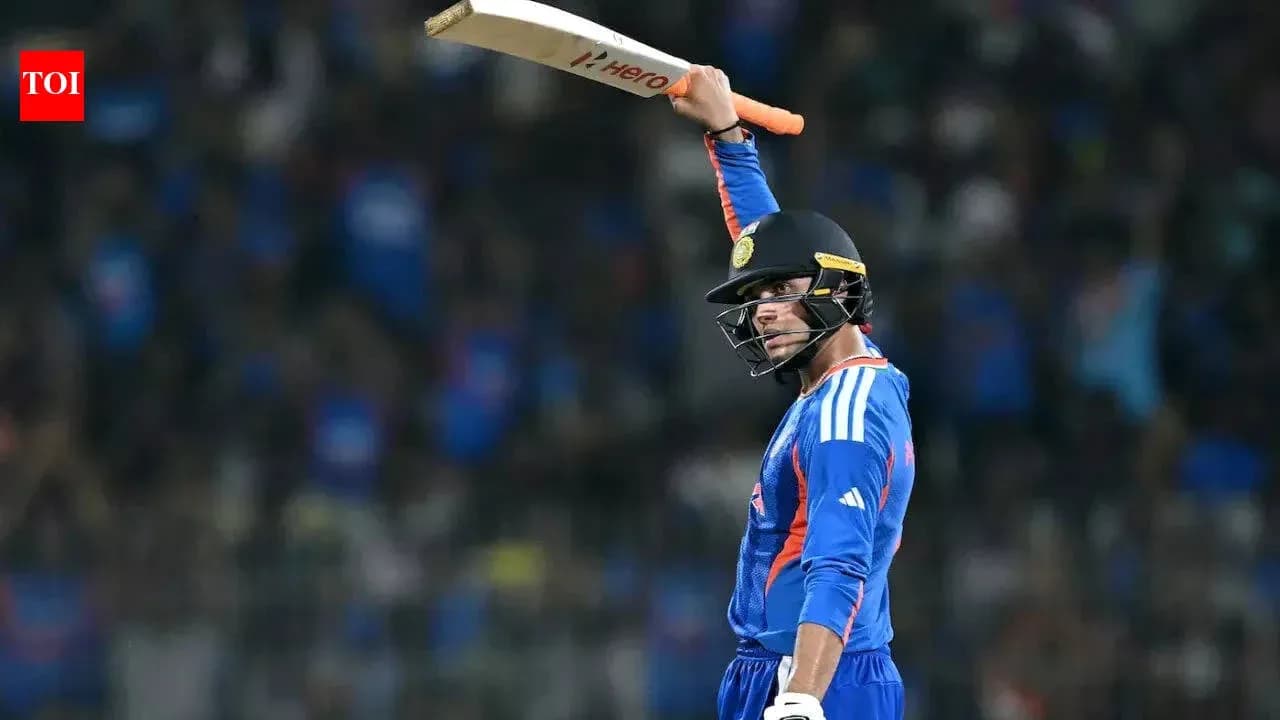
In February 2025, at a packed ground in Mumbai, Abhishek shredded England with one of the most brutal T20I innings an Indian batter has ever produced: 135 off 54 balls. Thirteen sixes. A century in 37 deliveries. Bowlers reduced to bowling machines, spectators reduced to ball-spotters.
On that night, he stopped being a promising addition to India’s T20 side and became something else entirely: a genuine threat, every time he walked out.
Asia Cup domination and a world record
The 135 was not a one-off. It was the warning.
The 2025 Asia Cup confirmed what that England innings had hinted at. Opening the batting, Abhishek turned India’s top order into a launchpad. He hammered 314 runs in seven matches at a strike rate of 200, the sort of number that bends games before they’ve settled.
He finished the tournament as Player of the Tournament. India finished it as champions. The link was obvious.
As the runs stacked up, the rankings followed. After a 61 against Sri Lanka, the numbers finally caught up with the eye test. Abhishek climbed to 931 rating points in the ICC T20I batting rankings — the highest rating ever recorded by a men’s T20I batter.
He went past Dawid Malan’s 919, beyond the peaks of Suryakumar Yadav and Virat Kohli. In a format built on volatility, he had carved out a position of rare statistical authority.
Built to destroy: the year of 1,000 runs and 108 sixes
The scale of his 2025 output almost defies the format’s logic.
Across T20 cricket that year, Abhishek became the first player to score more than 1,000 runs in a calendar year while striking at over 200. He finished with a strike rate of 202 and 108 sixes. That is not just aggression; it is sustained, calculated demolition.
The IPL bore the brunt of it.
Turning out for Sunrisers Hyderabad, Abhishek produced one of the great Indian Premier League innings in 2025: 141 off 55 balls against Punjab Kings. He reached fifty in 16 balls, a hundred in 40, and never really eased off.
Fourteen fours. Ten sixes. A chase of 246 made to look like a routine net session. By the time he walked off, he had broken KL Rahul’s record for the highest score by an Indian batter in IPL history.
It was the kind of knock that forces everyone to redraw their idea of what’s possible in a chase.
His evolution has been nudged and sharpened by some serious cricketing minds. Beyond Yuvraj, Abhishek has absorbed lessons from Shikhar Dhawan, Brian Lara and Travis Head. At Sunrisers, his partnership with Head has become a case study in modern T20 opening strategy — relentless tempo from ball one, no breathing space for the opposition.
World champion with a finishing kick
The next natural step was a global title.
At the 2026 T20 World Cup, Abhishek’s rise met the game’s biggest stage. He played a central role in India’s title-winning campaign, not as a bit-part dasher, but as a frontline match-winner.
In the final against New Zealand, with the trophy on the line, he delivered again: 52 off 21 balls, a blistering innings that ripped open the contest. Finals are supposed to tighten players up. Abhishek went the other way, swinging freely, forcing the game onto his terms.
India lifted the trophy. His reputation lifted with it.
The numbers behind the noise
Strip away the noise and the highlight reels, and the record still holds up.
Between 2024 and 2026, Abhishek Sharma has played 56 T20Is for India, scoring 1,629 runs in 55 innings at an average of 30.73. The real jolt comes with the tempo: a strike rate of 187.24.
Two international centuries. Eleven fifties. A highest score of 135. Across those innings, he has already crashed 164 fours and 104 sixes.
Every statistic points to the same conclusion: this is not just a hitter. This is a high-volume, high-impact opener built for the modern game, where 200 is a par score and caution is a luxury.
From that three-and-a-half-year-old in Amritsar to the man sitting atop the T20I batting world, Abhishek Sharma has turned raw instinct into a ruthless craft.
The question now is not how far he has come — it’s how much more damage he can do to the format he already seems to be redefining.