Afghanistan Premier League: A New Era for Afghan Cricketers
For years, Afghanistan’s best cricketers have been hired guns in other people’s tournaments. IPL, CPL, PSL, ILT20, SA20, BBL – you name a major T20 league, and an Afghan star has lit it up. Rashid Khan, Mohammad Nabi, Mujeeb Ur Rahman and others have built reputations far from home, carrying a nation’s story on their shoulders without a flagship stage of their own.
That changes at the end of this year.
APL Steps Out of the Shadows
The Afghanistan Cricket Board (ACB) has confirmed the launch of its own T20 league, the Afghanistan Premier League (APL), with the first ball scheduled for December 27. It will look and feel like the global powerhouses it has long fed – a franchise model, international visibility, and a clear commercial structure – but with Afghanistan at the heart of it.
The twist: the inaugural edition won’t be played on Afghan soil. The APL will debut in the United Arab Emirates, at ICC-approved venues, with the ACB keeping the door open to shift the league elsewhere in future editions if needed. The venue, for now, is pragmatic. The ambition behind it is anything but.
“The inaugural edition of the APL shall be hosted in the United Arab Emirates at ICC-approved venues. Subsequent editions of the APL may be hosted at alternative venues outside of the UAE, as may be communicated by the APL,” the ACB has stated, leaving the roadmap deliberately flexible.
Owners on Board, Identities Taking Shape
Crucially, money and commitment are already in place. Three franchises have been locked in, with a strong Indian and Afghan diaspora flavour.
Amit Kaushal, founder and chairman of AKCEL Group, has taken charge of the Kabul franchise, named Akcel United Kabul. From Dubai, business group Bullfrog – represented by Pankaj Chadha and Ashish Mehta – has stepped in to buy the Kandahar team, Kandahar Warriors. Bullfrog already has a foothold in the region’s cricket ecosystem as owners of Pokhara Avengers in the Nepal Premier League, and now extends that portfolio into Afghan cricket.
The third confirmed owner brings the story closer to home. Afghan-American entrepreneur Shakaib Rahimi, a long-time backer of Afghanistan’s cricket journey, has secured the Balakh franchise, Balakh Zwanan. His involvement underlines what this league represents: not just a business opportunity, but a chance for a scattered cricketing community to rally around a single, visible product.
Two more franchises are expected to complete the five-team line-up for the first season. Talks are ongoing with billionaire business magnates from the United States and several Indian corporates. The ACB wants deep pockets, but also long-term partners who see the APL as an asset to build, not a quick punt.
A Long-Term Play, Not a One-Off Experiment
To run and promote the league, the ACB has handed the rights to Cricket Ventures LLC-FZ, a UAE-based company in joint venture with the MENA subsidiary of ITW Universe. This is not a casual, short-term arrangement; it’s a structured attempt to rebuild the APL into a modern T20 property after previous, stuttering attempts.
“When we signed the long-term partnership with the ACB, the brief was simple and ambitious: rebuild the APL as a professionally run, internationally visible T20 property that develops Afghan talent and gives investors a decade-long runway,” said Bhairav Shanth, Co Founder, ITW Universe.
The vision is clear: not just another league squeezed into an already bloated calendar, but a sustainable platform that Afghan players can treat as home, and investors can treat as a serious asset.
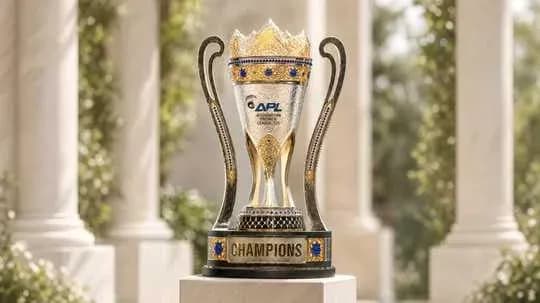
Shanth pointed to a symbolic centrepiece as well – the Koh-E-Zafar trophy. “This week’s announcements in Dubai — the first three franchises, their identities, and the Koh-E-Zafar trophy — turn that brief into a living league. The trophy’s mountain motif is not decoration; it is the right metaphor for a cricket nation that has climbed through extraordinary circumstances.”
Afghanistan’s rise has indeed felt like a mountain ascent: from refugee camps and borrowed grounds to World Cups and global T20 stardom. Now that journey gets its own summit to aim for.
The Clock Is Ticking
Romance and symbolism only go so far. The hard work now sits in the details – and the timeline is tight.
“What matters now is execution. Player registration opens 30 August. The inaugural draft is 27 September. The first ball is scheduled for 27 December,” Shanth outlined.
Between those dates, a lot has to fall into place. The remaining franchises must be finalised. Commercial partners have to be secured. Broadcast arrangements need to hit a standard that can compete with the slick production values fans now expect from T20 leagues. The fan experience – in stadiums and on screens – must feel big-league from day one.
“Between those dates we have to lock remaining franchises, commercial partners, broadcast quality and a fan experience that matches the standard we are already applying to other Afghanistan-linked properties. Leagues succeed when owners see a real asset, players see a real pathway, and brands see a clean, high-attention platform. That is the standard we are holding the APL to,” Shanth said.
That is the crux. The APL cannot afford to feel second-rate, not when Afghan players have already tasted the top shelf of the T20 world.
A League Chasing Its Moment
For Afghanistan’s cricketers, this league is more than just another paycheck. It is a stage where young players can break through without needing a foreign contract first, where established stars can return as centrepieces rather than supporting acts, and where a cricketing identity forged in adversity can finally breathe on its own terms.
The fixtures will be in the UAE. The franchises will be backed by global money. But the heartbeat will be Afghan.
The calendar is set. The owners are arriving. The Koh-E-Zafar trophy waits.
Now the question is simple: can the APL turn a decade of promise into a league that truly belongs among the game’s elite – and, in time, find its way home?