Ajay Sharma: The Ranji Giant's Remarkable Return
There are domestic records that make you wonder how a player didn’t play more for his country. Then there are numbers so outrageous they almost make the international column beside them look like a misprint.
Ajay Sharma belongs firmly in the second category.
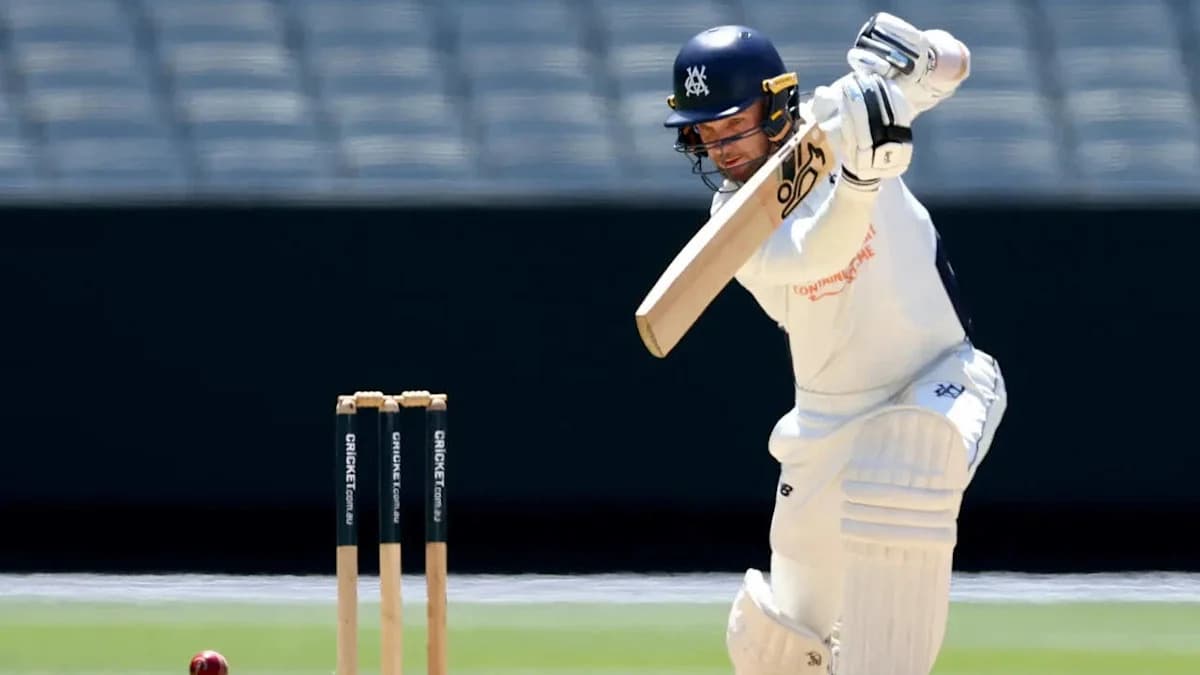
More than 10,000 first-class runs. Thirty-eight centuries. An average of 67.46. In the Ranji Trophy, the figures swell into something even more surreal: 7,319 runs at 80.42, 31 hundreds, and a habit of turning up when the pressure was at its fiercest. He scored centuries in four of the six Ranji Trophy finals he played.
And yet his Test career lasted one match.
One Test, two innings, and gone
Sharma’s only Test came in Chennai, January 1988, against a West Indies attack that included Courtney Walsh and Patrick Patterson. It is a match remembered for Narendra Hirwani’s staggering 16-wicket debut. In the shadows of that whirlwind, Sharma quietly made 30 and 23, contributed to a comfortable India win, and walked away assuming there would be more.
There never were.
He did at least get a run in ODIs, 31 matches between 1988 and 1993. The returns were modest: 424 runs at 20.19, three fifties, and some overs of slow left-arm spin. Handy, but hardly irresistible. His one-day numbers never carried the authority of his domestic record.
What happened away from the international stage, though, bordered on the absurd.
The Ranji colossus India barely saw
For Delhi, Sharma became a relentless run-machine, a batter whose scorecards seemed to operate on a different scale. With every season, his absence from the Test side looked more and more like a riddle Indian cricket never bothered to solve.
In 1991-92, he piled up 933 runs and then finished the job with 175 in the final against Tamil Nadu as Delhi took the title. Three seasons later, he went even bigger: 1,288 first-class runs at 92.00 in a single campaign, proof that his appetite for long stays at the crease had only sharpened after India stopped calling.
Then came 1996-97, the peak of his domestic dominance, long after his last international appearance. Sharma scored 1,033 Ranji Trophy runs in just eight matches, averaging 114.78, with five centuries and three fifties. Bowlers knew what was coming. They still couldn’t stop it.
By the time he was done, his first-class ledger read 10,120 runs from 129 matches, 38 centuries, average 67.46. Among batters with a substantial body of work, only a tiny, elite group in cricket history finished with a higher average.
Yet on the international sheet, the story stayed frozen: one Test, two innings, no recall. One of Indian cricket’s strangest records.
And then the story turned darker
In 2000, Indian cricket shook under the weight of the match-fixing scandal that followed the Hansie Cronje revelations. A CBI investigation dug into links between players and bookmakers. Sharma’s name surfaced in the inquiry, tied to allegations of associations with bookmakers and introductions involving other cricketers.
He denied receiving money for fixing matches. It didn’t matter. The impact on his cricketing life was instant and brutal.
In December 2000, the BCCI handed life bans to Sharma and former India captain Mohammad Azharuddin. Sharma was 36, already in the twilight of his playing days. The punishment still cut deep. It was not just the end of a career; it was a severing. He found himself shut out of the game around which his entire life had been built.
The ban pushed him out of the public eye and, in many ways, out of the sport’s memory. His extraordinary numbers became a footnote to a scandal.
Years later, the picture shifted
In 2014, a Delhi court declared the BCCI’s disciplinary order against Sharma null and void, ruling that he could not continue to be barred from BCCI-related activities on the basis of that order.
It was not a sweeping declaration that every allegation made during the scandal had been false. What the court did was dismantle the disciplinary process and the order that flowed from it. Technically, a door that had been bolted shut for 14 years swung open again.
By then, the damage had seeped far beyond the boundary ropes.
Sharma’s son, Manan, was trying to make his own way as a professional cricketer with Delhi. Even that journey became tangled in the shadow of his father’s name. Sharma later recalled asking his son if he could come to the ground to watch him play. Manan told him not to. The family feared that the mere presence of Ajay Sharma, and the controversy attached to him, might hurt the younger man’s prospects.
For someone whose identity had been fused with cricket, that was a particularly cruel twist. The game he had dominated for years had reached a point where he did not feel comfortable walking into a stadium to watch his own child.
Sharma stepped away and worked outside the sport, including a long stint with the Central Warehousing Corporation. Even after the 2014 judgment, his path back into organised cricket was anything but immediate. The stigma did not vanish with a legal ruling. He had to start again, from much lower down the ladder.
Coaching, and a most unlikely second act
His way back came through coaching. Not with a grand appointment, but through academies, slow-building sessions, and the patient work of teaching others what he once did almost instinctively.
Sharma grew into the role and eventually took charge of Jammu and Kashmir’s senior side. It was not an obvious pairing on paper: a former Delhi run-glutton, once banned for life, now tasked with lifting a team from India’s cricketing periphery.
It did not click straight away. Players found him excessively strict. Sharma himself later admitted he needed to change how he spoke to the group, to adjust the way he demanded standards if he wanted them to follow.
He did. The dressing room began to respond. Results followed.
Jammu and Kashmir started to harden into a competitive Ranji unit, no longer there just to make up the numbers. Then, in the 2025-26 season, they surged into uncharted territory.
They reached the Ranji Trophy final for the first time in their history.
After the semi-final win, the players hoisted Sharma onto their shoulders. For a man who had spent two decades associated with a scandal and a life ban, that single image – carried by his players, smiling in the middle of a Ranji fairytale – felt like a complete rewrite of the final chapter.
The Ranji title that rewrote an ending
The story did not stop at a feel-good semi-final. Jammu and Kashmir went on to beat Karnataka on first-innings lead in the final, winning the Ranji Trophy for the first time.
The trophy that had once been Sharma’s personal playground now became the stage of his redemption, this time from the dressing-room balcony instead of the middle.
The symmetry was impossible to ignore. He had been one of the competition’s greatest batters, averaging more than 80 in Ranji cricket, yet playing only one Test for India. He had then been cast out of the game, his name dragged through a scandal that pushed him to the margins.
More than twenty years later, it was the same tournament that pulled him back into the spotlight. Only the roles had changed.
He was no longer the man batting forever, grinding bowlers into the dust. He was the coach being carried, quite literally, by a group of players he had helped take somewhere Jammu and Kashmir had never been before.
For Ajay Sharma, the Ranji Trophy did not just define his career. It gave him an ending no selector, no judge, and no scandal could script.