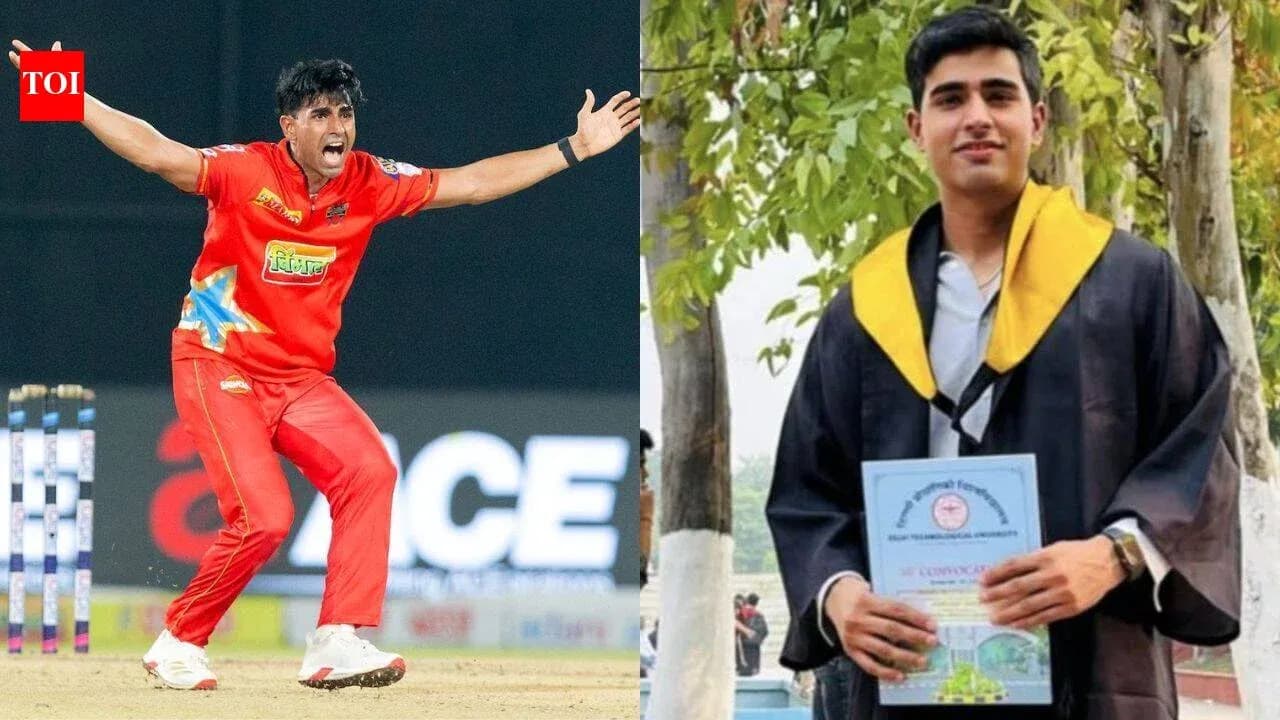
Anshuman Hooda: From Engineering to Fast Bowling Star
The fast bowler who almost walked away
NEW DELHI: Ask Anshuman Hooda to choose between his office laptop and a cricket ball and the answer comes with a laugh, but no hesitation.
“My cricket ball is my best friend,” he tells TimesofIndia.com.
That line makes sense now. It didn’t always.
A year ago, the 25-year-old engineer from Delhi Technological University, employed at EY, looked at his empty cricket résumé — no age-group caps, no junior tournaments, two failed Under-23 trials — and decided the game was done with him. The Ranji Trophy felt a world away. A sensible life in engineering seemed the only road.
Then came the Delhi Premier League. And a season that has dragged him back into cricket with the force of a 140 kmph bouncer.
Purple Cap, new life
In the third edition of the DPL, Hooda tore through batting line-ups. Twenty-two wickets, the Purple Cap, and a title for South Delhi Superstarz.
He wasn’t just filling in overs. He was driving a championship campaign.
His elder brother, Vikram Hooda, has watched the shift at home. Their mother, Prem Lata Singh, a primary school teacher with the MCD, used to worry about stability. That box, she felt, needed ticking before cricket could be more than a hobby.
“Earlier, they used to say that he needed a job. Now that he has one and is doing well, she is happy,” Vikram says.
The job arrived. The promotion arrived. But so did something else — a version of Anshuman that looked too good to be confined to corporate hours.
“I have seen some substantial progress in my cricket in recent months and in this tournament. So in the coming times, I might shift my whole focus to cricket and give it my all,” Anshuman says.
It is a bold thought from someone who, not long ago, was ready to quit.
The skater who became a quick
Hooda is a late bloomer by cricket’s standard clock, but his story starts even further away from the usual script. Not in a dusty nets session or a junior academy. On roller skates.
As a youngster, he was a national-level roller skater. Cricket existed on the periphery — his elder brother played, the sport was around the house — but it wasn’t his identity.
The pattern at home was simple: the younger brother followed the elder. Vikram chose science. So did Anshuman. Vikram studied engineering. So did Anshuman.
Cricket, though, refused to fit that template.
He only truly engaged with the game once he reached college. That is where he first picked up a leather ball seriously, playing for the DTU team, discovering the rush of pace and the thrill of wickets.
“I just started playing in college, and that’s when I got into leather-ball cricket professionally, playing for the college team and all. That’s when I fell in love with bowling fast, getting wickets and the aggression that comes with it. I just loved bowling fast.”
The love was real. The pathway was not. No junior cricket. No Under-16, Under-19 pedigree. Just a raw, late arrival with speed in his arm and very little else.
A coach refuses to let go
In 2019, coach Harish Dagar spotted Hooda at university. What he saw wasn’t a finished product. It was a body that moved right.
“His body alignment was natural. His strength was natural, and his pace was natural. But he didn't have enough strength in his body initially. That's why I told him that if you don't maintain your fitness along with your natural pace, you will face problems," Dagar recalls.
Hooda was then playing tennis-ball cricket. Dagar nudged him towards medium pace, then pushed harder once he sensed the potential. The first spells were wild, erratic, untidy. The pace was not.
The turning point came in 2023. Hooda graduated from DTU with a degree in Production and Industrial Engineering, secured a job through campus placement and was ready to step fully into corporate life. Cricket, he felt, had given him its answer.
“So at that time, I thought I should quit cricket and pursue my career in engineering or something,” he says.
Dagar refused to accept that.
“It was in 2023. He had just graduated. He had got the job through campus placement and was ready to move on with his life. I pleaded with him to give it one more year. I asked him to come to my academy four days a week for a year, and if nothing would pan out, I would let him pursue his corporate job,” the coach says.
The deal was struck. Four days a week at Delhi Cricket Hub in Paschim Vihar, late-night sessions squeezed between work-from-home deadlines and gym visits. It was relentless.
“I worked on his mind 80-85 per cent. I made him mentally strong. I told him never to think that he was tired or burdened. Once I worked on his mindset and the roadmap was clear in front of him, he knew what he had to do,” Dagar says.
At one point, Hooda had three parallel lives — employee, gym-goer, fast bowler in training.
The toll of speed
Fast bowling is cruel on the body. Hooda learned that quickly.
“Fast bowling is not a very comfortable activity for the body. You accelerate, then your whole body has to absorb the impact before you bowl. It definitely takes a toll on the body,” he says.
He had to understand his own frame — the niggles, the soreness, the recovery cycles. Dagar’s plan was clear: build him like a professional, even if the world did not yet see him as one.
There was structure: periodisation, rest, strength, workload management, diet, physio, skill work.
Hooda needed more than just a heavy ball. He needed a stock delivery he could trust, and variations — leg-cutter, off-cutter — that would hold up under pressure. Pace had to live alongside control.
The numbers began to move in the right direction. So did the opportunities.
DPL: the door opens
The first crack in the wall came with the DPL in 2024, when South Delhi picked him up. Initially, chances were limited. He hovered on the edge of the XI, waiting.
Then came a spell that changed how people spoke about him. The next season brought a five-wicket haul and, with it, a shift in perception.
Franchise scouts started to notice. IPL teams began looking at him as a net bowler and for trials. For a player with no junior background, the rise was abrupt.
The attention became real when Shikhar Dhawan, owner of South Delhi Superstarz, walked up to him.
“Shikhar Dhawan himself, the team owner, surprised me. He came and we had a little conversation. He gave me some very good tips and a direction to work towards from here,” Hooda says.
Dhawan later praised him in an Instagram story. For Hooda, that wasn’t just a social-media mention. It was validation that he belonged in serious cricket conversations.
Chasing more speed, guarding the line
Right now, Hooda sits in a rare space for a developing quick: he can already touch 140 kmph, and his coach believes there is more in the tank.
At that speed, careers can change quickly. So can expectations.
“Definitely, speed is what I want. If I can, I will definitely look to bowl even faster and build the strength and skills to do that, while making sure there is no compromise on accuracy and line,” he says.
That last part matters. Pace gets you noticed; accuracy keeps you picked.
Hooda knows the next phase will not be about one magical number on a speed gun. It will be about sustaining high pace across long spells, especially with the red ball.
“These are the things we prepare for. Who bowls in a four-day or five-day game and bowls long spells with the same effort? That is what I am preparing for. If I get an opportunity, I will definitely do that.”
The ambition is mapped out clearly in his mind: first cement a place in Delhi cricket, then first-class cricket, then push for the IPL and, eventually, India.
“The eventual goal is to play and win matches for the country. That is my ultimate goal,” he says.
Security vs possibility
Away from the nets, another contest plays out quietly in his life — the tug-of-war between security and possibility.
On one side sits an engineering degree, a multinational employer and a promotion that arrived before this DPL season. A future that is stable, predictable, respectable.
On the other sits cricket: volatile, unforgiving, thrilling. A career that can explode in a season or vanish in an injury.
For now, Hooda has gone back to his job.
“Currently, I have joined back. But as I have seen some substantial progress in my cricket in recent months and in this tournament, I might, in the coming times, shift my whole focus to cricket and give it my all,” he says.
It is a significant admission from someone who once sat down and almost closed the cricket chapter for good.
There is a quiet irony here. The engineer who learned to balance workloads, manage time and juggle responsibilities may soon have to simplify his life to a single choice.
He already knows which way his heart leans.
“I will give it my all. Let’s see what happens ahead.”
The ball, his “best friend”, may soon demand an answer that no laptop can match.