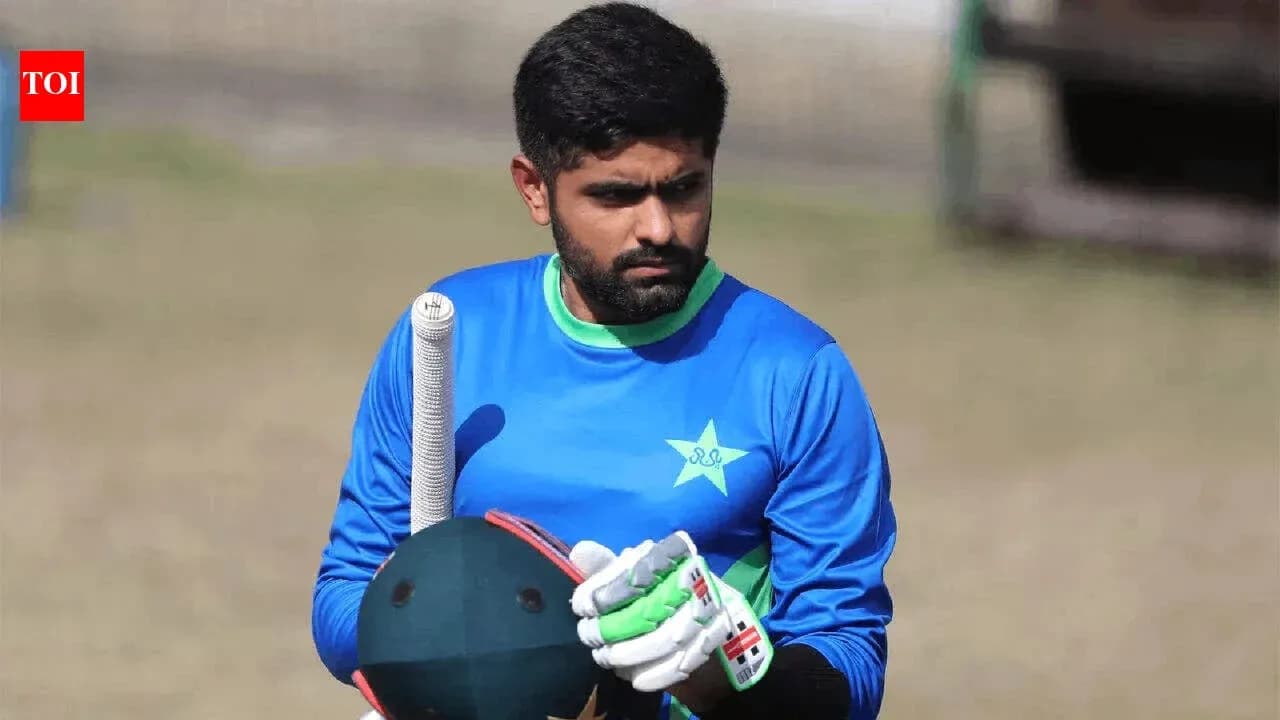
Babar Azam's Struggle for Test Centuries
For years, Babar Azam treated Test hundreds like a routine. A technical correction here, a gentle push through cover there, and the three figures would arrive almost on cue.
That rhythm has vanished.
His last Test century came on December 26, 2022, in Karachi — a commanding 161 against New Zealand that underlined his status as one of the premier batters in the world. It was his ninth Test hundred and the crown jewel of a stunning 2022 in which he piled up 1,184 runs with four centuries.
Since that day, the scoreboard has told a very different story. Seventeen Tests. Thirty-six innings. No hundreds.
What began as a blip has hardened into a drought.
From Karachi high to a sudden stall
The irony is that the drought began almost immediately after that 161. In the very next innings of that New Zealand Test, he fell for 14. The follow-up Test in Karachi brought 24 and 27 — decent starts, nothing more.
On the 2023 tour of Sri Lanka, the pattern held. Scores of 13, 24 and 39 hinted at fluency without the finish. In Australia, against relentless pace and bounce, the numbers thinned further: 21, 14, 1, 41, 26, 23 across three Tests. The 41 in Melbourne, his highest of that stretch at the time, looked like the beginning of something. It wasn’t. Once again, an innings that promised much broke down before it could grow into a match-defining effort.
The runs didn’t disappear. The centuries did.
2024: When a drought became a problem
By 2024, the conversation around Babar’s form had shifted. It was no longer about “when” the next hundred would come, but “why” it hadn’t.
Against Bangladesh, he scraped together 0, 22, 31 and 11 across two Tests. Scratchy, uncertain, un-Babar-like. Then came England at home, and a flat number that stung more than most: 30 in Multan, lbw to Chris Woakes on a surface where Shan Masood and Abdullah Shafique both reached three figures. While others cashed in, Pakistan’s premier batter extended a run without even a fifty.
The pressure mounted. The captaincy had changed, conditions had varied, but the same question remained.
South Africa at the end of the year finally brought a flicker of the old Babar. At Centurion, he reached 50 — his first Test half-century since that 161 against New Zealand. At Cape Town, the gears turned again: 58 in the first innings, 81 in the second. Technically sound, mentally sharp, he looked close to breaking the spell.
Nineteen runs short. Again.
2025: Better numbers, same void
He carried that 81 into 2025 as a reminder of what he could still do. Across the two-Test series in South Africa, he gathered 193 runs, three fifties, and that top score of 81. As a body of work, it was solid. Respectable. The kind of return many batters would happily sign for.
For Babar, it wasn’t enough.
Through the rest of 2025, his Test numbers improved compared to the thin returns of 2023 and 2024. He looked more settled, more assured at the crease. The problem refused to budge: the hundred stayed out of reach. His best score of the year remained 81 — a ceiling he kept touching, never breaking.
2026: Run-out on 88 — the one that got away
If there was a single moment that captured the cruelty of this stretch, it came in Port of Spain.
In the second Test against West Indies, Babar built the kind of innings that usually ends with him raising his bat to the dressing room. He moved to 88, 12 runs away from the milestone that had been taunting him for nearly four years. The timing was there, the control was there.
Then came the mix-up.
A misunderstanding with his partner, a sharp throw from Brandon King, and Babar was run out for 88. No glorious flourish, no hundred, just the long walk back, helmet off, eyes fixed ahead. Another chance gone.
Earlier in the series, he had crafted an unbeaten 58 in a fourth-innings chase, only for Pakistan to lose by 90 runs. Across the two Tests, he scored 193 runs, including that 88 and an unbeaten 24, enough to nudge him back into the ICC Test top 10.
The rankings moved. The narrative didn’t. Still no tenth Test century.
Bangladesh again, another opening missed
Before the England tour, Bangladesh arrived and with them another opportunity to reset the numbers. Babar responded with 68 and 47 in the two-Test series — useful, composed, important runs.
But again, not the landmark.
He got in, he looked set, and then he got out. The pattern held, almost stubbornly.
England: Injury, return, and more frustration
Then came England. And another twist.
Babar missed the first Test at Headingley with a finger injury, forced to watch from the sidelines as Pakistan were crushed by an innings and 103 runs. The absence only sharpened the sense of dependence on him. When he declared himself 90 percent fit for the second Test at Lord’s, his return felt like a lifeline.
Lord’s, though, can be unforgiving.
In Pakistan’s first innings, with the visitors desperate for stability, Babar lasted just 8 runs. Josh Tongue found the edge, Jordan Cox accepted the catch, and Pakistan crumbled to 110 all out. One more innings, one more low score.
The chase of 389 in the second innings demanded a statement from the senior batter. Instead, Jofra Archer tore in, heavy ball, steep bounce, and Babar’s response turned awkward. The ball ballooned to Cox at third slip. Out for 6.
Two innings at Lord’s.
8 and 6.
The drought lengthened.
A race against time, not talent
This is not the story of a player who forgot how to bat. The runs, the fifties, the 80s and that agonising 88 show a batter still capable of shaping games. What has deserted Babar is the final act — the push from dominance to completion, from a good innings to a defining one.
For a man who once made centuries feel inevitable, the number 10 has become a wall he cannot quite break.
How long can a player of his class stay away from three figures? And when that next hundred finally comes, will it feel like a return to normal — or the start of something entirely new?