Edinburgh Castle Rockers Win Inaugural European T20 Premier League Title
Under grey Malahide skies, with a fresh coastal breeze cutting across the ground, Edinburgh Castle Rockers wrote their name into European cricket history.
A chase that could have turned nervy never came close to panic. Not while Andries Gous was at the crease.
His unbeaten 90 from 61 balls powered Edinburgh to a seven-wicket win over Belfast Wolves and delivered the first-ever European T20 Premier League title, a landmark moment sealed with 1.2 overs to spare.
Boult strikes early, Tector stands tall
Edinburgh captain’s decision to bowl first was bold in a final. It looked inspired within minutes.
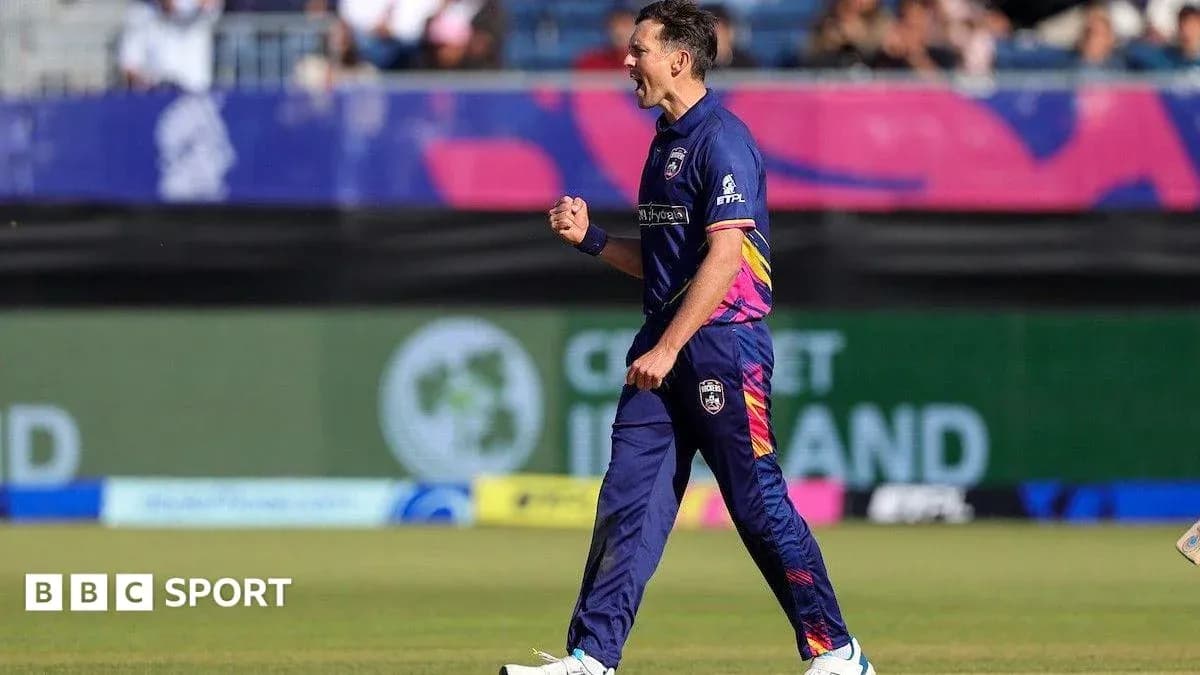
Trent Boult, all rhythm and menace with the new ball, removed Paul Stirling for just eight. One of Europe’s most dangerous hitters gone, Belfast immediately on the back foot.
From there, the innings belonged to Tim Tector. While partners came and went, he held the Wolves together with a measured, composed 84 from 62 deliveries. It was not a blaze of chaos. It was a captain’s-style knock in everything but name: controlled, busy, and crucial.
Around him, the innings frayed.
Glenn Maxwell managed only three. Lorcan Tucker scratched his way to six. Both were back in the pavilion far earlier than Belfast would have planned, leaving Tector to rebuild almost alone.
Curtis Campher and Harry Manenti tried to inject life into the innings, but it was Tector who did the heavy lifting. He found some support when Conway arrived, adding a useful 29 before JJ Smuts cut that partnership short.
Even then, Belfast never quite broke free. Manenti’s unbeaten 16 from 14 balls nudged them along, but it never felt like a total spiralling out of control for Edinburgh.
The final ball of the innings underlined that sense. Tom Curran, mixing his pace cleverly at the death, finally prised out Tector, preventing the late surge Belfast craved and closing the innings at 150-5.
Competitive, yes. Intimidating, no.
Adair’s spark, then the Gous takeover
Edinburgh’s reply began with intent. No cautious prodding, no nervous sighters. Ross Adair went straight at the chase.
He hammered 23 from just 14 balls, setting the tone and forcing Belfast’s bowlers onto the defensive almost immediately. When he fell, the platform was already in place.
Smuts followed not long after for 15, and for a brief moment Belfast sensed an opening. Two set batters gone, a final on the line, the pressure starting to creep in.
Gous shut that door.
He played the chase with the calm of a man in complete control of his game. Early on, he worked the gaps, turning over the strike, refusing to let the Wolves’ attack build any kind of sustained pressure.
Then he began to open his shoulders.
Eight fours. Four sixes. Each boundary chipped away at Belfast’s belief. Every clean strike pushed Edinburgh closer to the trophy and dragged the game further from the Wolves’ reach.
Where Belfast’s innings had stuttered, Edinburgh’s moved with a steady, unhurried rhythm. The required rate never ballooned. There were no wild swings of momentum. Just Gous, anchored at one end, steering the chase with ruthless clarity.
Wickets fell around him, but never in clusters, never enough to shake his grip on the match. By the time the game slipped into its closing overs, the contest had the feel of a formality.
Edinburgh crossed the line at 151-3 in 18.4 overs, Gous still there, unbeaten, the defining figure of the final.
A new name, a new standard
For a new tournament searching for identity, this was a fitting finale.
Boult’s early incision, Curran’s last-ball strike, Tector’s lone stand, Adair’s spark, and Gous’ commanding chase combined to give Malahide a final worthy of the occasion.
Edinburgh Castle Rockers walk away as the first champions of the European T20 Premier League, a line in the record books that can never be erased.
Belfast Wolves leave with regrets and a sense of what might have been. Edinburgh leave with a trophy, a statement, and a standard for every team that follows in this competition’s footsteps.