India Dominates Asia Cup Final as Mandhana and Verma Shine
India did not just retain their Women’s T20 Asia Cup crown. They underlined ownership of it.
On a humid Sunday, with the pressure of a final supposedly in the air, Smriti Mandhana and Shafali Verma turned the contest into a mismatch inside an hour, setting up a 72-run demolition that delivered India a fourth title in the competition.
By the time Sri Lanka finally separated the openers, the trophy already felt as good as engraved.
Verma lights the fuse, Mandhana conducts the chaos
Verma began not with brute force, but with touch. Two gentle deflections off Mithali Ayodhya – one steered past gully, the next nudged to midwicket – skipped away for fours and set the tone. The brutality arrived soon enough.
Chamari Athapaththu bore the brunt. Verma freed her arms, launching two sixes in four balls, and the final’s tempo lurched sharply in India’s favour. The crowd sensed it. So did Sri Lanka.
Mandhana, who has so often been the aggressor in this partnership, slipped easily into a different role. She punched the first ball of the innings for four, then settled into a rhythm of busy ones and twos, letting Verma set the field ablaze while she quietly stacked up her own tally.
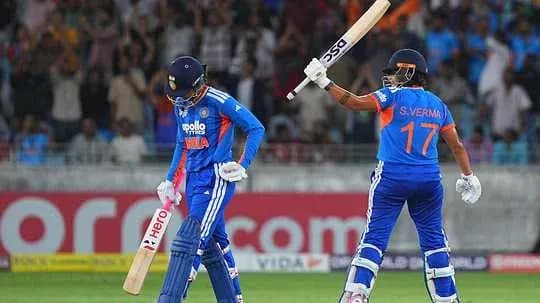
The scoreboard raced. Verma, having started steadily, suddenly went through the gears and tore to the fastest fifty in Women’s T20 Asia Cup history, reaching the landmark in 24 balls – one delivery quicker than Mandhana’s mark from 2022. Against Chamudi Praboda she cashed in again, punishing anything remotely loose with another pair of back-to-back boundaries.
Her third fifty of the tournament arrived as early as the eighth over. Sri Lanka were already gasping.
At the other end, Mandhana’s restraint did not blunt the damage. Together, the pair marched India to yet another statistical milestone, equalling the world record for the most 100-plus stands for any wicket in women’s T20Is – six. By the 12th over, India had cruised to 120 without loss. A final was slipping, almost unnoticed, out of Sri Lanka’s reach.
A stutter, not a collapse
Something had to give, and it finally did in the 13th over. Verma’s dismissal offered Sri Lanka a sliver of daylight. The very next twist was self-inflicted: a dreadful mix-up between Mandhana and Harmanpreet Kaur left India’s vice-captain stranded and run-out, cutting short what had been a masterclass in controlled aggression.
The momentum stalled. With the platform begging for a late assault, India’s middle order instead found itself chasing the rate it had created. Wickets fell in the scramble to keep the tempo high, Sri Lanka’s bowlers briefly finding reward as batters perished in the attempt to maintain the early carnage.
Yet the damage from the openers had been so severe that even a wobble could not drag India back to par. Freshly drafted in for Pratika Rawal, G Kamalini provided the last flourish, launching the final ball of the innings for six to push India beyond 180 – a towering score in this competition.
A chase haunted by history
Sri Lanka knew the scale of the task. Only once had a side chased more than 150 in a Women’s T20 Asia Cup match, and that solitary success belonged to them – against this same Indian side in the 2024 final.
Two years on, the script flipped.
Any dreams of a repeat evaporated almost immediately. Imesha Dulani tried to impose herself with a lap shot first up, but when she went back to the stroke four balls later, Kranti Gaud had her measure. Fired up, Gaud shattered the stumps and sent Dulani on her way with a fierce send-off that spoke volumes about India’s intent.
Sri Lanka crawled through the early overs, the chase stuck in first gear. Then Athapaththu, as she so often does, tried to rip it open. She slog-swept Verma – now with ball in hand – for a six and plundered 12 from the over, finally injecting some life into the pursuit.
Vishmi Gunaratne joined in, and for a short while, Sri Lanka looked composed. The pair pushed the total past 50 without further loss, Athapaththu then turning her attention to Prema Rawat, taking 11 from the over with a six and four off consecutive deliveries. The Indian camp, so dominant for so long, suddenly had something to think about.
Deepti and Charani slam the door
The tension did not last. Deepti Sharma’s second over ended the contest.
Athapaththu, eager to keep the pressure on, charged down the track at the off-spinner. Deepti held her nerve, drew the misstep, and had her stumped. In that moment, India grabbed the game back by the throat.
Three balls later, Gunaratne’s stumps were rattled as well. Two set batters gone in one over; Sri Lanka’s fragile middle order exposed to a target that now loomed like a mountain.
From there, Shree Charani took over. The year had already been kind to her, and she bowled like a player in complete command of her craft, slicing through the middle order and snuffing out any lingering hope of a miracle chase. The scoreboard slowed to a crawl, then began to crumble.
Beyond the top three, only Nilakshika Silva managed to reach double figures. Everyone else folded, one by one, against India’s spin-heavy squeeze. The chase never truly threatened to become a contest again, and Sri Lanka were eventually bundled out for 111.
A margin that echoes across formats
The 72-run victory stands as the second-biggest win in the final of a five-plus team tournament in Women’s T20Is, bettered only by Australia’s 85-run hammering of India in the 2020 T20 World Cup final at the MCG.
That is the company this Indian performance now keeps: ruthless, clinical, and utterly dominant on the biggest regional stage.
Four Asia Cup titles in the bag, a record-breaking opening pair in full flow, spinners dictating terms under pressure – the question no longer is whether India are the standard in this tournament.
It is how long anyone else can live with them.