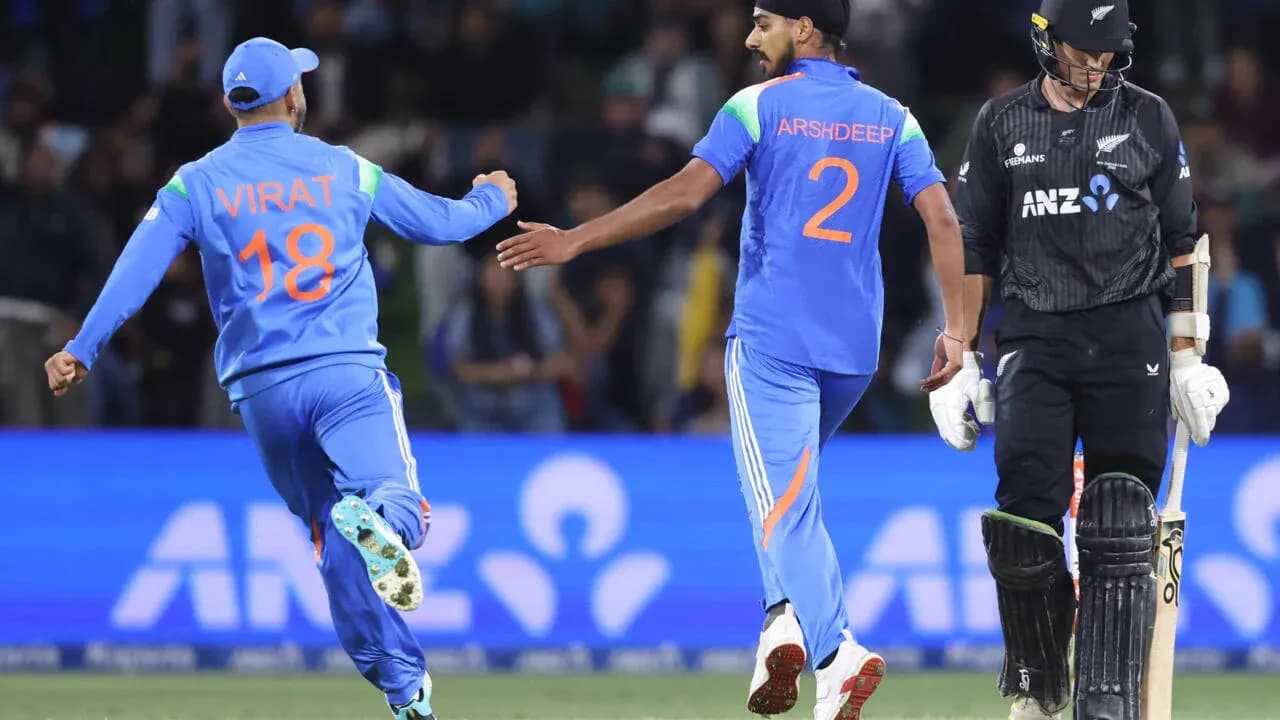
India Crumble in Series Decider as New Zealand's Bowlers Dominate
MOUNT MAUNGANUI — On the same Bay Oval strip that chewed India up 24 hours earlier, New Zealand’s bowlers went back for seconds. The visitors walked into the series decider needing steel; they found only resistance in patches, swallowed by a relentless home attack led by captain Mitchell Santner and the pace of Will O’Rourke Fisher and Jacob Duffy.
By the 36th over, India were 166 for 8. The contest, and with it a chance to stamp authority on the tour, had been dragged to the brink.
A farewell that fizzled
If this really is the last sight of Rohit Sharma and Virat Kohli in professional cricket on New Zealand soil, it will not be replayed fondly in Indian dressing rooms.
Rohit’s series never left the runway. He scratched together just 30 runs in four innings, including two ducks, and here he departed for 7 off 13, undone by Fisher’s change of pace. The seamer stayed full, took a little pace off, and Rohit flicked tamely to Dean Foxcroft at mid-wicket. India 23 for 1 in the sixth over, the tone already uneasy.
Kohli at least had that luminous 74 in Auckland to point to, but after that, the numbers fell off a cliff: only 12 runs in his next three innings, one of them a duck. In Mount Maunganui, he lasted seven balls. Fisher went short and wide, Kohli threw everything at it, and only a top edge answered. Tim Seifert sprinted, leapt to his right and held on. Kohli gone for 5, India 33 for 2 in the seventh over, and the Bay Oval crowd knew they were watching an era creak, not roar.
“Not the fondest farewell for Ro-Ko,” the scoreboard might as well have said. The numbers did the talking.
Gaikwad’s window closes
With Shubman Gill missing the final two ODIs, this mini-tour was a golden audition for Ruturaj Gaikwad. It slipped through his fingers.
He had started brightly here. A streaky edge and a neat clip off Fisher brought early boundaries, then he picked up a shorter ball and pulled it with authority over mid-wicket — one bounce to the rope, India 33 for 1 and Gaikwad looking freer than he had all week.
The platform, though, never hardened. Duffy, nagging and disciplined, went fuller and got the ball to nip back. Gaikwad drove, inside edge, Seifert did the rest. Out for another modest score, India 37 for 3 in the ninth over.
Across two innings in New Zealand with Gill absent, Gaikwad mustered only 23 runs. Since late September, he has played just five ODIs, with a lone standout – 57 in New Chandigarh against West Indies. This was the stage to demand more chances. Instead, it felt like a wasted opportunity.
Axar fights as the lights go out
At 47 for 3 after 11 overs, with New Zealand’s slips buzzing and India’s top order in retreat, Axar Patel walked in and did what he has increasingly done for India in white-ball cricket: he absorbed the chaos.
He and Shreyas Iyer were both reprieved early – Iyer shelled by Finn Allen at third slip, Axar surviving a run-out scare the very next ball – but they used that slice of fortune to start a rebuild. A 34-run stand off 35 balls steadied India at 68 for 3 after 14 overs, even as the pitch kept misbehaving, sometimes gripping, sometimes leaping.
Axar then shifted gear. A four off Kristian Clarke at the end of the 14th over, followed by a clean six off Blair Tickner, hinted at a counterattack. And then, in a scene more suited to a village game than an international decider, the broadcast went dark. A power cut at Bay Oval left viewers relying on sporadic camera angles and score updates while India’s most assured batter tried to drag his team forward.
He did it with typical economy of movement. A crisp cover drive off Tickner brought up India’s hundred. Another short ball, another punch off the back foot past backward point, and the visitors were 107 for 4 after 22 overs, Axar having faced more deliveries than anyone else in blue.
He looked set for a statement fifty. Then the pitch bit back.
On 46, Axar went for the lofted stroke over midwicket, only for the ball to stick just enough in the surface. The shot lost its power, hung in the air, and sailed straight to the fielder. Michael Bracewell wheeled away with the wicket. Axar stood, staring at the pitch in disbelief, knowing how much more India needed from him. At 121 for 5 after 25 overs, the innings lost its anchor.
Ishan holds on as New Zealand hunt
Iyer, who had scratched his way to 22 off 26, never quite settled. When the power returned, the picture for him darkened. Tickner dug one in short, Iyer miscued, and mid-on accepted the chance. The broadcast angle from deep cover captured his walk back more clearly than the dismissal. India 97 for 4 in the 21st over, the middle order again failing to convert starts into substance.
Ishan Kishan, meanwhile, lived dangerously. Tickner cramped him with a short ball that nipped back; Ishan’s attempted pull produced a noise and a catch for the keeper. New Zealand went up in unison, but the ball had brushed thigh, not bat. He survived, and immediately answered with a boundary, a reminder of the strokeplay still available if he could just stay in.
He did, inching into the 20s as India shifted into survival mode. At 138 for 5 after 29 overs, with Naman Dhir for company, the instruction was clear: protect the tail, drag the game deep. Boundaries became rare, risk even rarer. New Zealand sensed it and tightened the screws.
Santner shuts the door
Every time India hinted at a partnership, Santner found a way to snap it.
First, he went after Dhir. Slowing the ball right down, he tempted the debutant into a big swing over deep cover. Dhir, on 22, took the bait, went through with the stroke, and picked out the fielder on the rope. A clever change of pace, a soft dismissal, India 160 for 6 in the 34th over.
From there, the collapse accelerated.
Auqib Nabi lasted only nine balls. Santner tossed one up, Nabi drove, and Allen at cover did the rest. Out for 5, India 166 for 7, New Zealand’s spinners now feasting on a nervous lower order.
The captain wasn’t done. In a ruthless double-wicket maiden, he removed debutant Yash Thakur for a duck with the final ball of the over. From the other end, Ishan could only watch as the innings crumbled around him. India 166 for 8 after 36 overs, Santner with figures that mirrored his grip on the game.
This was control, not just containment. Fields set like traps, pace varied by fractions, India’s batters coaxed into errors they could not afford.
Old scars, familiar questions
All this played out on the very pitch where, a day earlier, Matt Henry had ripped through India with a six-for, including three wickets in his first over, to bundle them out for 89 in a chase of 334. His spell had dragged minds back to the 2019 World Cup semifinal and that grim morning in Manchester. The question at the start of this decider was simple: did India have an answer to Henry and to conditions that exposed their technique and temperament?
The answer never really arrived. Henry’s threat loomed, but it was Fisher, Duffy, Tickner, Bracewell and Santner who shared the damage, each over tightening the noose.
There was one bright spot for India before the slide: the return of Mohammed Siraj, backed by captain Iyer at the toss as a bowler “craving an opportunity” across formats, and the debut of Yash Thakur. Both represented India’s desire to test their bench strength on this tour.
By the time Santner was wheeling away with his arms aloft, though, the story had shifted from experimentation to survival.
India came to Mount Maunganui with a 2–1 lead and a chance to close out a hard-fought series. They walked into a familiar New Zealand storm instead, their senior batters misfiring, their hopefuls squandering auditions, their middle order leaning too heavily on Axar and Ishan.
On a ground that has so often exposed visiting teams, the bigger question lingers: when the ball grips, seams and asks hard questions, who in this Indian batting line-up truly has the answers?