India U19 Claim Asia Cup Title in Thrilling Last-Ball Finish
Under the lights in Al Amerat, with the equation stripped bare to three needed from one ball and a continental title on the line, a No.10 decided he wanted the moment for himself.
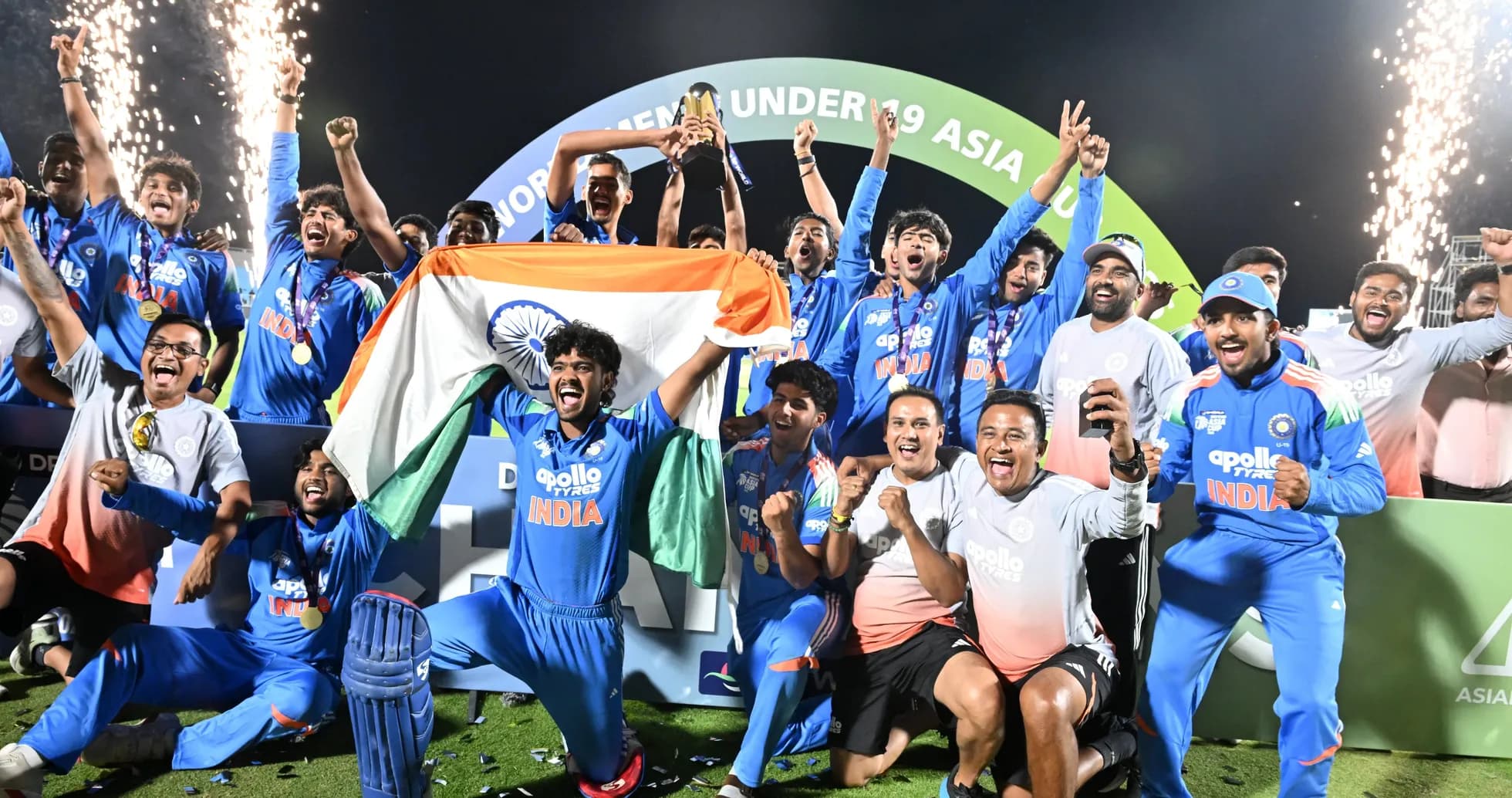
Mohit Ulva charged down the pitch, swung through the line, and sent the ball skimming to the boundary to haul India U19 to a scarcely believable one-wicket win over Pakistan and the 2026 ACC Men’s U19 Asia Cup crown in Oman on Saturday.
Scoreboard pressure. History. Rivalry. All of it beaten by a 26-ball 49* from a teenager batting at ten.
A chase that lurched from control to chaos
Set 338 to win after Pakistan piled up 337/9, India began the pursuit with the composure of a side that had learned from its group-stage defeat to the same opponents.
Captain Lakshya Raichandani and Aaryavir Sehwag walked out as if in a bilateral, not a final. They left well, punished width, and slowly stripped the tension from the stands. The pair stitched together 95 for the first wicket, a partnership that gave the chase its spine.
Sehwag was the first to break free, timing the ball crisply in a 58 off 61 deliveries that kept India ahead of the rate. Raichandani played the counterweight, soaking up pressure and building an 80 from 101 balls that looked tailor-made for a successful pursuit.
Then the game turned.
Pakistan’s bowlers, who had worn the early assault, refused to fold. Wickets began to puncture the innings. The middle order never quite settled, and what had looked like a controlled chase started to fray.
From 95 without loss, India found themselves staring at the abyss at 252/8. The dressing room balcony grew crowded. Every dot ball felt heavier. Every misfield drew a roar.
Manal Chauhan and the first rescue act
Into that storm walked Manal Chauhan.
With the required rate climbing and Pakistan’s fielders circling, Chauhan counter-attacked. He picked his areas, refused to be boxed in, and carved 47 off just 32 balls. His intent dragged the game back from Pakistan’s grasp, if only slightly.
Crucially, he found an ally in Ulva.
Together, Chauhan and Ulva added 57 for the ninth wicket, a stand that rewrote the mood of the evening. Singles turned into twos, mishits into calculated risks. The equation, once daunting, began to shrink.
Then, just as India dared to believe again, Chauhan fell. Another twist, another intake of breath. India still needed runs; Pakistan needed just one more ball to land cleanly.
Ulva and Venkata: last pair, cold nerves
At 282/9, with the final teetering, Chigurupati Venkata walked out for his first appearance of the tournament. No sighters, no easing in. Just a continental final, a rampant attack, and almost 60 runs still to get.
He did not flinch.
Where Ulva exploded, Venkata held shape. He rotated the strike, picked off gaps, and finished unbeaten on 11 from 8 balls. His numbers were modest; his contribution was anything but.
Ulva, sensing this was his night, went after Pakistan’s death bowlers. He cut, pulled, and drove with a clarity that belied the occasion. Boundaries arrived just when India needed them most, the target shrinking with each clean strike.
The pair added an unbroken 30 for the last wicket. Every run felt like a small act of defiance. Every misfield, every overthrown return, chipped away at Pakistan’s composure.
Eight were needed from the final over. One wicket in hand. The kind of scenario that scars or forges a young cricketer.
Ulva chose the latter.
By the time it came down to three off the last ball, both dugouts were on their feet. Ulva advanced, met the ball sweetly, and sent India charging onto the field in a blur of blue. A last-ball boundary to win an Asia Cup final against Pakistan. Some finishes live forever; this was one of them.
Pakistan’s platform: Usman’s hundred and a brutal middle order
That India needed every last run was down to Pakistan’s imposing work with the bat earlier in the day.
Having opted to bat on a true surface, they built a total that, for long stretches, looked match-winning. Usman Khan anchored the innings with a composed 107 off 111 balls, the kind of century that allows others to swing hard around it.
Abdul Qadir did exactly that.
His 80 off 54 deliveries injected chaos into the middle overs, ripping into spin and pace alike. Captain Farhan Yousaf added 63 off 60, ensuring Pakistan never drifted after each wicket. The scoreboard kept ticking, then racing, towards 337/9 — a total that screamed “final pressure.”
India needed someone to drag those numbers back into range. Kavya Patel stepped up with the ball, taking 4/68 and breaking crucial stands just as Pakistan eyed an even bigger total. Venkata, before his heroics with the bat, chipped in with 3/40, his spell a reminder of why the management trusted him in the biggest game of the campaign.
Those wickets at the back end mattered. Without them, the chase might have been buried before it began.
Revenge, character, and a title
This was more than a trophy for India U19. It was payback.
They had been beaten by Pakistan in the group stage. Outplayed, out-thought. That defeat could have lingered. Instead, it sharpened them. The same opponent, the same colours, a far bigger stage — and this time, India refused to blink.
From Raichandani’s controlled leadership at the top, to Patel’s persistence with the ball, to Ulva’s fearless finish and Venkata’s steel in his first outing of the tournament, this was a campaign that built towards one defining night.
Player of the Match went, fittingly, to Mohit Ulva for his unbeaten 49 off 26 balls. A No.10 on the teamsheet, a No.1 in the moment that mattered.
Years from now, when this group scatters into senior cricket and beyond, they will remember the noise, the tension, and that last ball in Al Amerat.
Pakistan had the runs. India had the nerve. And that, in the end, decided a final that will echo through this rivalry for a long time to come.