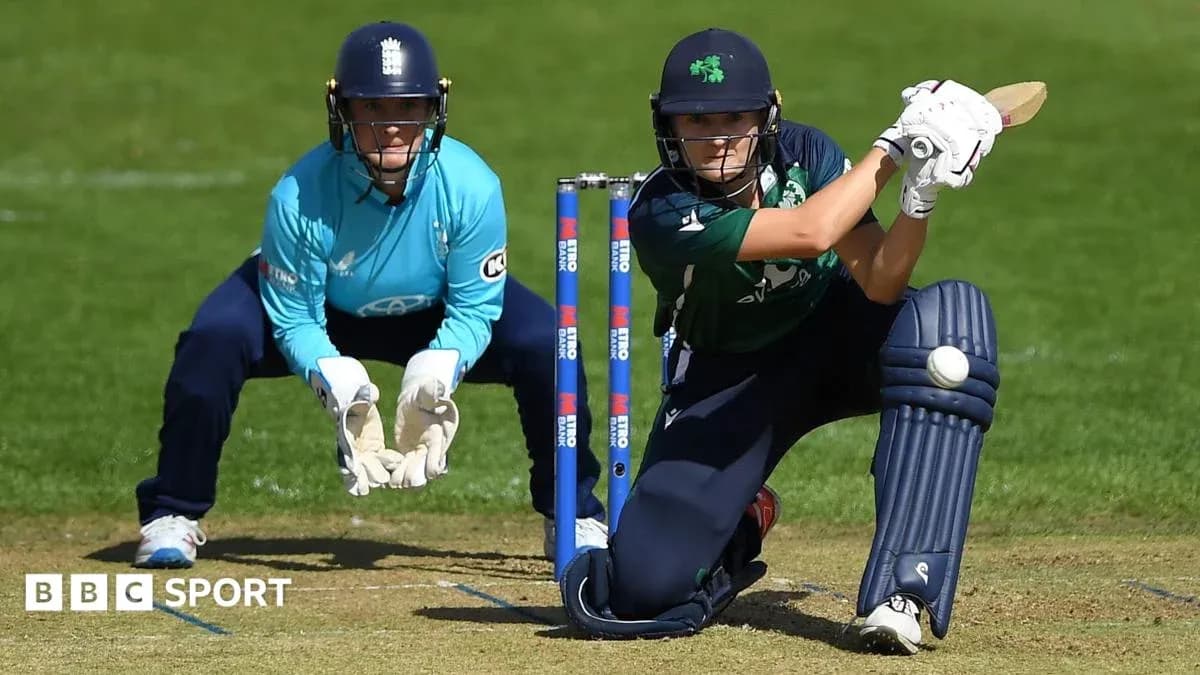
Issy Wong and Mady Villiers Spark England's Fightback
For most of Ireland’s innings, it felt like Gaby Lewis and Orla Prendergast were walking England into a corner. Runs flowed, the ball softened, and the fielders chased hard leather across the rope. Then Issy Wong and Mady Villiers yanked the contest back.
The first crack came at 149-2. Lewis, set on 69 and looking immovable, finally misread one. Wong, having switched ends and found her rhythm, pushed it through with a bit of fizz and just enough nip off the surface. Lewis’ bat came down a fraction late, the gate opened, and the ball crashed into the stumps. Wong exploded into a leap, a roar that told you exactly how much that wicket meant.
Up to that point, Wong had looked loose, struggling with her lines. The change of ends transformed her. The wayward stuff disappeared. Prendergast, such a key figure for Ireland, was pinned on nought, forced to respect a bowler suddenly in control rather than chasing a release shot.
That wicket shifted the mood. England, who had been flat and searching, suddenly had a foothold.
Ireland still had a platform at 165-2, still threatening something imposing. Tilly Corteen-Coleman, though, couldn’t quite clamp down. A ball dragged too wide, despite a packed off-side field, disappeared for four and was compounded by the call of no-ball. It summed up a slightly untidy spell: effort there, control missing. Ireland cashed in.
Yet the pressure didn’t all belong to the batters. At 156-2, Alice Capsey delivered a small moment that hinted at a bigger future. Standing up to the stumps to Wong, in only her second professional match as a wicketkeeper, she plucked a rising ball near shoulder height. It was a difficult take made to look simple, the kind of skill that earns trust quickly in an international dressing room. Those around England had suggested she could take on this role at the start of the summer; the evidence is growing.
Ireland pushed on to 172-2, Prendergast beginning to free her arms. Then came the twist. Villiers, who had been the most threatening spinner all day, finally got her reward – in the most scruffy way possible.
She dragged one down, short and there to hit. Prendergast did exactly that, timing it too well. The ball flew to deep mid-wicket, where Maia Bouchier had ground to make and a decision to commit to. She went hard to her right, tumbled forward, and clung on to a superb catch. A poor ball, a clean strike, and a wicket that changed the temperature of the innings.
Prendergast was gone for 19. Ireland, cruising at 172-2, suddenly stood at 172-3. A big moment, and England knew it.
The numbers told you why Villiers kept being in the game. She had spun the ball more than any other England spinner on show – 2.8 degrees of turn compared with Corteen-Coleman’s 2.2 and Charlie Dean’s 2.0 – and she kept aiming at the stumps, attacking one in every four deliveries. She wasn’t just containing; she was hunting.
Her intensity ran through every action. In the field, she sprawled full length to her right to cut off a boundary off the final ball of her over, a diving stop that drew as much appreciation as a wicket. It was the sort of effort that drags teammates with you.
By 174-3, Rebecca Stokell had joined the fray. She missed her first ball, looking to drive, then settled with a neat stroke second up to get off the mark. Ireland still had runs on the board and time to build again, but England’s bowlers no longer looked like passengers in someone else’s script.
The passage from 149-2 to 174-3 belonged to Wong and Villiers – one ripping out the set batter, the other twisting the ball sharply and forcing errors from players who had been dictating terms.
If this is the standard of England’s next wave – Wong recalibrating mid-spell, Villiers attacking with real bite, Capsey growing into the gloves under pressure – then days like this won’t just be about surviving Irish momentum. They’ll be about seizing it.