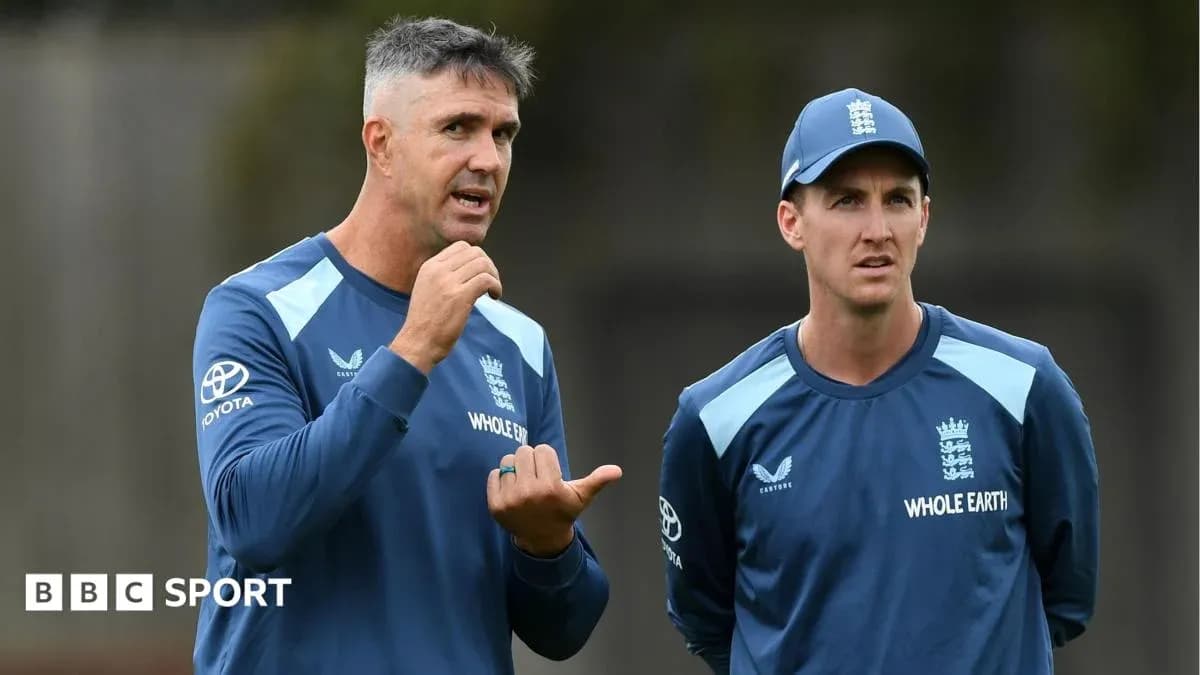
Kevin Pietersen Returns as Mentor for England's World Cup Squad
Kevin Pietersen back in England colours. Not in the middle this time, but in the dressing room, as a mentor guiding a 50-over side towards a World Cup in South Africa next autumn.
For a lot of people, the news jarred. His last meaningful engagement with the ECB was that fateful meeting at Lord’s in 2014, when he was told his England career was over. Since then, he has built a lucrative life elsewhere – fronting his YouTube channel, The Switch, and living as a globe-trotting pundit and personality. The idea of him diving back into the grind of an international setup felt, on the surface, unlikely.
Step back, though, and it starts to make sense.
A dressing room that needs friction
Pietersen is blunt. He can be confrontational. He has never been one for soft edges or polite silences. Yet dressing rooms, the serious ones, need that edge. They cannot survive as echo chambers where everyone nods along and no one gets challenged.
On England’s white-ball tour of India last year, working for the host broadcaster, he tore into what he saw as a creeping complacency. Players were skipping extra practice, rolling into games undercooked. That, to Pietersen, bordered on a sin. His own training sessions had always been fierce, purposeful, and laced with a kind of theatre.
He would walk into the nets, look a bowler in the eye and announce he was going to smash them everywhere and not get out. It was part wind-up, part psychological warfare, and wholly deliberate. It raised the temperature. It made the net session feel like a contest, not a warm-up. Bowlers tried to bowl quicker, sharper, angrier. He wanted that. He needed that.
Those battles made people better. They made him better too.
Arguments would flare over imagined field settings, over whether a lofted stroke would have gone to hand, over how many runs he’d “scored” off a particular ball. It was relentless, competitive, sometimes exhausting. But it was elite preparation. The kind of environment that strips away comfort and exposes standards.
Ahead of his time, obsessed with work
Pietersen was never just a shot-maker with a flair for the dramatic. He was a thinker. The inventor of the switch hit. One of the earliest and loudest advocates of the IPL when many in England still looked at franchise cricket with suspicion. Flamingo flicks through mid-wicket in Test matches, that audacious blow sending Glenn McGrath back over his head for six at Lord’s in 2005 – his game was built on daring, but underpinned by hours of unseen graft.
He never believed he had “cracked” cricket. Not for a second.
In 2012, in Sri Lanka, he turned up early at the SSC in Colombo for what was officially just a warm-up day. While others drifted in, he had already spent an hour facing local left-arm spinners, trying to iron out a technical flaw that had nagged at him for years. The sessions were intense, almost obsessive. Ironically, Andy Flower – the man who would later oversee his exit – watched on.
The payoff came in the form of one of his great Test innings: a brutal, brilliant 151 against Rangana Herath in the second Test, dismantling a high-class spinner and hitting him to all parts. Later that year, in India, he repeated the trick. His runs there, particularly in Mumbai, formed the backbone of a historic series win. Those knocks did not materialise out of thin air. They came from the lonely hours when no cameras rolled and no crowds roared.
That is the mentality England are tapping into now.
Helping others face the fire
Pietersen’s work ethic was never solely about his own game. In Perth during the 2013-14 Ashes, as Mitchell Johnson and his moustache tore through England’s order, fear crept in. Tailenders sat in corners of the dressing room, shellshocked at the thought of walking out to face another barrage of short balls.
KP spotted it. He walked over and said: “Let’s go practice facing the short ball in the nets.” No fuss. No big speech. Just action.
He then spent the session hurling bouncers at a team-mate’s head, helping him develop a method – or, more accurately, an escape plan – against the short stuff. Ducking, swaying, getting used to the sight of the ball whistling past the nose. It may have been as much about getting himself out of a toxic dressing room as anything else, but it helped. It was the kind of practical, brutal support only someone who has lived in the eye of the storm can offer.
That is what he can bring as a mentor: an eye for weakness, and a willingness to drag players into uncomfortable work until those weaknesses shrink.
An unfiltered voice in a new era
Pietersen never hid in team debriefs. If he thought the approach was wrong, or the preparation soft, he said so. Loudly. His dissent towards a fitness-based fielding session before the 2014 Sydney Test is one of several examples. He pushed back, questioned, argued. That attitude helped fuel the perception that he was disruptive.
Some will worry about that now. Why drop a lightning rod into a white-ball environment that has been, by most measures, successful and evolving in the right direction?
Because challenge, handled well, sharpens a team.
Brendon McCullum has already shown with the Test side that he understands the balance between freedom and discipline, between fun and hard truths. Under him, England’s red-ball cricket rediscovered its identity only when standards and roles became clear. The dressing room opened up, but it did not soften.
Pietersen comes from a different financial era, when Test cricket was the primary route to a decent living and technical excellence was non-negotiable. You survived first, then you expanded. You built a game solid enough to carry across formats, not the other way round.
Now, power has shifted. Players can chase franchise deals, hop across continents, and piece together a career without leaning so heavily on their country. The tempo of 50-over cricket, though, sits closer to the modern Test game than to the chaos of T20. It still demands fundamentals: a sound base, a repeatable method, the patience to ride out spells when the bowlers are on top.
That is where Pietersen’s presence makes sense. His mindset – attack built on hard work, flair anchored by discipline – fits what England will need in South African conditions, where there will be days when 350 feels a long way off and survival comes before fireworks.
A necessary jolt before a World Cup
Over the next 14 months, Pietersen will walk back into an England setup that has changed beyond recognition since he last wore the shirt. The players are richer, more travelled, and, in many ways, more powerful. The dressing room is looser, the cricket more expressive.
What it has perhaps lacked at times is an internal agitator. Someone who refuses to let standards drift, who will call out soft sessions, who will question tactical comfort. Someone who will not allow a team to “maraud on” unchecked.
That is what England have signed up for. An unfiltered voice. A challenge from within.
If they embrace it, this could be the most important innings Kevin Pietersen plays for England – without facing a single ball.