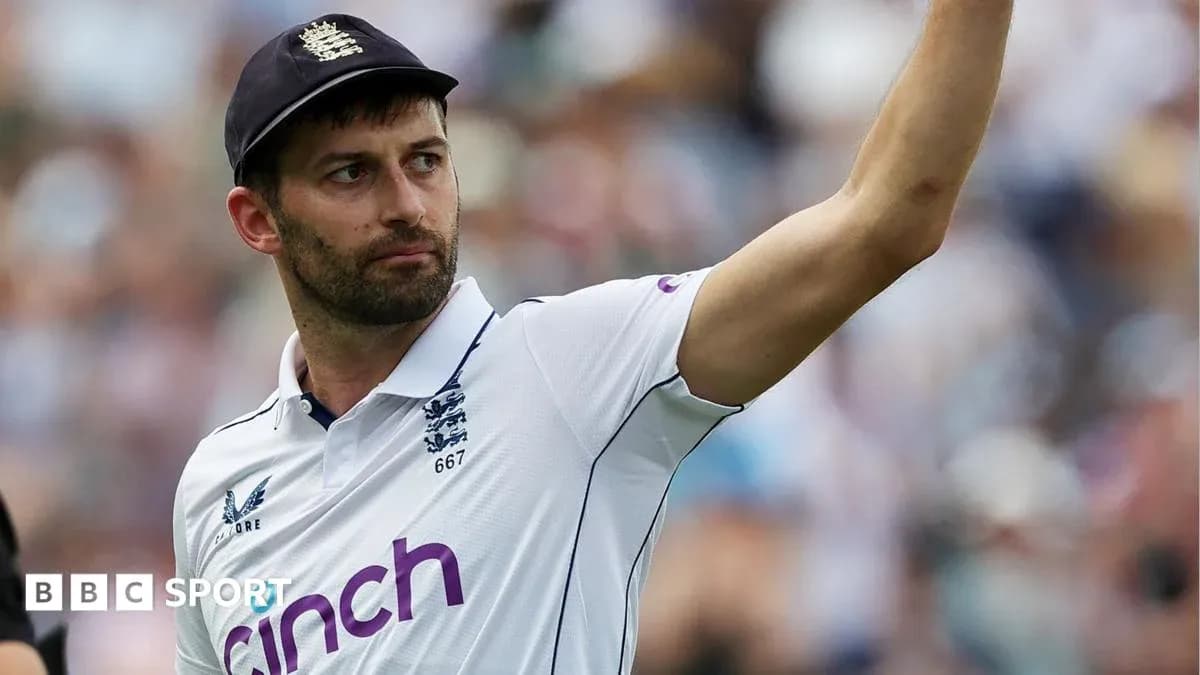
Mark Wood Retires: England's Fast Bowling Star Calls Time on Career
Mark Wood has always lived on the edge of fast bowling’s limits. On Thursday, those limits finally pushed back for good.
The 36-year-old Durham quick, one of the fastest bowlers ever to pull on an England shirt, has retired from international cricket with immediate effect, drawing a line under a career that thrilled crowds, shredded stumps and repeatedly tested the tolerance of his own body.
“It just feels like a natural time at the end of my contract,” Wood said in a statement on social media, acknowledging what many inside the England set-up had sensed for months. The past year had been a slow goodbye.
A body that wouldn’t let him stay
Wood’s last act for England came in Perth, in the first Ashes Test of last winter. It was meant to be the comeback: 15 months of rehab after elbow trouble and knee surgery, all geared towards one more crack at Australia.
He managed 11 overs.
Swelling in his left knee cut him off mid-stride, sent him home for treatment and, in truth, never really let him back. He has not played for England since.
“On medical advice, Test cricket and 50-over cricket are not possible,” he admitted. “The England dream has slowly been ground out of me over the last year.”
The phrase is brutal, but so was his reality. Ankle, knee, elbow – the catalogue of injuries is as long as his run-up became. For a man who could touch 95mph, the cost of that speed was always steep. In the end, it was too high.
Numbers that only tell half the story
On paper, Wood’s Test career reads: 38 caps, 119 wickets, debut in 2015, Ashes winner that same summer. Add 80 wickets in 70 ODIs, 54 in 38 T20 internationals, a 50-over World Cup winner in 2019, a T20 World Cup winner in 2022.
Impressive, but incomplete.
The stats don’t show Headingley 2023, when England were 2-0 down in the Ashes and desperate. Held back until the third Test, Wood was unleashed like a secret weapon. He charged in with that elongated run-up, flung himself off his feet, and bowled at a speed that made even hardened Test batters flinch.
One ball to Usman Khawaja – a 95mph rocket that detonated the off stump – captured everything about him. Raw pace, violent movement, pure theatre. It was one of the great Ashes spells of recent times, the kind that changes not just a match but the mood of a series.
With the bat, improbably, he was still there at the end. In a nerve-shredding chase, Wood and his great friend Chris Woakes dragged England over the line. Without that partnership, without those spells, England are staring at a heavy Ashes defeat. Instead, they clawed back to 2-2. Wood’s fingerprints were all over that fightback.
Rebuilt run-up, same menace
By 2018, the strain on his body had become impossible to ignore. To save his career, Wood lengthened his run-up, searching for a smoother rhythm and less stress through the crease.
The pace stayed.
St Lucia in 2019 was the warning shot. West Indies ran into a version of Wood that had been remodelled but not tamed, and he tore through them in a spell that hinted at what he might yet become if his body finally played along.
It never quite did, yet those glimpses were enough to shape an era. He was one of the few England players to emerge with any credit from the grim 2021-22 Ashes tour, pounding away on unhelpful pitches, still hitting speeds most bowlers only dream about.
World champion, twice over
Wood’s career is stitched into England’s white-ball revolution. He was in the XI on that unforgettable day at Lord’s in 2019, when England won the 50-over World Cup. He batted with Ben Stokes despite carrying an injury, hobbling more than running, but refusing to disappear from the contest.
He was there again in 2022 as part of the T20 World Cup-winning squad, his role curtailed at the end by a calf problem, another cruel twist in a career full of them. Yet his impact across both formats was undeniable.
He leaves as England’s sixth-highest wicket-taker in men’s T20 internationals, his 54 wickets in 38 games coming at a pace that unsettled even the best. In ODIs, his 80 wickets in 70 matches helped power England through a golden period in white-ball cricket.
Pace, personality and what might have been
Anyone who has ever tried to bowl fast knows the fantasy: ball screaming through, batters ducking, stumps cartwheeling. Wood lived that fantasy for real.
The sight of him sprinting in, hair streaming, hurling himself through the crease and sometimes clean off his feet was one of the great modern images of English cricket. He didn’t just bowl quickly. He bowled with joy.
He connected with supporters, joked, played up to the crowd. He never seemed to forget that cricket, for all its pressure and pain, is supposed to be fun. That personality, as much as the speed gun, made him a fan favourite.
Yet the question lingers: what if his body had held up? How many more Tests? How many more Ashes spells like Headingley? The human frame is not built to withstand the violence of genuine pace, and Wood paid more than most.
Rob Key, England’s managing director of men’s cricket, summed it up simply: “To have been a point of difference in Ashes series wins, two World Cup wins, and to have thrilled crowds every time he got the ball in his hand is something very few players achieve. He can look back with enormous pride on a career very well spent.”
End of an era
Wood’s decision comes at a time of sweeping change in England’s attack. Stuart Broad has gone. James Anderson has gone. Woakes has stepped away. Now Wood joins them.
Add in the all-round heft of Ben Stokes whenever he finally puts his bowling boots away, and England are staring at the loss of 1,871 Test wickets in less than three years. Experience, nous, and in Wood’s case, the kind of pace you simply cannot coach.
He does not leave the game entirely. Wood has made it clear he hopes to continue playing cricket in some capacity, most likely on the franchise circuit, where his pace will still be a prized commodity.
For England, though, the chapter is closed. The last man in their Test side to have won both World Cups and the Ashes has walked away. Only Joe Root remains from the team that reclaimed the urn in 2015.
The fastest of them has gone. The question now is not just who replaces his wickets, but who dares to chase that kind of speed again, knowing exactly what it can take from you.