Ollie Robinson: Redefining English Seam in 2026
Matt Henry had days when he looked unplayable. Nathan Smith too. Mohammad Abbas, at his own walking pace, made batters feel as if every shot was a multiple-choice question with no right answer.
But the 2026 English summer has one name stamped all over it. Ollie Robinson.
He arrived on a comeback trial. He has ended up redefining the conditions.
A season that belongs to medium pace
The numbers are outrageous. Robinson has averaged 7.96 with the ball this summer. Not in a county stint, not in a two-Test cameo. Across four Tests, with another innings still to come.
Henry sits next on the list at 13.33. Abbas at 20.80. Josh Tongue and Jofra Archer have had strong seasons at opposite ends of the speed gun, but they have not matched Robinson’s ruthless efficiency.
The broader picture is just as telling. Balls under 80mph have taken 40 wickets at 17.92, striking every 33.4 balls and going at only 3.21 an over. The quicker stuff, above 80mph, has taken three times as many wickets, but at a higher average of 23.38. Only once in the ball-tracking era has sub-80mph bowling produced a better average in an English summer: 2019, when 26 wickets at 17.42 were largely fuelled by Ireland’s three-day ambush at Lord’s.
This year, the medium pacers have not merely survived in a quick-bowling world. They have dictated it.
Conditions have helped. In the ball-tracking era, stretching back to 2006, only one English summer has offered seamers a lower expected average than 2026. The expected figure is 23.6. The actual? 22.14.
This has not been a grind for bowlers. The ball has moved, the length has mattered, and uncertainty has been a constant. Wobble seam has become the season’s signature.
And that has changed where wickets come from.
Traditionally, English seam has hunted outside edges and slip catches. This summer, the stumps have taken centre stage. Bowled and lbw dismissals have accounted for 45.6% of all wickets – the highest proportion in an English summer since the war ended in 1945. The ball has not just kissed the bat; it has threatened the pads and rattled the timber.
That is where the medium pacers have walked in. With keepers often standing up, they have attacked the stumps, using movement rather than raw pace to prise errors. The aim has been simple and brutal: force batters to defend their stumps against a ball that will not behave.
Nobody has done that better than Robinson.
False shots, true dominance
Robinson has 26 wickets in four Tests this summer, with another innings still available, at 7.96. He collected Player-of-the-Match awards in each of his first three appearances. The last England player to do that in three consecutive home Tests was Ian Botham in 1981 – a summer that came to be known by one man’s name.
The numbers behind the wickets are just as stark. Robinson has induced a false shot with 39.7% of his deliveries. Two balls in every five. No bowler in an English season, for which such data exists, has made batters play the wrong stroke more often. Abbas sits second this year at 32%, a full tier below.
This is not a bowler living off edges alone. It is a bowler forcing constant misjudgement.
The context makes it even more remarkable. Two years ago, Robinson was nowhere near England’s plans.
Dropped, then redesigned
By early 2024, despite outstanding figures across his first 20 Tests, Robinson had disappeared from Brendon McCullum’s blueprint. England wanted more pace to crack Australia. Robinson, with his mid-130s rhythm and old-fashioned seam, was parked for 24 months.
The raw career numbers, though, have always belonged in elite company. In 24 Tests, he has 102 wickets at 19.10, with an innings still to play. At the same stage of his career, Jasprit Bumrah had 101 wickets at 22.79. Robinson’s strike rate stands at 42.5; Bumrah’s was 51.4. Robinson has already collected six Player-of-the-Match awards; Bumrah had one at that point.
Since Robinson’s debut in 2021, only Travis Head has more POTM awards in Tests – 10 in 48 matches. Robinson’s six have come in just 23, meaning he walks away with the individual prize in over a quarter of his games. No one else touches that share.
And yet the most interesting part of this comeback is not what stayed. It is what he has stripped away.
Less swing, more seam, better length
Robinson 2.0 is not the same bowler who broke through in 2021.
His average swing has almost halved from that debut summer, dropping from 1.06 degrees to 0.55. At the same time, his average seam movement has climbed from 0.72 to 0.85 degrees. The ball is doing less in the air and more off the pitch.
His discipline has tightened as well. The proportion of deliveries in the good-length zone – that 6-8 metre band that keeps batters guessing – has risen from 61.2% in 2021 to 69.5% this summer.
This is the essence of the new Robinson. He runs in, hits that length, and lets the wobble seam turn every ball into a question mark after it lands. The air is no longer his main ally; the pitch is.
The shift in method has brutal consequences for left-handers.
Around the wicket, around the throat
Between 2021 and 2024, Robinson averaged a respectable 28.32 against left-handers. Solid, not spectacular. In 2026, that number has crashed to 6.60. Eleven wickets from just 262 balls.
The angle tells the story. During his first stint, only 37% of his deliveries to left-handers came from around the wicket. From that line, he took seven wickets in 584 balls at 39.28. Useful, but hardly terrifying.
This summer, he has gone all in. Eighty per cent of his balls to southpaws have come from around the wicket. Ten wickets in 210 deliveries at 6.20. The same angle, completely different threat.
He has turned a fashionable method into a weapon. From wide of the crease, the ball angles in, then either holds its line or nips back. Pads, stumps, indecision – all in play.
Robinson has not simply slotted back into England’s attack. He has adapted himself to what English pitches and Dukes balls are offering in 2026: less romantic swing, more hard-nosed seam.
Historic company, modern template
His home record was already among the best of the modern era. This summer has sharpened it into something historic.
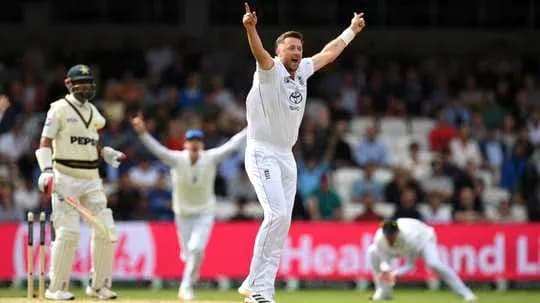
On the first morning of the third Test, Robinson reached his 100th Test wicket. The manner felt entirely in keeping with his reinvention: Saim Ayub, a left-hander, pinned lbw by a nip-backer from around the wicket.
He got to 100 wickets in just 4285 balls – the fifth-fastest in the post-war era, behind only Dale Steyn, Vernon Philander, Waqar Younis and Kagiso Rabada. His career average at that point, 19.10, is the sixth best among the 206 bowlers with 100 or more Test wickets, and the best recorded in the last 100 years.
At home, the numbers are even more stark. An average of 16.05 in England puts him fourth all-time (minimum 50 wickets) and again, the best in the last century.
These are not the figures of a stop-gap seamer. They are the numbers of a bowler who has turned medium pace into a precision instrument.
The summer of 2026 has dragged medium pace back into fashion. Robinson has become its sharpest expression: less swing, more wobble seam, a relentless good length, and a ruthless plan to left-handers from around the wicket. In a season where the stumps have mattered more than the slips, he has kept batters guessing after the ball hits the pitch.
If he holds this level, the question is no longer whether he fits England’s plans. It is how long he can lead them.