Pakistan's Cricketing Struggles Highlighted by England's Whitewash
It takes a special kind of collapse to inspire Icelandic cricketing ambition. Pakistan delivered it at Edgbaston.
On a final day that should have been a routine procession, England completed a 3-0 whitewash with an eight-wicket win, chasing 130 in just 25 overs. The scoreline was emphatic. The story behind it was anything but.
A flicker of fight, then the familiar fall
Pakistan’s resistance began with Razaullah Khan, who refused to go quietly. His brisk 81 dragged the tourists away from the humiliation of an innings defeat and forced England to bat again. For a brief spell, it felt like Pakistan had rediscovered something they had mislaid all tour: defiance.
The target was small, just 130, and the mood in the ground suggested England would cruise. Then Mohammad Abbas changed the script with the new ball.
First delivery: Ben Duckett, gone. Same over: Emilio Gay, gone as well. Two wickets, no runs. Suddenly, 130 looked a little less trivial. Pakistan had England two down without a run on the board and, for the first time in the series, the home dressing room had to take a breath.
The pressure, though, lasted only as long as England allowed it.
Joe Root and Jordan Cox walked in, absorbed the noise and the nerves, and slowly suffocated the contest. They left no room for panic. No room for Pakistan.
Root did ride his luck. On 23, Mohammad Ali knocked back his stumps, only for the delivery to be called a no-ball – Ali’s 17th of the series. On 38, Root edged Abbas between first and second slip; both fielders hesitated, neither committed. The chance went begging, and with it, any realistic hope of a miracle.
From there, England shut the door.
Root finished unbeaten on 62, another entry in a career already overflowing with milestones: his 110th Test innings of fifty or more, with 41 of those converted into centuries. Cox, assured and unflustered, ended 59 not out. England coasted home with eight wickets in hand, the whitewash sealed in style.
Root, speaking afterwards, chose not to gloat.
“Fair play to Pakistan, they threw some punches last night,” he said. “They made it very difficult for us and in some ways it's a good thing to go through that.”
England framed it as a useful examination. For Pakistan, it felt more like an autopsy.
Iceland Cricket twists the knife
As England wrapped up the series, one of the sharpest verdicts came not from a pundit or former player, but from Iceland Cricket’s social media account.
“We believe we won't be hopeless at cricket forever, and Pakistan's fight in the Third Test gave us exactly that hope,” they wrote on X. “We aim for world cricketing domination by the year 2082. If we can do it sooner than then, we will, because our Board will all be dead in 2082.”
It was a joke, but it landed because it brushed against an uncomfortable truth. Pakistan’s second-innings resistance, admirable in isolation, stood out mainly because the rest of the tour had been such a shambles.
This was their 16th defeat in 21 Tests. A proud cricket nation reduced to being a punchline for an associate board dreaming of relevance by the next century.
Chaos off the field, confusion on it
The numbers on the pitch were grim enough. The story off it was worse.
Across the tour, Pakistan lurched from one crisis to another. Seven players were removed from the squad after the second Test. Head coach Sarfaraz Ahmed and assistant Umar Gul were both sacked mid-series. A disciplinary inquiry saw phones confiscated from players. Internal upheaval became a parallel saga, running alongside the defeats.
At times, it felt like Pakistan were fighting themselves as much as they were fighting England.
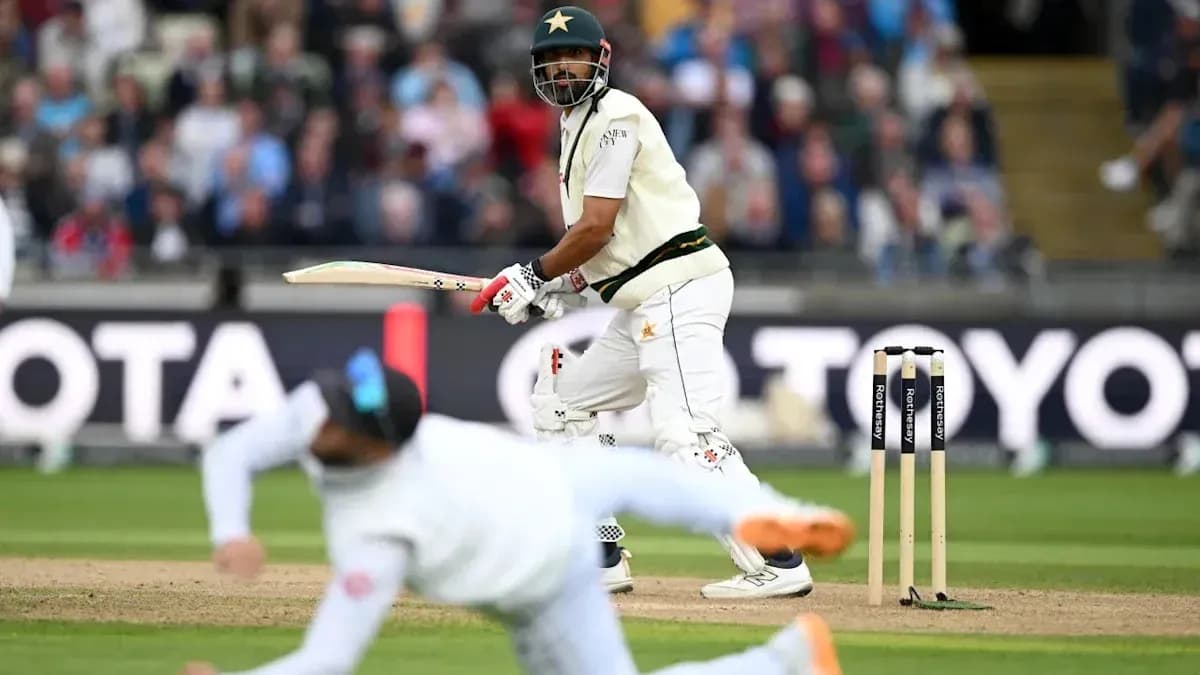
Babar Azam, trying to make sense of the wreckage, pointed to the batting in the first innings at Edgbaston as the key failure. Pakistan were bowled out for 133 on the best surface of the series.
“We had a couple of good moments. I think we have bowled well, but I think the first innings cost us. Too many soft dismissals,” he said.
He wasn’t wrong. The match was lost long before Abbas found that early movement with the new ball in the fourth innings. The late fight only highlighted how much had been squandered earlier.
A cautionary tale in real time
Strip away the noise and the memes, and what remains is a stark picture.
A 3-0 defeat to England. A dressing room turned inside out mid-tour. A captain discovering squad changes through a press release. A disciplinary probe hanging over players. Sixteen losses in 21 Tests.
That isn’t a bad patch. That is a system malfunction.
The Iceland quip stung because it hinted at where Pakistan stand in the global game right now. When the most uplifting passage of play across an entire tour is a lower-order counterattack in a match still lost by eight wickets, the problems go far beyond selection or form.
Pakistan do not just need a new coach or a refreshed squad. They need a plan that survives more than one series, a structure that doesn’t implode at the first sign of trouble, a culture that doesn’t leave its captain reading about his own team on official letterheads.
England’s 3-0 scoreline is brutal, yes. It is also accurate. It reflects not only a gulf in performance, but a gulf in direction.
The question now is simple, and unforgiving: who, inside Pakistan cricket, is actually ready to close it?