Pakistan's Historic Collapse on Day One of Third Test
The skies above Edgbaston were heavy and grey at lunch on day one of the third Test. Inside Pakistan’s dressing room, the mood was darker still.
This was supposed to be the reset. A jolt. The Pakistan Cricket Board’s sweeping, contentious changes were billed as shock therapy for a side drifting through this series. Instead, as Pakistan slumped to 100-7 in just 23 overs, the defibrillator barely flickered.
By the interval, their campaign in Birmingham already felt beyond rescue. If you’re holding tickets for day three, you might be better off checking the cinema listings.
Records no one wants
The collapse was not just ugly. It was historic.
With the Thwaite Memorial scoreboard showing a miserable 48, Pakistan’s top five were all back in the pavilion. All out for single figures. It was only the 12th time in Test history a top five had suffered that fate — and the first time it has ever happened in a first innings.
The start of their innings across this tour of England is now veering towards a 19th-century low. No team has ever begun innings in England as poorly as Pakistan are threatening to do.
Their second wicket has fallen with the score on 6 and 13 at Leeds, 16 and 7 at Lord’s, and 14 at Edgbaston. That’s a total of 56 runs for the first two wickets across the series, an average opening stand of 5.6 and just 11.2 runs at the fall of the second wicket.
They are on course to undercut a mark that has stood since 1888, when Australia averaged only 16 for the fall of their second wicket in an English series. That was a different era. The batting here looked from another planet.
‘Technique and mindset… pretty ordinary’
Former Pakistan captain Ramiz Raja did not sugar-coat it.
He called Pakistan’s “technique and mindset” “pretty ordinary”, and he was not talking about one bad shot or one unlucky dismissal. He was describing a pattern.
“There’s mental fatigue and turmoil in the dugout, I can understand that,” he told Test Match Special. “But from an individual point of view, I think Pakistan have been waiting for the ball to come and damage them completely.
“They have not been proactive at all. They have to have a plan. This is a flat pitch, it’s not a demon-like pitch, like the third day at Lord’s.”
He was right about the surface. While the ball misbehaved enough to keep batters honest — CricViz’s bounce inconsistency rating was 5.7, higher than 2025 against India (2.6), 2024 against West Indies (3.2) and 2023 against Australia (3.3) — this was no minefield. It demanded discipline, not disaster.
England smell blood
England did their part with ruthless efficiency.
Under autumnal skies, Joe Root won the toss and, with barely concealed delight, put Pakistan in. His four-man seam attack responded by hitting their lengths with clinical precision. Ollie Robinson probed, Josh Tongue thudded in, and the pressure mounted over by over.
Former England captain Michael Vaughan watched the carnage and could see a side running on empty.
Pakistan, he said, were “clearly shot for confidence” after a turbulent week off the field. “I feel for Pakistan because this is embarrassing with everything they’ve had to cope with in the last week,” he added.
The sympathy was real. The scoreboard was brutal.
Rust, rash strokes and a captain under siege
Some of the story is structural. Some of it is rust.
Opener Saim Ayub, parachuted in for this Test, had not played first-class cricket since October 2025. Asking him to tame Robinson under low cloud at Edgbaston was almost cruel. From the moment he marked his guard, his dismissal felt inevitable.
Yet this was not just about unfamiliarity with red-ball rhythms. Too many shots carried an end-of-term looseness, completely at odds with what the situation demanded.
Four down, Saud Shakeel and Babar Azam were still flashing extravagantly outside off stump, driving at width, flirting with edges. These are not green rookies. Both are in their thirties, with a stack of experience. They should be the ones calming the storm, not feeding it.
Pakistan’s false-shot percentage in the morning session hit 40% — the second highest in the opening session of a Test since 2006. That number tells you everything. England did not need to dig for wickets; Pakistan handed them over.
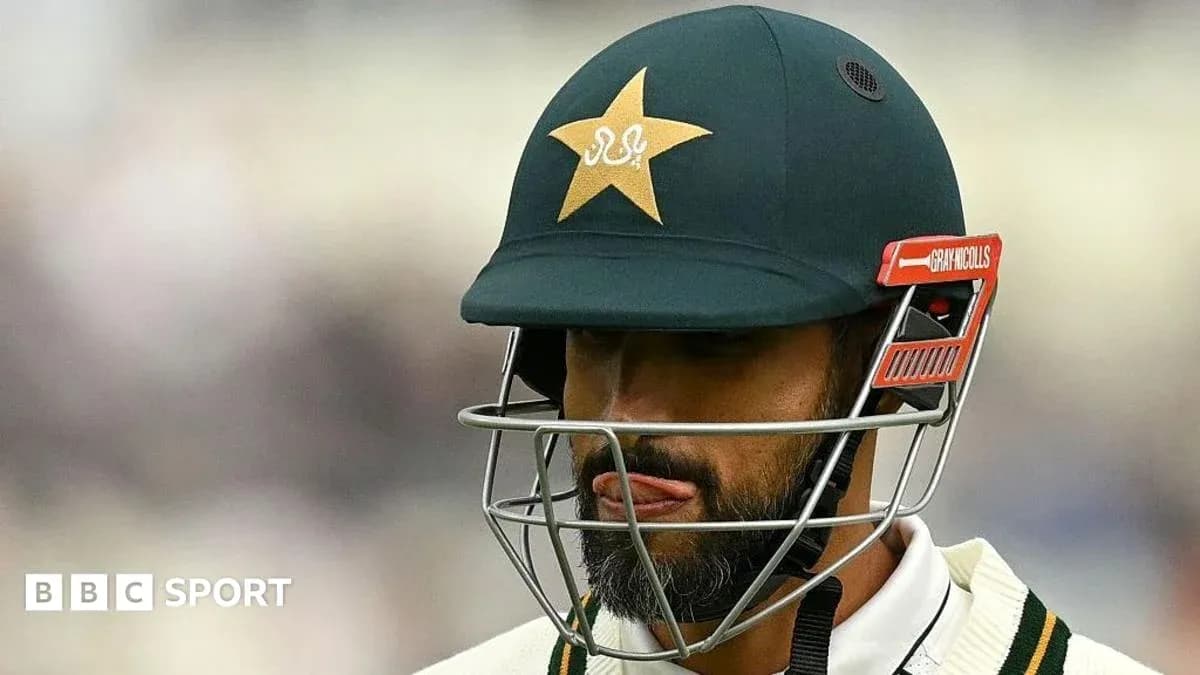
Saud clung on until lunch. Babar did not. About 40 minutes before the interval, Tongue went full and straight, the ball crashed into the stumps, and Pakistan’s captain walked off, gesticulating at the pitch as if it were the main culprit.
Ramiz saw something more internal.
“He [Babar] disintegrated. It’s tough for him,” he said. “He’s got to explain all this mayhem and then he has to look after himself and then he’s got to work with the lot that are more T20 in nature than Test cricket.
“This innings is in serious turmoil.”
Where do they go from here?
Turmoil feels the right word. On the field, the numbers scream crisis. Off it, a reshaped set-up is still trying to find its voice. In between stands a captain being asked to justify chaos while holding his own game together.
The pitch at Edgbaston may not be a demon. Right now, the real battle for Pakistan is in the mind.