Percy Fender's 35-Minute Fury: The Fastest Century Unmatched
The clock has been ticking for more than a hundred years. It still hasn’t caught Percy Fender.
On August 26, 1920, four days after his 28th birthday, the Surrey all-rounder walked out at Northampton and tore into Northamptonshire’s attack with such ferocity that the record books are still trying to keep up. One hundred runs. Thirty-five minutes at the crease. No tricks, no contrivance, no part-time lobs to the short boundary. Just a sustained, ruthless assault.
Cricket has changed almost beyond recognition since then. Formats have shrunk, bats have swollen, fielding restrictions and powerplays have turned aggression into a default setting. Yet Fender’s hundred, timed by the old measure of minutes rather than balls, still stands as the fastest authentic first-class century by time spent at the crease.
Because this wasn’t a stunt. It was a storm.
A Championship Match Turns into a Spectacle
The day itself began in more sedate fashion. Northamptonshire, anchored by 128 from Fanny Walden, posted 306 in their first innings. Fender had already made his mark with the ball, taking three wickets, but Surrey’s reply started shakily.
At 160 for four, with Andy Sandham gone for 92, Surrey were wobbling. The match looked like a typical County Championship arm-wrestle of the era, not the stage for a record that would echo for a century.
Then Andy Ducat and Alan Peach changed the tempo. The pair added 288 in just 135 minutes, a partnership that dragged Surrey from trouble and flung them into complete control. Ducat eventually fell for 149, his work done.
That was Fender’s cue.
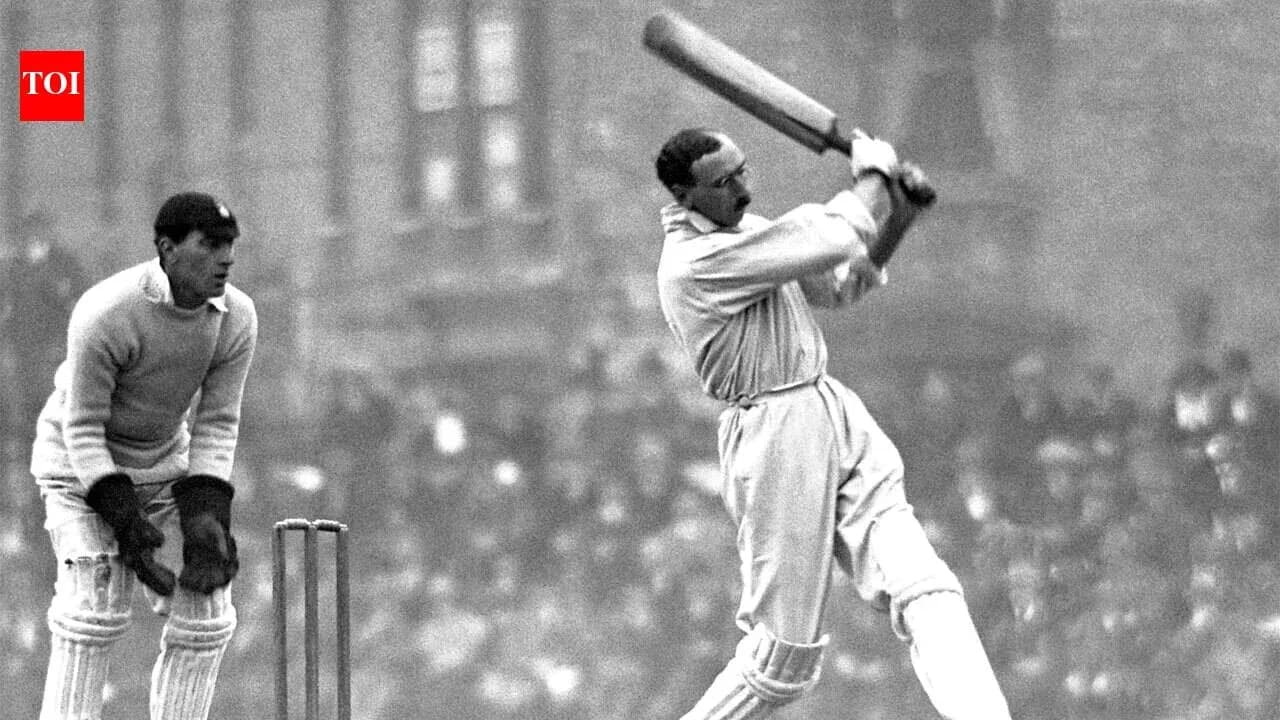
He arrived with the platform set and the bowlers tiring. What followed barely resembled the cricket that had gone before. From almost his first stroke, he attacked: booming drives down the ground, savage cuts square, pulls and slashes that carved the ball to and over the ropes. Northamptonshire’s bowlers searched for control and found only punishment.
He reached fifty in 19 minutes. Nineteen. In an era of uncovered pitches, conservative fields and long, grinding days, Fender was batting as if he’d been parachuted in from a different sport.
Gilbert Jessop had long been the benchmark for speed, his 40-minute hundred for Gloucestershire against Yorkshire at Harrogate in 1897 regarded as the pinnacle of time-based hitting. Fender erased that mark by five minutes. By the time he reached three figures, just 35 minutes had passed since he took guard.
The clock said everything. The scorebook struggled to keep up.
Boundaries, Bedlam and an Unmoved Record
If the century was a blur, the aftermath was scarcely less brutal. Fender did not pause to admire his work.
He finished unbeaten on 113 in 42 minutes, his innings containing 16 fours and five sixes. Ninety-four of those 113 runs came in boundaries. More than 83 per cent of his score arrived via fours and sixes, the sort of ratio that would look outrageous even in a T20 highlights reel.
At the other end, Peach quietly compiled a double-century. Surrey declared once he reached 203 not out, with the sixth-wicket stand worth 171 in only 42 minutes. It was mayhem disguised as a scorecard.
Crucially, the record Fender set that day is not about how many balls he faced. The stopwatch, not the delivery count, ruled the feat. In the early 20th century, that was how speed was measured: by the time a batter spent at the crease. No wagon wheels, no strike-rates, no ball-by-ball data. Just the ticking of the clock.
That distinction has become central to the debate ever since.
When Records Start to Look Fake
For 63 years, nobody got close. Then Steve O’Shaughnessy arrived.
In 1983, the Lancashire all-rounder raced to a century in 35 minutes against Leicestershire, apparently drawing level with Fender. On paper, it looked like the record had finally been matched.
The reality was very different.
The match had been ravaged by bad weather. Time was short, and both captains needed to manufacture a result. Declarations were shaped with that in mind. When Lancashire began their innings, O’Shaughnessy and Graeme Fowler faced an attack that included David Gower and James Whitaker – both fine cricketers, but here deployed as willing, gentle providers.
What followed was described as farcical. Gower and Whitaker served up full tosses and long hops, and a short boundary turned mis-hits into sixes. Fowler belted 100 with 10 sixes. O’Shaughnessy charged to his own hundred in 35 minutes.
The runs counted in the match. The innings did not count in the same way in history.
This was cricket with the safety catches off, the bowling and the circumstances manipulated to force a result. A spectacle, yes, but a staged one. The spirit of the record – a batter taking on a genuine attack in a genuine contest – simply wasn’t there.
So O’Shaughnessy’s name sits beside Fender’s in some lists, but not in the one that matters most: the one that asks which was the fastest authentic first-class century by time.
The Manufactured Blitzes That Don’t Make the Cut
O’Shaughnessy’s innings opened the door to a strange corner of the record books, where numbers look spectacular but context strips them of weight.
Glen Chapple hammered a century in 21 minutes for Lancashire against Glamorgan in 1993. Mark Pettini thrashed one in 24 minutes for Essex against Leicestershire in 2006. Michael Goodwin and Tom Moody produced hundreds in 25 and 26 minutes respectively.
On raw timing alone, all of them eclipse Fender. On authenticity, none do.
These were the days when three-day County Championship matches forced captains into creative chaos. Weather delays, slow over-rates and flat pitches left teams scrambling to carve out a result. The solution was often the same: part-time bowlers rolling in gentle, hittable deliveries, fields scattered, boundaries brought into play, all in the name of manufacturing a chase.
The scorecards look wild. The records, though, come with an asterisk in everything but name. Cricket’s statisticians and historians have drawn a firm line: centuries compiled against deliberately friendly bowling, in contrived situations, are not fair comparisons with Fender’s assault in 1920.
He played in real time, under real pressure, against a proper attack trying to keep Surrey in check. That is why his 35-minute hundred still stands as the benchmark.
When ‘Fastest’ Depends on What You Measure
The debate over speed has shifted in another way as well.
If “fastest century” is judged by balls faced rather than time elapsed, different names leap to the front. In first-class cricket, David Hookes holds the record: 102 from just 34 balls for South Australia against Victoria in 1982, a blitz of a completely different kind.
In Test cricket, Brendon McCullum owns the mark, his 54-ball hundred against Australia in Christchurch in 2016 redefining what early-innings aggression could look like at the highest level.
Those feats sit in their own category, measured by deliveries rather than minutes. They are modern records for a modern game.
But by elapsed time, in what are widely accepted as genuine first-class conditions, Fender still rules. More than a century after he tore into Northamptonshire, nobody has legitimately gone faster from arrival at the crease to three figures.
The sport has become louder, quicker, more data-driven. Batters now clear ropes that Fender might barely have reached with his longest drive. Yet the stopwatch that mattered in 1920 has refused to move.
Percy Fender’s 35-minute hundred remains the gold standard. The question is no longer whether it was remarkable. It’s whether anyone, in an era obsessed with pace and power, can ever break it without breaking the spirit of the record itself.