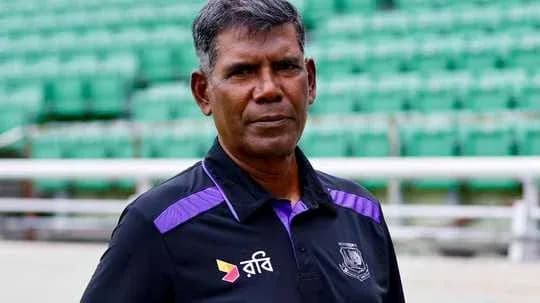
Sarowar Imran's Coaching Exit: A Demand for More from Bangladesh Women Cricketers
Sarowar Imran sat on the outside looking in, and he knew exactly why. In his mind, the price of demanding more from Bangladesh’s women cricketers was his job.
The Bangladesh Cricket Board (BCB) chose not to renew his contract after it expired in October 2026, shortly after the Asian Games. They moved on, appointing David Hemp as head coach and quietly filing away Sarowar’s long association with the country’s cricket. Officially, the board pointed to concerns over his temperament. Unofficially, senior players had already made their discomfort clear.
A coach shown the door, without a conversation
For a man who guided Bangladesh in their inaugural Test against India back in 2000, the end felt cold.
"BCB did not communicate with me after the Asian Games and Asia Cup. I got a letter that I am not going to the Australia tour as another coach will go. This is all the communication I had with BCB," he told Ekattur TV on Tuesday (November 10).
No meeting. No debrief. No chance, he says, to explain his side of the story after unrest in the dressing room following Bangladesh's Asian Games exit. The board had even drafted a show-cause notice before backing away, citing his long service to Bangladesh cricket. The decision on his future, though, had already been made.
Comfort zones and quiet coaches
If the BCB saw an ill-tempered coach, Sarowar saw something else: a culture that had grown too soft.
"When I entered the women's team, what I saw was that there from bowling coach to spin bowling coach, batting coach, trainer, physio all were very quiet. They listen to whatever the women cricketers say and they cannot improve living in this comfort zone. That is the reason our team is still the same as it was five years back," he said.
He painted a stark picture. A spinner stopping after 30 balls and the coach simply agreeing. One or two batters occupying the nets all day. Little pushback. Little challenge. So he started to interfere, as he put it—on workload, on fitness, on standards.
"When I needed to scold them I did that and if you say this is ill temper in that case I don't feel Bangladesh cricket can improve."
The friction that followed, in his view, was inevitable.
“I am a coach, not their friend”
Sarowar does not shy away from his own personality. He accepts he has temper in life, but rejects the idea that it spills into his work.
"If anyone says that I am ill-tempered that is wrong because in life I can have temper but when I am coaching I am not ill-tempered because I am a professional and I know what needs to be done."
His philosophy is old-school and unapologetic.
"A coach cannot be a friend of a player because if I am a friend of a player I cannot drop the player. I am a coach and I am not their friend."
He insists his approach was rooted in belief, not ego. He felt he could improve the side, he says, and points to seven or eight tours under his watch before results dipped over "one or two tours" and everything unravelled.
"I have my own dignity and I am aware of what I am capable of and I don't work to show off. I don't have any problem and there is no reason to feel that my prestige has gone down because I know my work."
Staff under pressure, players in charge?
In Sarowar’s telling, the problem runs deeper than one coach and one dressing room fallout. He accuses members of the support staff of bending too easily to the players’ wishes to safeguard their own positions.
"I think whoever worked with them (women cricketers) adjusted with them but the women cricketers won't improve if they are in the comfort zone and I felt foreign coaches also did the same. I feel a coach ensures his job by doing this (adjusting and remaining silent)."
It is a damning assessment: a system where silence is safer than standards, where challenge risks conflict, and conflict risks contracts.
Fitness under the microscope
Then comes the sharpest cut of all—fitness. For a national side, his verdict is brutal.
"I am telling you more than half of the first XI cricketers do not have the required fitness level. Most of them are below average (in fitness) while some of them are medium while a couple have standard fitness level."
He throws down a simple truth: international cricket does not forgive under-prepared bodies.
"Fitness is a big issue and when the fitness test is conducted the trainer can say how many of them match international fitness level. They don't have that (fitness level). If I feel that I will be world champion only by bowling 30 balls, that will never happen."
The implication is clear. Tactics, technique, and talent all fall flat if the legs and lungs cannot keep up.
A divided dressing room?
On the question of team unity, Sarowar chooses his words more carefully. He stops short of confirming factions, but hints at fault lines.
"I cannot say about grouping but some were close to the captain while some others were not close to the captain," he said, referring to skipper Nigar Sultana.
It is a small line, but it adds another layer to a picture of a squad wrestling with internal dynamics at the same time as external expectations rise.
In the end, the BCB has moved on, the players have a new voice in David Hemp, and Sarowar Imran stands on the outside, convinced he was sacrificed for demanding more. The real test now is simple: will Bangladesh women justify the comfort they fought to protect, or prove that the hard questions he asked were the ones they needed all along?